California opens cooling centers for heat wave vulnerable / Photo: Frederic J. BROWN - AFP

 Lights out in Laos as electricity exports surge

 Steven Strogatz weighs AI mathematics advances and their consequences for researchers

 Anthropic boss calls for AI slowdown, Altman and Musk agree

 French IT giant Capgemini sells subsidiary after row over ICE links

 Quebec Brokerage Qubit Insurance Announces New Data on Coverage Shortfalls as Rebuilding Costs Rise

 Lady Gaga welcomes first child with fiance: US media

 Bhutan business bets on hazelnuts for farming future

 'Widow's Bay' and 'The Pitt' are favorites for Emmys night

 Coastal erosion forces cancellation of California music festival

 Argentina's Dirty War rears its head in Venice film

 UK lawmakers throw out bill to legalise assisted dying

 US inflation steady in August, fueling Fed rate hike expectations

 New York marks 25th anniversary of 9/11 attacks

 Nepal flood reconstruction bill to be $4.78 bn: foreign ministry

 JUMO and Standard Bank launch Social Finance Framework to scale inclusive finance in Africa

 Doomsday tech: could AI really kill us all?

 French comedy show 'Call my agent' makes film comeback

 It's all coming back: Celine Dion fans gear up for Paris return

 Researchers eye AI revolution in natural disaster forecasts

 US braces for inflation report that may push Fed to hike rates

 Musk threatens legal action over documentary

 Latin America fact-check group asks Meta not to replace verification practice

 AI Risks to Enter 60–80% of Liability and Cyber Insurance Underwriting by 2028, ScienceSoft Predicts

 Tribal Launches Campfire, Letting Business and Technical Teams Build on Salesforce Together

 Stocks fall as fresh oil surge fans inflation fears

It is too hot in Nelly Amaya's place when the mercury surges into triple digits, driven by the punishing heat wave gripping the western United States.
"We don't have air conditioning at our house, we only have a fan," Amaya, a retiree, told AFP.
"We come here because we can't stay at home."
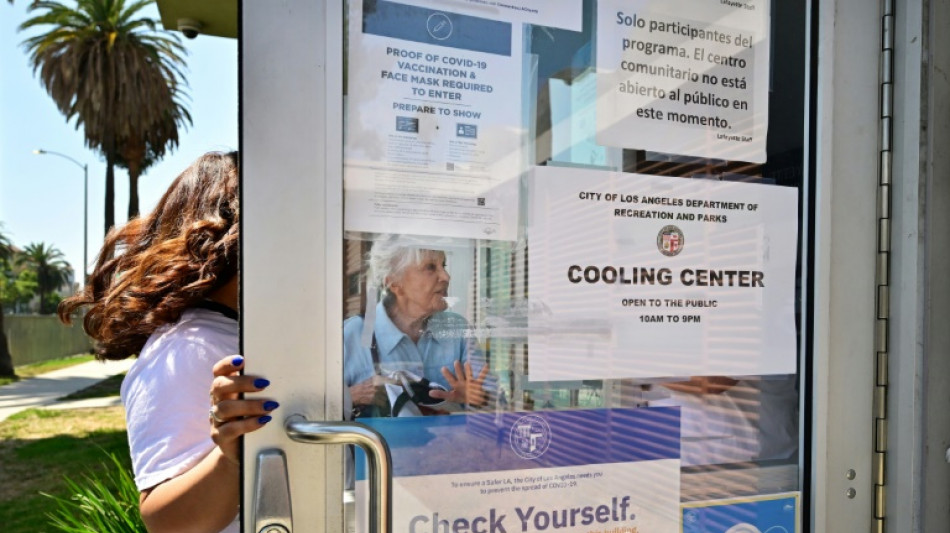
Amaya is one of hundreds of people in Los Angeles who are making use of the 40 cooling centers set up by the county's emergency department as a fearsome heat dome sends temperatures soaring.
The centers have been established in libraries, recreation and park facilities, and senior living facilities, offering shelter in air-conditioned rooms and cold drinks during the heat of the day.
Forecasters have issued an excessive heat warning for most of California, as well as parts of Nevada and Arizona, with thermometers logging highs over 110 Fahrenheit (43 Celsius) in some places.
The oppressive heat is expected to last well into next week, smothering a holiday weekend, with little relief in the way of cooler nights.
Doctors say when temperatures remain elevated for long periods -- particularly overnight -- it puts strains on the human body that can cause a cascade of illness, sometimes even leading to death.
Joseph Riser of the Los Angeles emergency management department said the city was doing its best to look out for those in need of help when the mercury rises over 100 Fahrenheit.
"Once that hits that peak... then the plans we have for adverse weather kick in and we begin rallying the troops, getting the supplies, making sure which centers can be open and that we have enough," he said.
- 'Stay hydrated' -
The effects of intense heat are not evenly felt across societies, and tend to be more acute in poorer and more marginalized communities.
Homeless people or those who work outside during the heat of the day are obviously at risk, but so are people living in neighborhoods without tree cover, or near to sources of pollution like roads.
"It may be people who are living in homes where there's no air conditioning, and maybe people who are unhoused," Riser said.
"It may be just young people seeking shelter from the heat, from maybe a home where the air conditioning doesn't work very well."
For Ruth Rivera, the Lafayette Park center near downtown Los Angeles is a godsend.
"It helps a lot, we have to stay hydrated, because it's really hot outside," she said.
The operator of California's creaking electricity grid on Friday called a third consecutive "Flex Alert," asking households to conserve power and turn up their thermostats to help reduce power demand.
"Reducing energy use during a Flex Alert can help stabilize the power grid during tight supply conditions and prevent further emergency measures, including rotating power outages," California Independent Service Operator said.
The heat dome is expected to last well into next week, with thermometers set to peak at 116 degrees Fahrenheit in some densely populated areas around Los Angeles over the upcoming Labor Day holiday weekend.
It is not unusual for southern California to experience heat waves in September, but temperatures above 100 degrees Fahrenheit are considered hot even for a place almost perpetually baked by sunshine.
Scientists say global warming, which is being driven chiefly by the unchecked burning of fossil fuels, is making natural weather variations more extreme.
Heat waves are getting hotter and more intense, while storms are getting wetter and, in many cases, more dangerous.
L.Peeters--CPN