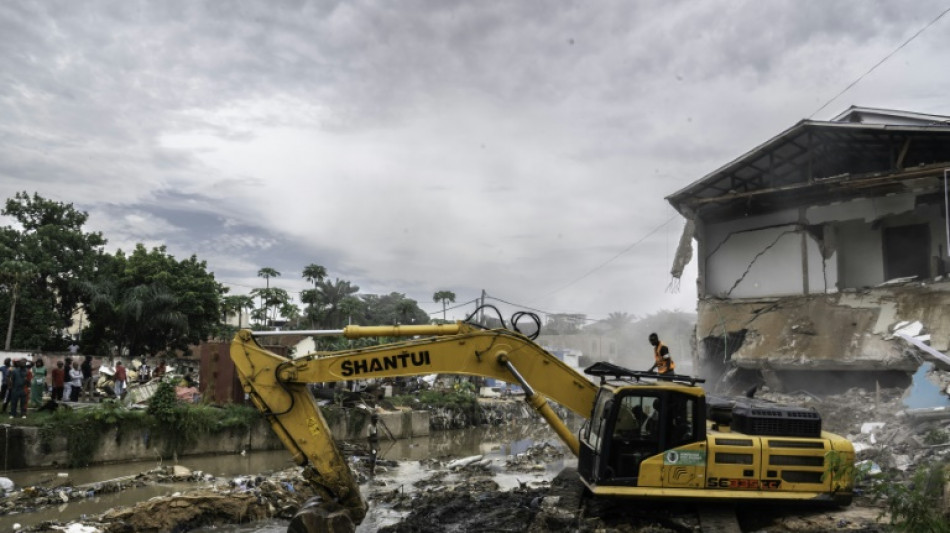
Kinshasa deploys excavators against illegally built homes / Photo: Glody MURHABAZI - AFP

 S.African women runners arm themselves after string of killings

 Indonesia fires threatens critically-endangered orangutan: IUCN

 Iran proposes Hormuz plan, Trump reportedly refuses
 El Nino rewrites the menu in the world's top restaurants

 Jay-Z rape accuser says she made 'false accusations'

 Trump's photo of Xi greeting carries signs of AI

 First US trial against TikTok to open Monday

 French literary prize removes novel from longlist after AI claims

 Trump accuser E. Jean Carroll finally has her damages

 Heavy fighting, internet disruption as Ethiopia conflict rages
 Asian markets mixed after oil gains

 UN approves resolution on dealing with rising sea levels

 Global stocks mostly fall as oil prices and bond yields rise

 Starbucks to close 250 more cafes in North America

 Stocks fall as oil prices rise and bonds back under pressure
 Top ECB official to resign to take up IMF role

 Eviction of pensioner puts Spain housing crisis in spotlight

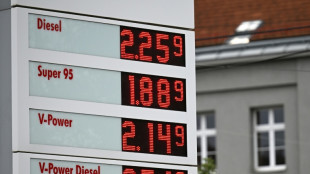 Average EU diesel price hits record 2.23 euros a litre: AFP analysis

 Whitetip Investments Marks 10 Years of Regulation, Transparency & Responsible Trading

 Stocks fall, oil prices rise as global bonds under pressure

 Hungary detects invasive spotted lanternfly for first time in EU

 Forex Expo Dubai 2026 Breaks Guinness World Record Again With 23,816 Attendees

 Asian markets fall on US-China jitters as leaders meet
 As Moscow steps up attacks, Kyiv residents brace for harsh winter
 Markets mixed as China's Xi arrives for US talks

A mother watched in despair as an excavator demolished her Kinshasa home, part of a campaign to clamp down on unauthorised buildings after deadly floods.
Flash flooding in the overcrowded megalopolis, which sits on the banks of the mighty Congo River, killed dozens of people early last month.
Authorities have begun demolishing riverside constructions built without permits, where the death toll is often high with each deluge in the vast Democratic Republic of Congo.
"Our homes destroyed, and our belongings stolen, where will we go?" asked Passy, in vain.
"Authorities, have pity on us, why treat us like this?"
Provincial urban development and public works minister Alain Tshilungu came to oversee the demolition in northwestern Ngaliema district.
Passy's home was among 15 plots earmarked for demolition -- a small fraction of the sprawling shantytowns on the outskirts of the city of 17 million people.
"You condemn the state by saying that it doesn't act. Now we want to act," the minister told reporters.
A day earlier, Kinshasa officials had announced the start of operations in the campaign, originally unveiled in November.
The excavator moved on to an apartment block built illegally along the river.
- 'Don't have much left' -
Its occupants hastily got out.
A mother, her young son and two little girls hugged each other, looking tired, next to a small pile of belongings, saved from the excavator and scattered on the ground.
The young woman said she did "not have the strength" to comment on the authorities' decision.
After around a dozen blows, the walls caved in and the building collapsed under a thick cloud of dust.
A dog darted out from the rubble.
Shortly after, local residents descended on the premises and looted whatever they could: doors, windows, sinks and even toilet bowls.
Augustin Masudi, who lived in the building, watched the events unfold before his tearful eyes.
The father of six managed to save a mattress, freezer and a few other items from the place he called home for three years.
"We don't have much left, everything has been looted. The authorities should give us one or two weeks' notice," he said, his voice hoarse.
Another victim of the demolition, Dady Kasongo, looked frozen behind his black glasses.
He said he had poured "thousands of dollars" into buying materials to build his house, which was being pulled down in front of him before it had even been finished.
The plots were "registered properly" with the state authorities, he said, adding that he hoped to receive compensation.
"What we are doing is not a malicious demolition, but rather recovering the public authority of the state," Tshilungu, the provincial minister, said, emphasising that building on riverbanks and riverbeds is illegal.
In a country ranked among the poorest in the world and where corruption is rife, some owners obtained "fraudulent" building permits, local authorities say.
Kinshasa has undergone successive, similar demolition campaigns for decades.
But the sprawling city continues to battle problems of congestion and a lack of infrastructure in keeping with its rapid demographic growth.
Across vast areas of Africa, climate change has thrown weather patterns into disarray and made flooding much more severe.
Experts estimate that by 2030, up to 118 million Africans already living in poverty will be exposed to drought, floods and intense heat.
Y.Jeong--CPN