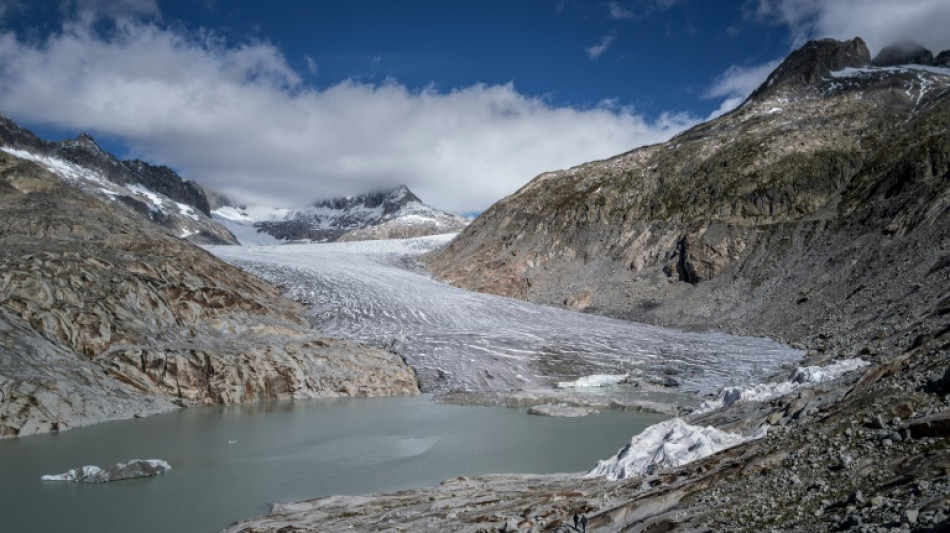
Snow cover of Swiss glaciers below average this year: study / Photo: Fabrice COFFRINI - AFP/File

 S.African women runners arm themselves after string of killings

 Indonesia fires threatens critically-endangered orangutan: IUCN

 Iran proposes Hormuz plan, Trump reportedly refuses
 El Nino rewrites the menu in the world's top restaurants

 Jay-Z rape accuser says she made 'false accusations'

 Trump's photo of Xi greeting carries signs of AI

 First US trial against TikTok to open Monday

 French literary prize removes novel from longlist after AI claims

 Trump accuser E. Jean Carroll finally has her damages

 Heavy fighting, internet disruption as Ethiopia conflict rages

 Asian markets mixed after oil gains

 UN approves resolution on dealing with rising sea levels

 Global stocks mostly fall as oil prices and bond yields rise

 Starbucks to close 250 more cafes in North America

 Stocks fall as oil prices rise and bonds back under pressure

 Top ECB official to resign to take up IMF role

 Eviction of pensioner puts Spain housing crisis in spotlight

 Average EU diesel price hits record 2.23 euros a litre: AFP analysis

 Whitetip Investments Marks 10 Years of Regulation, Transparency & Responsible Trading

 Stocks fall, oil prices rise as global bonds under pressure

 Hungary detects invasive spotted lanternfly for first time in EU

 Forex Expo Dubai 2026 Breaks Guinness World Record Again With 23,816 Attendees

 Asian markets fall on US-China jitters as leaders meet

 As Moscow steps up attacks, Kyiv residents brace for harsh winter

 Markets mixed as China's Xi arrives for US talks

The amount of snow covering Swiss glaciers at the end of the winter this year was 13 percent below the 2010-2020 average, said a group of glacier monitoring experts on Monday.
Each spring, when snow cover reaches its peak, Matthias Huss, head of the Glacier Monitoring Switzerland (Glamos), and his team take measurements on several Swiss glaciers.
This year, the Glamos team measured snow depth at 21 glaciers and found densities ranging between 1 and 4 metres (3 and 13 feet), or between 0 and 52 percent below the reference value.
The extrapolation of these measurements to all 1,400 registered Swiss glaciers shows a "winter snow deficit" that is 13 percent below the 2010-2020 period, their report said.
"This value is less negative than in the very dry winters of 2022 and 2023," the experts said.
The measurements examine both the depth and density of the snow, providing useful data to evaluate the upcoming summer melting season.
"Overall, snow measurements on glaciers indicate another dry year with significant repercussions on melting in the coming summer," Huss said on X.
"Another difficult year for glaciers ahead," he added.
Snow cover is vital for glaciers as it allows them to "recharge" their mass, while protecting them from heat and sunlight in spring and summer.
This year's measurements show "strong regional differences", with a very low snow cover on glaciers located in northeastern Switzerland but values close to average in the south and southwest, thanks to exceptional snowfall in these regions in mid-April.
Swiss glaciers, severely impacted by climate change, melted as much in 2022 and 2023 as between 1960 and 1990, losing in total about 10 percent of their volume.
Despite a very snowy 2024 winter, glaciers in Switzerland still lost 2.4 percent of their overall volume last year due to summer heat -- a process accelerated by dust coming from the Sahara.
The accumulation of dust on the ice reduces the albedo effect: the whiter a surface is, the more light and heat it reflects.
L.Peeters--CPN