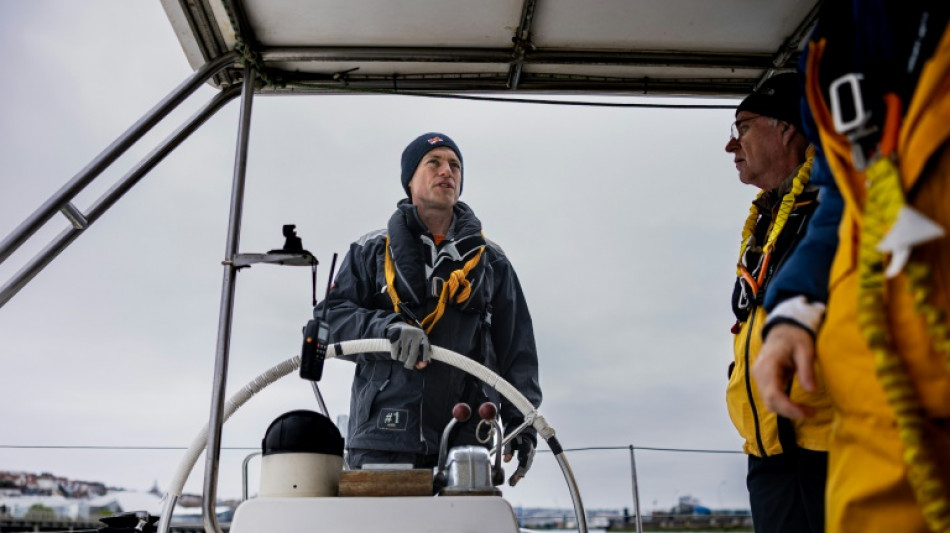
'Slow travel' start-up launches cross-Channel crossings by sail / Photo: Sameer Al-DOUMY - AFP

 Kenya's economy faces climate change risks: World Bank

 'Beginning of the end': Relief but no party as French wildfire winds down

 Southern Europe 'becoming more flammable' in hotter climate, experts say

 Mammoth bones found on parched bed of Danube in Bulgaria

 MEXC Lists Grvt (GRVT) with $60,000 Worth of GRVT and 10,000 USDT in Airdrop+ Rewards

 George and Amal Clooney flee French home due to wildfire

 MEXC Ventures Supports Alpha Arena's APAC Debut at Coinfest Bali

 AI data centre supplier Zhongji InnoLight slips on Hong Kong debut

 May, June heatwaves caused 2,877 extra deaths in England: govt

 BMW profit down a third as carmaker plans job cuts

 Seoul extends losses as most Asian markets drop, oil rises again

 Gambling.com Group Is Now Grandstand

 Meet the astronomer digging into the Milky Way's 'fossils'

 AI data centre supplier Zhongji InnoLight falls on Hong Kong debut

 Samsung operating profit up 1,800% in second quarter on AI boom

 Japanese population below 120 million for first time in decades

 US actor Jared Leto denies latest accusations of sexual assault

 Danube drops to 'historic lows' as fresh heatwave hits
 BTS pulls out of Grammys after Asian pop category introduction
 OpenAI says rogue AI agent attack hit other companies

 How an AFP beach snap became emblem of Europe's wildfire summer

 TRX Spot and Perpetuals Listing Launches on Backpack, Expanding Access to the TRON Ecosystem
 Nepal's tiger numbers climb 20 percent to estimated 429: survey

 FIFA's plans to sell $4.2bn stake in its tournaments widely criticised

 BMW aims to cut 8,000 jobs by end 2027: company source

The crossing may be "a bit choppy", Captain Andrew Simons warns a dozen of his passengers waiting in the French port of Boulogne to cross the Channel with only wind to get them to England.
SailLink is a British start-up that aims to offer sailing as a low-carbon alternative to ferries. This week, it made its first paid crossings of the English Channel on its catamaran, a route that will soon become daily.
Despite the swell and icy gusts on Thursday, Johannes Schneider, 67, fully enjoyed the crossing in the catamaran. He paid 85 pounds (98 euros) for the privilege, more expensive than a pedestrian ferry crossing.
"Really interesting to really be able to live it, rather than being on a big ship, where you see nothing, or a plane where you see even less," he said.
SailLink's catamaran is 17 metres (56 feet) long and can carry up to 12 passengers.
To compensate for sometimes rough seas, the crew offers its passengers mint tea to combat motion sickness, and pastries and blankets in the cabin, where they can shelter from the spray.
- 'Experience of the sea' -
SailLink was born in the summer of 2019 when Simons, who was about to board a ferry to England with his daughter, looked at the Cherbourg marina in northern France and wondered why its moored little boats could not be used instead for the crossing.
He found ferries polluting and impractical with their out-of-the-way terminals.
Simons imagined a new mode of cross-Channel transport "offering that experience of the sea to people who are not travelling with a car".
His initial idea of a co-navigation platform —- a sort of BlaBlaCar for boats -- proved too complex to implement.
So Simons modelled his approach on the existing ferries, offering pedestrians and cyclists a fixed, daily route with set schedules.
He had to raise 500,000 euros ($560,000), including 350,000 euros to buy the boat, which he raised from a handful of private investors "who really believed in it".
Sail passenger routes already exist in France. Sailcoop has run a route between Saint-Raphael on south coast to the Mediterranean island of Corsica since 2022.
Another company, Iliens, has since 2021 run a route between Quiberon, on France's Atlantic coast, to the little island of Belle-Ile-en-Mer.
- 'only real alternative' -
A few kilometres before reaching the English coast, a container ship blocked the catamaran's way and Simons and his team had to briefly use a motor to move away.
Navigating one of the busiest seas in the world is no easy task, with about 700 to 800 commercial vessels and around 1,400 fishing boats using the strait every day.
SailLink still managed the crossing to Dover from Boulogne-sur-Mer in less than four hours. That is faster than the scheduled five hours, but much longer than the 1.5 hours ferry journey —- excluding waiting time.
"It's a new relationship with speed, a new relationship with the landscape," appealing to fans of "slow travel," said researcher Sylvain Roche, who saw "a direct link between the resurgence of sailing boats" and that of "night trains".
While only marginal for the moment, sail-powered transport could grow in coming years.
Today, sailing is the only real alternative to fossil fuels, said Roche, as other technologies for decarbonising maritime transport, such as hydrogen, are currently "absolutely immature".
Maritime transport accounts for nearly three percent of global greenhouse gas emissions, according to the International Maritime Organization (IMO).
But a ferry journey still emits almost three times less greenhouse gases per passenger than a plane, according to the European Environment Agency.
Y.Tengku--CPN