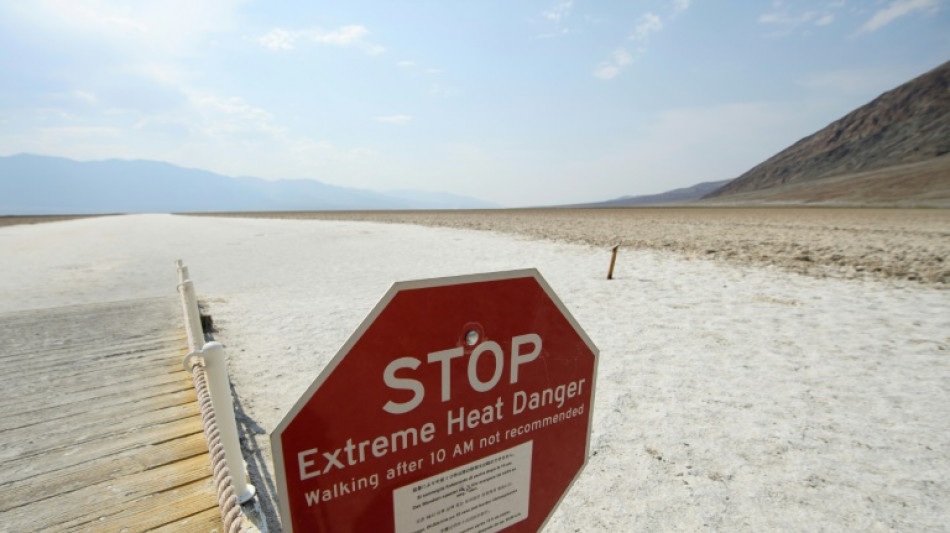
Southwestern US on alert for dangerous heatwave / Photo: Patrick T. FALLON - AFP/File

 Lights out in Laos as electricity exports surge

 Steven Strogatz weighs AI mathematics advances and their consequences for researchers

 Anthropic boss calls for AI slowdown, Altman and Musk agree

 French IT giant Capgemini sells subsidiary after row over ICE links

 Quebec Brokerage Qubit Insurance Announces New Data on Coverage Shortfalls as Rebuilding Costs Rise

 Lady Gaga welcomes first child with fiance: US media

 Bhutan business bets on hazelnuts for farming future

 'Widow's Bay' and 'The Pitt' are favorites for Emmys night

 Coastal erosion forces cancellation of California music festival

 Argentina's Dirty War rears its head in Venice film

 UK lawmakers throw out bill to legalise assisted dying

 US inflation steady in August, fueling Fed rate hike expectations

 New York marks 25th anniversary of 9/11 attacks

 Nepal flood reconstruction bill to be $4.78 bn: foreign ministry

 JUMO and Standard Bank launch Social Finance Framework to scale inclusive finance in Africa

 Doomsday tech: could AI really kill us all?

 French comedy show 'Call my agent' makes film comeback

 It's all coming back: Celine Dion fans gear up for Paris return

 Researchers eye AI revolution in natural disaster forecasts

 US braces for inflation report that may push Fed to hike rates

 Musk threatens legal action over documentary

 Latin America fact-check group asks Meta not to replace verification practice

 AI Risks to Enter 60–80% of Liability and Cyber Insurance Underwriting by 2028, ScienceSoft Predicts

 Tribal Launches Campfire, Letting Business and Technical Teams Build on Salesforce Together

 Stocks fall as fresh oil surge fans inflation fears

A large swathe of the southwestern United States was on alert Thursday for a potentially deadly heatwave that could push temperatures as high as 47 degrees celsius (117 Fahrenheit) over the coming days.
Millions of people in California, Nevada and Arizona were warned to expect dangerous conditions for at least some of the weekend, with the National Weather Service advising residents to stay out of the sun.
While the region usually heats up at this time of year, forecasters warned it would be considerably hotter than average.
Inland and desert areas of California will be particularly hot on Friday and Saturday, with the tourist city of Palm Springs expected to hit 45 degrees, while nearby Ocotillo Wells could reach 47 degrees.
"We've had some prior heat waves this year, but not as intense as this one or as long duration," San Diego weather service meteorologist Alex Tardy said.
Prolonged exposure to high temperatures can be exceedingly dangerous for humans.
The World Health Organization says excessive heat stresses the body, and increases the risk of respiratory and cardiovascular disease.
"Heatwaves can acutely impact large populations for short periods of time, often trigger public health emergencies, and result in excess mortality, and cascading socioeconomic impacts," the WHO says on its website.
Heatwaves and temperature variations are a natural part of the climate, but scientists say human-caused global warming is creating a greater number of extreme events, sometimes with devastating consequences.
In June last year a "heat dome" sat over the western United States and Canada.
The intense temperatures and worst-in-a-millennium drought gripping the region led to numerous fires.
In the village of Lytton, northeast of Vancouver, temperatures reached 49.6 degrees in the days before a destructive fire swept through.
California, along with much of the American West, is on high alert for wildfires.
Years of below-average rainfall has left huge tracts of countryside tinder-dry, and almost the entire state is classed as suffering from severe drought or worse.
In 2020 and 2021, a total of almost seven million acres (2.8 million hectares) were burned in California alone, and forecasters are warning there could be another grim year ahead.
L.Peeters--CPN