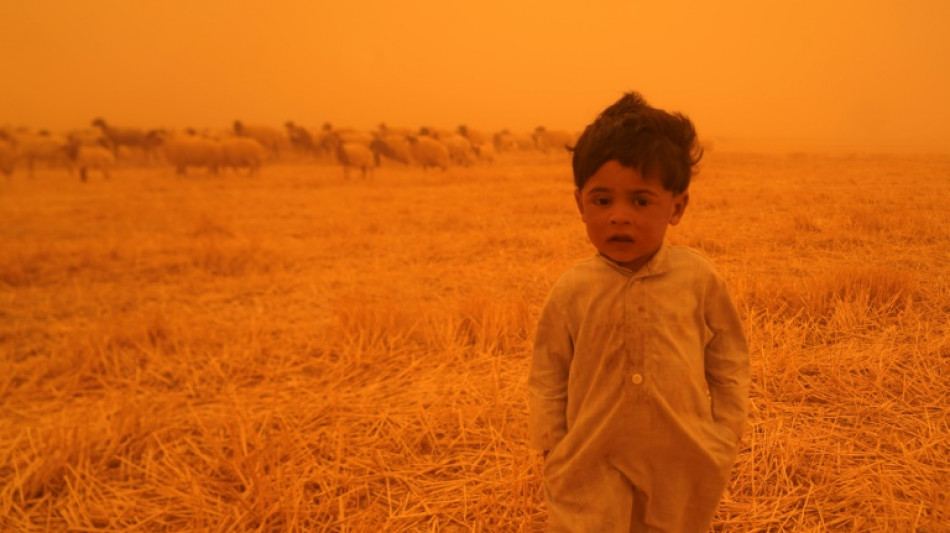
Iraq sandstorm grounds flights, sends 1,000 to hospitals / Photo: Qassem al-KAABI - AFP

 Lights out in Laos as electricity exports surge

 Steven Strogatz weighs AI mathematics advances and their consequences for researchers

 Anthropic boss calls for AI slowdown, Altman and Musk agree

 French IT giant Capgemini sells subsidiary after row over ICE links

 Quebec Brokerage Qubit Insurance Announces New Data on Coverage Shortfalls as Rebuilding Costs Rise

 Lady Gaga welcomes first child with fiance: US media

 Bhutan business bets on hazelnuts for farming future

 'Widow's Bay' and 'The Pitt' are favorites for Emmys night

 Coastal erosion forces cancellation of California music festival

 Argentina's Dirty War rears its head in Venice film

 UK lawmakers throw out bill to legalise assisted dying

 US inflation steady in August, fueling Fed rate hike expectations

 New York marks 25th anniversary of 9/11 attacks

 Nepal flood reconstruction bill to be $4.78 bn: foreign ministry

 JUMO and Standard Bank launch Social Finance Framework to scale inclusive finance in Africa

 Doomsday tech: could AI really kill us all?

 French comedy show 'Call my agent' makes film comeback

 It's all coming back: Celine Dion fans gear up for Paris return

 Researchers eye AI revolution in natural disaster forecasts

 US braces for inflation report that may push Fed to hike rates

 Musk threatens legal action over documentary

 Latin America fact-check group asks Meta not to replace verification practice

 AI Risks to Enter 60–80% of Liability and Cyber Insurance Underwriting by 2028, ScienceSoft Predicts

 Tribal Launches Campfire, Letting Business and Technical Teams Build on Salesforce Together

 Stocks fall as fresh oil surge fans inflation fears

Iraq closed public buildings and temporarily shut airports Monday as another sandstorm -- the ninth since mid-April -- hit the country.
More than 1,000 people were hospitalised across the nation with respiratory problems, health ministry spokesman Seif al-Badr told AFP.
Flights were also grounded in neighbouring Kuwait for a second time this month, as the region grapples with the increasingly frequent weather phenomenon.
The Iraqi capital Baghdad was enveloped in a giant dust cloud that left usually traffic-choked streets largely deserted and bathed in an eery orange light, AFP correspondents said.
Prime Minister Mustafa al-Kadhemi ordered all work to cease in state-run institutions, except for health and security services, citing "poor climatic conditions and the arrival of violent sandstorms".
Air traffic was suspended at the international airports in Baghdad, Arbil and Najaf, before flights resumed at Baghdad and Arbil.
Iraq is ranked as one of the world's five most vulnerable nations to climate change and desertification.
The environment ministry has warned that over the next two decades Iraq could endure an average of 272 days of sandstorms per year, rising to above 300 by 2050.
Iraq's previous two sandstorms sent nearly 10,000 people to hospital with respiratory problems and killed one person.
- More trees needed -
The Middle East has always been battered by sandstorms, but they have become more frequent and intense in recent years.
The trend is associated with rising temperatures and water scarcity, the overuse and damming of rivers as well as overgrazing and deforestation.
Oil-rich Iraq is known in Arabic as the land of the two rivers, the Tigris and Euphrates, where the ancient civilisations of Mesopotamia flourished.
Iraq's environment ministry has said the increased sandstorms could be countered with more vegetation cover including trees that act as windbreaks.
A major duststorm last week swept across the region, reaching Saudi Arabia, Kuwait, Iran and the United Arab Emirates.
It left more than 1,200 people hospitalised in Riyadh alone. In Dubai, the world's tallest building was engulfed in a cloud of dust.
Experts predict the phenomenon will worsen as climate change warps regional weather patterns, further dries out and degrades soils and speeds up desertification across much of the Middle East.
A.Agostinelli--CPN