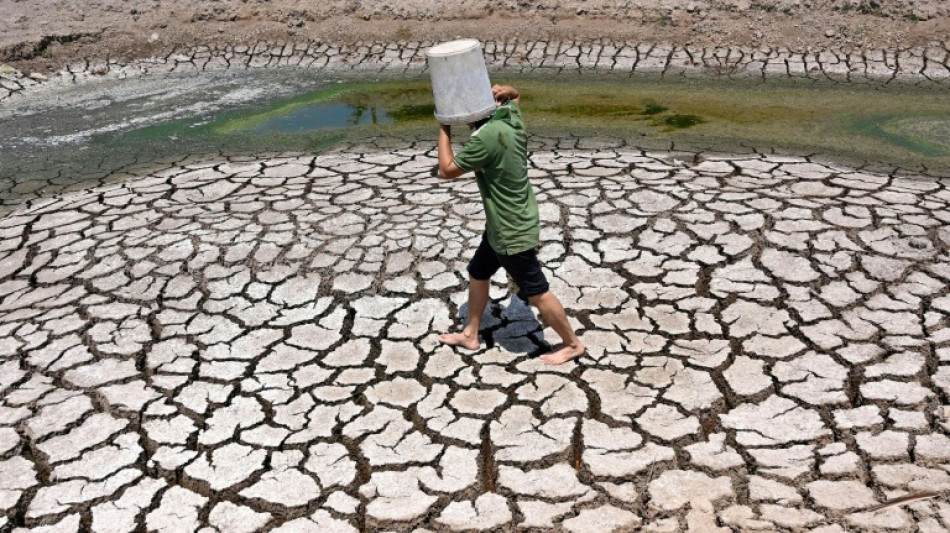
March saw 10th straight month of record global heat: monitor / Photo: Nhac NGUYEN - AFP

 Kenya's economy faces climate change risks: World Bank

 British oil giant BP aims to sell North Sea business

 China factory activity slides as leaders seek spending boost

 Tech rebound fuels record-breaking rally in South Korean stocks

 Cables and cooling bring AI windfall to Indian suppliers

 Anthropic's models gained unauthorized 'real-world' access during testing

 Apple tops estimates in CEO Cook's final quarter, but shares fall

 Milei demands expulsion of foreigners expressing 'hate' against Argentina

 Italy's Po River valley on drought alert

 Prada profits pinched as growth hard to chase

 Stocks climb on earnings and rates, oil retreats

 US economic growth slows in second quarter, missing expectations

 Russia adds Telegram founder Durov to 'terrorist' blacklist

 Stocks diverge on earnings, as oil steadies

 Eurozone economy grows despite Middle East war

 Singapore group will develop 'most promising' Ebola vaccine

 Shell profit surges as Mideast war fuels oil prices

 Car maker Stellantis says back in profit in second quarter

 Samsung quarterly operating profit up 1,800% on AI boom

 South Korean stocks bounce after rout, oil holds gains on Mideast woes

 South Korea's women web sleuths fight AI deepfake porn

 Anything but programmable: New cost-efficient EC-power-supply-series for the DIN rail by CAMTEC PS

 Meta misses profit expectations, sticks to massive AI spending

 Campari - king of the spritz - hopes to conquer American heartland

 Air France-KLM and Lufthansa bid for Portugal's TAP airline

Europe's climate monitor said Tuesday that March was the hottest on record and the tenth straight month of historic heat, with sea surface temperatures also hitting a "shocking" new high.
It is the latest red flag in a year already marked by climate extremes and rising greenhouse gas emissions, spurring fresh calls for more rapid action to limit global warming.
- Rolling records -
Every month since June 2023 has beaten its own "hottest ever" tag -- and March 2024 was no exception.
The EU's Copernicus Climate Change Service (C3S) said that March globally was 1.68 degrees Celsius hotter than an average March between the years 1850-1900, the reference period for the pre-industrial era.
The March record was only broken by 0.1C but it is the broader trend that was more alarming, said Samantha Burgess, deputy director of C3S.
Huge swathes of the planet endured above-average temperatures in March, from parts of Africa to Greenland, South America and Antarctica.
- 'Borrowed time' -
It was not only the tenth consecutive month to break its own heat record, but capped the hottest 12-month period on the books -- 1.58C above pre-industrial averages.
This doesn't mean the 1.5C warming limit agreed by world leaders in Paris in 2015 has been breached -- that is measured in decades, not individual years.
Nonetheless "the reality is that we're extraordinarily close, and already on borrowed time," Burgess told AFP.
The UN's IPCC climate panel has warned that the world will likely crash through 1.5C in the early 2030s.
- 'Incredibly unusual' -
The story at sea was no less "shocking", Burgess said, with a new record for global ocean surface temperature set in February eclipsed once again in March.
"That's incredibly unusual," she said.
Oceans cover 70 percent of the planet and have kept the Earth's surface liveable by absorbing 90 percent of the excess heat produced by the carbon pollution from human activity since the dawn of the industrial age.
- More heat, more rain -
Hotter oceans mean more moisture in the atmosphere -- scientists say the air can generally hold around seven percent more water vapour for every 1C of temperature rise.
This leads to increasingly erratic weather, like fierce winds and powerful rain.
Russia is reeling from some of its worst flooding in decades while parts of Australia, Brazil and France experienced an exceptionally wet March.
"We know the warmer our global atmosphere is, the more extreme events we'll have, the worse they will be, the more intense they will be," Burgess told AFP.
- Heat on the horizon -
Copernicus said the cyclical El Nino climate pattern, which warms the sea surface in the Pacific Ocean, leading to hotter weather globally, continued to weaken in March.
But its "warming effect" alone did not explain the dramatic spikes witnessed this past year and projections for the coming months still indicated above-average temperatures, Burgess said.
Could this mean more records shattered this year?
"Whilst we continue to see so much heat in the surface ocean -- so in the sea surface temperatures -- I think it's highly likely," Burgess said.
- Bigger question -
Copernicus records go back to 1940 but other sources of climate data such as ice cores, tree rings and coral skeletons allow scientists to expand their conclusions using evidence from much deeper in the past.
"We know that the period that we're living in right now is likely to be the warmest that it's been for the last 100,000 years," Burgess said.
As climate records tumble, scientists are debating whether the extreme heat seen this past year was within the bounds of what was forecast -- or was something more uncharted.
"Is it a phase change? Is the climate system broken? We don't really understand yet why we have this additional heat in 23/24. We can explain most of it, but not all of it," Burgess said.
What had transpired was "within the envelope" of scientific forecasts "but it was the very outer edge of the envelope, rather than the mean or the median where you'd expect it to fall", she added.
- Up and up -
Humanity, meanwhile, continues to pump ever-more planet-heating emissions into the atmosphere even as scientists say they need to fall by almost half this decade to keep the Paris goals within reach.
Levels of carbon dioxide, methane, and nitrous oxide -- the three main human-caused greenhouse gases -- rose for another year in 2023, scientists from the US-based National Oceanic and Atmospheric Administration said on Friday.
"Until we get to net zero, we will continue to see temperatures rise," Burgess said.
P.Schmidt--CPN