Rare Mideast snow brings Jerusalem joy, misery for Syria refugees

 Lights out in Laos as electricity exports surge

 Steven Strogatz weighs AI mathematics advances and their consequences for researchers

 Anthropic boss calls for AI slowdown, Altman and Musk agree

 French IT giant Capgemini sells subsidiary after row over ICE links

 Quebec Brokerage Qubit Insurance Announces New Data on Coverage Shortfalls as Rebuilding Costs Rise

 Lady Gaga welcomes first child with fiance: US media

 Bhutan business bets on hazelnuts for farming future

 'Widow's Bay' and 'The Pitt' are favorites for Emmys night

 Coastal erosion forces cancellation of California music festival

 Argentina's Dirty War rears its head in Venice film

 UK lawmakers throw out bill to legalise assisted dying

 US inflation steady in August, fueling Fed rate hike expectations

 New York marks 25th anniversary of 9/11 attacks

 Nepal flood reconstruction bill to be $4.78 bn: foreign ministry

 JUMO and Standard Bank launch Social Finance Framework to scale inclusive finance in Africa

 Doomsday tech: could AI really kill us all?

 French comedy show 'Call my agent' makes film comeback

 It's all coming back: Celine Dion fans gear up for Paris return

 Researchers eye AI revolution in natural disaster forecasts

 US braces for inflation report that may push Fed to hike rates

 Musk threatens legal action over documentary

 Latin America fact-check group asks Meta not to replace verification practice

 AI Risks to Enter 60–80% of Liability and Cyber Insurance Underwriting by 2028, ScienceSoft Predicts

 Tribal Launches Campfire, Letting Business and Technical Teams Build on Salesforce Together

 Stocks fall as fresh oil surge fans inflation fears

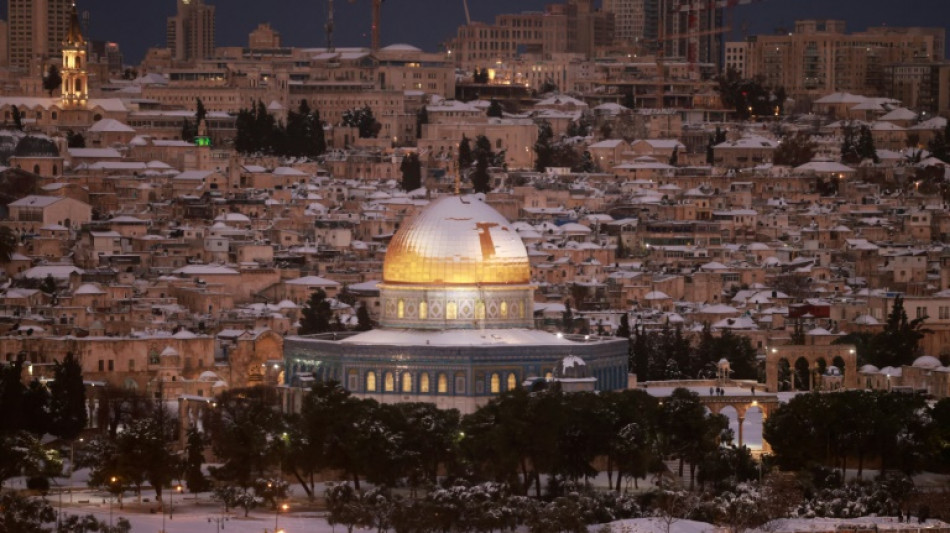
Snow carpeted Jerusalem and the eastern Mediterranean Thursday as a rare storm turned the holy city into a winter wonderland but brought misery to the region's Syrian refugees.
The cold snap, which has already caused major disruption in Athens and Istanbul, saw heavy snowfall in areas better known for their summer heat.
In the alleyways of Jerusalem's walled Old City, children pelted each other with slushy snowballs after the first flakes fell late on Wednesday.
By morning, snow crowned the golden-tipped Dome of the Rock in the Al-Aqsa mosgue compound, Islam's third holiest site, and carpeted the esplanade in front of the Western Wall, the holiest site where Jews can pray.
Israel's meteorological service reported that between 15 and 25 centimetres (six and 10 inches) of snow had fallen overnight.
It took until midday for snow ploughs to reopen the main highways leading into Jerusalem from the north, south and west.
Schools in Jerusalem and northern Israel were closed, leaving children free to play in the snow, which was not expected to last as temperatures rose and rain fell.
The Israel Electric Company reported that power consumption reached an all-time high overnight as Israels switched on the heating.
Snow also covered higher ground in the occupied West Bank, where the Palestinian Authority closed schools and some public services.
In neighbouring Jordan, heavy snowfall closed roads in the capital Amman and made driving conditions treacherous across much of the country.
Jordan's Meteorological Department forecast more snowfall on higher ground with temperatures expected to fall below freezing again on Thursday night.
Egypt recorded its coldest winter in a decade, with temperatures as much as seven to eight degrees below the seasonal average.
The storm whipped up waves of nearly six metres (20 feet), disrupting shipping in the eastern Mediterranean, the meteorological office said.
- 'Sick and barefoot' -
In Syria, days of heavy snowfall blanketed displaced persons' camps in the rebel-held northwest where families huddled together under canvas in temperatures well below zero Celsius (32 degrees Fahrenheit).
"We've been trapped in the snow for four days," said Abu Hussan, who lives with his family in a makeshift camp outside the city of Jisr al-Shughur.
"We have no shoes. We are soaked with water. The children are sick and walk barefoot. They have nothing."
The UN humanitarian agency OCHA said this week that at least 227 displacement sites across the northwest have been hit by severe winter weather since January 18.
"545 tents have been reported destroyed and 9,125 tents damaged by snowfall, floods and winds, along with belongings of displaced people," it said.
In crisis-hit Lebanon, refugees and Lebanese alike struggled to secure fuel for heating as severe weather blocked mountain roads and left Syrian refugees shivering in flimsy tents.
In the small Mediterranean country, where economic crisis has driven more than 80 percent of the population into poverty, fuel prices have skyrocketed after the cash-strapped government lifted subsidies last year.
Conditions have been particularly severe in the town of Arsal, high in the mountains on the Syrian border, where Lebanese families and some 70,000 Syrian refugees have been struggling to cope with the cold.
"Most of the people can't afford fuel for heating," Arsal mayor Basel Hujeiri told AFP.
S.F.Lacroix--CPN