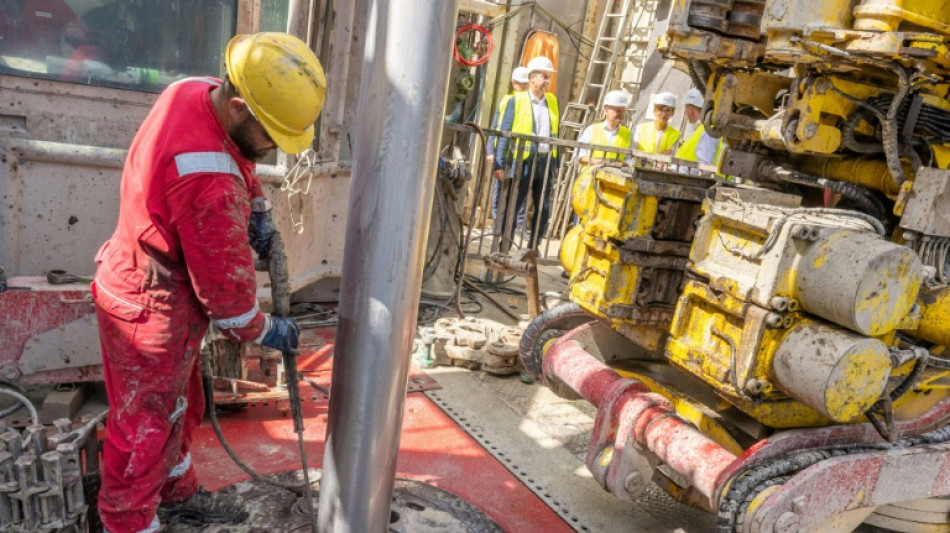
Dig deep: US bets on geothermal to become renewable powerhouse / Photo: Peter Kneffel - POOL/AFP

 Kenya's economy faces climate change risks: World Bank

 British oil giant BP aims to sell North Sea business
 China factory activity slides as leaders seek spending boost

 Tech rebound fuels record-breaking rally in South Korean stocks

 Cables and cooling bring AI windfall to Indian suppliers

 Anthropic's models gained unauthorized 'real-world' access during testing

 Apple tops estimates in CEO Cook's final quarter, but shares fall

 Milei demands expulsion of foreigners expressing 'hate' against Argentina

 Italy's Po River valley on drought alert

 Prada profits pinched as growth hard to chase

 Stocks climb on earnings and rates, oil retreats

 US economic growth slows in second quarter, missing expectations

 Russia adds Telegram founder Durov to 'terrorist' blacklist

 Stocks diverge on earnings, as oil steadies

 Eurozone economy grows despite Middle East war

 Singapore group will develop 'most promising' Ebola vaccine

 Shell profit surges as Mideast war fuels oil prices

 Car maker Stellantis says back in profit in second quarter

 Samsung quarterly operating profit up 1,800% on AI boom

 South Korean stocks bounce after rout, oil holds gains on Mideast woes

 South Korea's women web sleuths fight AI deepfake porn

 Anything but programmable: New cost-efficient EC-power-supply-series for the DIN rail by CAMTEC PS

 Meta misses profit expectations, sticks to massive AI spending

 Campari - king of the spritz - hopes to conquer American heartland

 Air France-KLM and Lufthansa bid for Portugal's TAP airline

Though geothermal represents only a tiny fraction of current US energy production, several businesses and President Joe Biden's administration are betting on technological advances to make it a backbone of the green transition.
"If we can capture that heat beneath our feet, it can be the clean, reliable, baseload-scalable power for everybody from industries to households," Energy Secretary Jennifer Granholm told the CERAWeek conference in Houston this past week.
Her department estimates that geothermal energy could overtake hydroelectric and solar power in the country by 2050.
Geothermal, which draws on naturally high temperatures underground and is used mainly to produce electricity and heat buildings, amounted to only 1.6 percent of US energy consumption in 2022.
To ramp up production, the US government has invested more than $200 million since 2018 in an experimental site in Utah involving the drilling of exceptionally deep wells -- an approach different from the traditional, near-surface geothermal energy.
Scientists at the site have been testing, in real-world conditions, a technology known as Enhanced Geothermal Systems (EGS), similar but different from hydraulic fracturing techniques, also known as fracking, which is used to extract oil and natural gas.
The approach involves injecting water into naturally very hot rocks -- often deeper than two miles (3 kilometers), which does not require a nearby hot spring or underground reservoir.
"In theory, you could make geothermal anywhere," said Francesco d'Avack, an analyst with S&P Global Commodity Insights.
"It also reduces the upfront risk," he said -- that is, the risk of drilling and finding nothing, which has been a deterrent for some investors in the past.
Granholm, in her speech to the CERAWeek energy conference, underscored another advantage: the US government is allowing companies to convert permits for oil or gas exploration into geothermal licenses -- reducing paperwork and delays.
In a report this past week, the Energy Department said EGS use fewer chemical additives than classic fracking, a system deplored by environmentalists.
It added that geothermal drilling does not release hydrocarbons, as fracking does.
And unlike solar or wind power, geothermal provides a steady flow of energy regardless of weather or time of day.
- 'A big unlock' -
As for cost, the US government estimates it will drop from a current range of $70 to $100 per megawatt hour (MWh) to $45 by 2035.
The use of existing drilling technology makes geothermal both quicker and cheaper to develop.
"We took the oil and gas operation models, we changed the drill bits a little bit and... we demonstrated a completely new application," said Jigar Shah of the Energy Department's loan office. "That's a big unlock" -- a big leap forward.
"The US has been a first mover" with the new technology, said Ajit Menon, a specialist in subterranean development with Texas-based energy company Baker Hughes, which has invested in geothermal energy.
There are already EGS sites in other countries, notably France, but they're considered experimental.
A possible risk of geothermal drilling projects is that, as with fracking, they can cause seismic activity.
In France's Alsace region, a deep-drilling project was abandoned in 2020 after it provoked several tremors.
The US Energy Department requires all funded projects follow a mitigation protocol to address induced seismicity and is funding research on the issue.
It says no community has felt seismicity occurring near a DOE-funded project.
Several US and Canadian start-ups are vying for position in this budding market and have raised hundreds of millions of dollars from investors.
One of them, Fervo Energy, recently linked its Nevada site to the electric grid. The project was developed in collaboration with Google, which needs huge amounts of electricity for its data centers. So far, though, the site is generating only 3.5 megawatts.
As the geothermal supply begins to grow, demand is following. Google, Microsoft and steel-maker Nucor announced Tuesday that they will jointly be purchasing geothermal energy.
Shah pointed out that the three big firms are "willing to pay a premium" for the energy, and that "gets the private sector excited."
"The new or next generation market is still quite open," said Cindy Taff, CEO of Sage Geosystems, which specializes in subterranean energy. One reason, she said, is that "we need that first commercial facility, and there hasn't been one" yet.
Once one company shows how it can be successfully done, others will follow, she added.
With the sector still so small, "your primary objective is to grow it right," said Menon. "Not only for you -- for everyone."
C.Smith--CPN