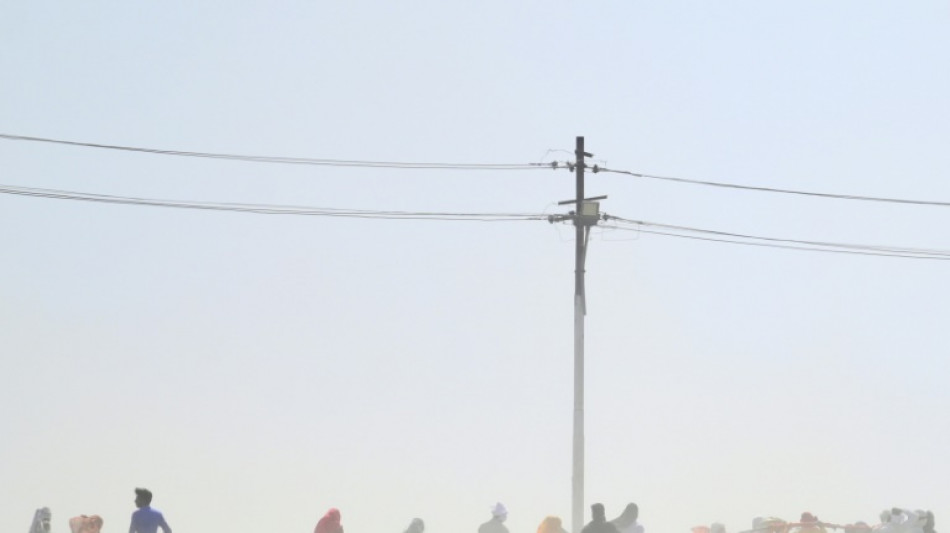
Threat from sand and dust storms spreading: UN / Photo: Sanjay KANOJIA - AFP

 Kenya's economy faces climate change risks: World Bank

 US Fed dissenters call for rate hikes over sustained inflation
 New York sues online prediction markets giant Kalshi

 Profits surge at US oil giant amid Iran war supply shock

 Stock markets rally on tech rebound

 France, Spain assess scorched terrain as new wildfires threaten other regions

 Chipmaker Kioxia reports AI-driven 45-fold surge in quarterly net profit

 Far right and far left battle for power in polarised Berlin

 The last trio: S.Africa's zoo elephants await their fate

 Oil industry sees war windfall but girds for political blowback

 Amazon beats expectations with cloud and AI growth

 Blowout Microsoft results lift US stocks as oil retreats

 'Beginning of the end': Relief but no party as French wildfire winds down

 Southern Europe 'becoming more flammable' in hotter climate, experts say

 Mammoth bones found on parched bed of Danube in Bulgaria

 MEXC Lists Grvt (GRVT) with $60,000 Worth of GRVT and 10,000 USDT in Airdrop+ Rewards

 George and Amal Clooney flee French home due to wildfire

 MEXC Ventures Supports Alpha Arena's APAC Debut at Coinfest Bali

 AI data centre supplier Zhongji InnoLight slips on Hong Kong debut

 May, June heatwaves caused 2,877 extra deaths in England: govt

 BMW profit down a third as carmaker plans job cuts

 Seoul extends losses as most Asian markets drop, oil rises again

 Gambling.com Group Is Now Grandstand

 Meet the astronomer digging into the Milky Way's 'fossils'

 AI data centre supplier Zhongji InnoLight falls on Hong Kong debut

The UN warned Wednesday that the number of sand and dust storms are increasing "dramatically" with Central Asia most hit by the dangerous phenomena.
Toxic sand storms have plagued parts of desert and steppe covered Central Asia and North Africa and the UN said they are a threat to life.
The UN's Convention to Combat Desertification (UNCCD) is meeting for five days in the historic city of Samarkand, just under a week before the COP28 climate change summit opens in Dubai.
"The sight of rolling dark clouds of sand and dust engulfing everything in their path and turning day into night is one of nature's most intimidating spectacles," Ibrahim Thiaw, UNCCD's secretary, said in a statement.
"It is a costly phenomenon that wreaks havoc everywhere from Northern and Central Asia to sub-Saharan Africa."
The agency said the storms impact areas far beyond their origin and that in some parts of the globe "desert dust doubled in the last century."
"An estimated two billon tons of sand and dust now enters the atmosphere every year, an amount equal in weight to 360 Great Pyramids of Giza," it added.
The experts warned the storms can have "life threatening" effects.
"Fine dust particles are carried to high tropospheric levels (up to a few kilometres high) where winds can transport them over long distances," the statement said.
Last month, AFP met with residents in neighbouring Tajikistan who suffered respiratory and other health problems doctors said were caused by the storms.
Previously rare, such storms now start in spring and continue into the autumn in large parts of Central Asia.
The storms often start out in the dried-out stretches of the Aral Sea in Uzbekistan but also in the Kazakh steppes and in neighbouring Afghanistan.
Ch.Lefebvre--CPN