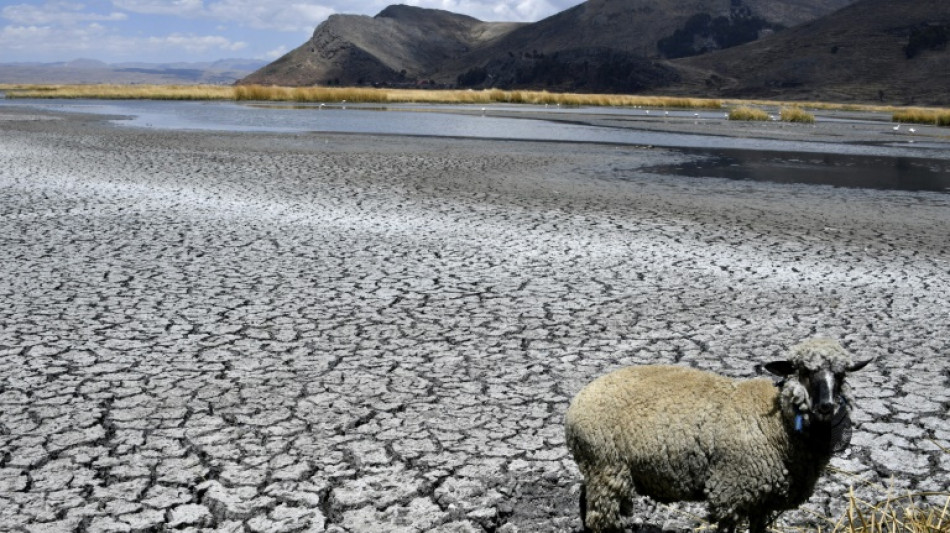
Climate change main culprit for hot South American winter / Photo: AIZAR RALDES - AFP

 Kenya's economy faces climate change risks: World Bank

 Hungary to shut nuclear plant as heatwave hits central Europe

 Tech-fuelled rally fizzles as oil prices rise

 Alarm over climate-linked low level of German waterways

 Commerzbank agrees to talks with UniCredit after two-year standoff

 Fornaro Legal Releases Guidance to Help Businesses Maintain Clear Ownership Records During Growth

 Japan probe made closest-ever asteroid flyby: space agency

 British oil giant BP aims to sell North Sea business

 China factory activity slides as leaders seek spending boost

 Tech rebound fuels record-breaking rally in South Korean stocks

 Cables and cooling bring AI windfall to Indian suppliers

 Anthropic's models gained unauthorized 'real-world' access during testing

 Apple tops estimates in CEO Cook's final quarter, but shares fall

 Milei demands expulsion of foreigners expressing 'hate' against Argentina

 Italy's Po River valley on drought alert

 Prada profits pinched as growth hard to chase

 Stocks climb on earnings and rates, oil retreats

 US economic growth slows in second quarter, missing expectations

 Russia adds Telegram founder Durov to 'terrorist' blacklist

 Stocks diverge on earnings, as oil steadies

 Eurozone economy grows despite Middle East war

 Singapore group will develop 'most promising' Ebola vaccine

 Shell profit surges as Mideast war fuels oil prices

 Car maker Stellantis says back in profit in second quarter

 Samsung quarterly operating profit up 1,800% on AI boom

A wave of unusually extreme heat at the end of South America's winter was made 100 times more likely by climate change, according to a study published Tuesday.
"While many people have pointed to El Nino to explain the South America heat wave, this analysis has shown that climate change is the primary driver of the heat," said Lincoln Muniz Alves, a researcher at the Brazil National Institute for Space Research who participated in the study by the World Weather Attribution (WWA) group.
From Buenos Aires to Chile, and parts of Brazil, people found themselves in T-shirts at the height of the Southern Hemisphere winter in August and September, with temperatures shooting above 25 degrees Celsius (77 Fahrenheit), and reaching 37 degrees Celsius in some cases, breaking records.
The WWA study found that while the naturally occurring El Nino warming phenomenon had some impact, climate change was the main culprit, driving temperatures up between 1.4 and 4.3 degrees.
A team of 12 experts studied the link between the extreme weather and climate change over the 10 hottest winter days in a region encompassing Paraguay, central Brazil and regions of Bolivia and Argentina.
"The scientists found that these extreme heat episodes in South America outside the summer months would have been extremely unlikely without human-caused climate change," read a statement on the study.
"Heat episodes like these will become even more frequent and extreme if greenhouse gas emissions are not rapidly reduced to net zero."
In Sao Paulo, the biggest city in Latin America, four deaths were attributed to the heatwave.
"Heat kills, particularly in spring, before people are acclimatized to it," said Julie Arrighi, a director at the Red Cross Red Crescent Climate Centre.
"Temperatures above 40 degrees Celsius in early spring are incredibly extreme and while we are aware of just four heat-related fatalities, it's likely the true number is much higher."
The heatwave came during a winter and early spring marked by extreme weather phenomena, from torrential rains in Chile, to cyclones in southern Brazil and a drought which pushed Uruguay's potable water supply to the brink.
The heat also led to increased forest fires in the Amazon.
Unseasonable warm weather was not limited to South America, with last month dubbed the hottest September on record by the European Union climate monitor.
The El Nino phenomenon -- which warms waters in the southern Pacific and stokes hotter weather beyond -- is likely to contribute to 2023 becoming the hottest year on record in the next three months.
A.Agostinelli--CPN