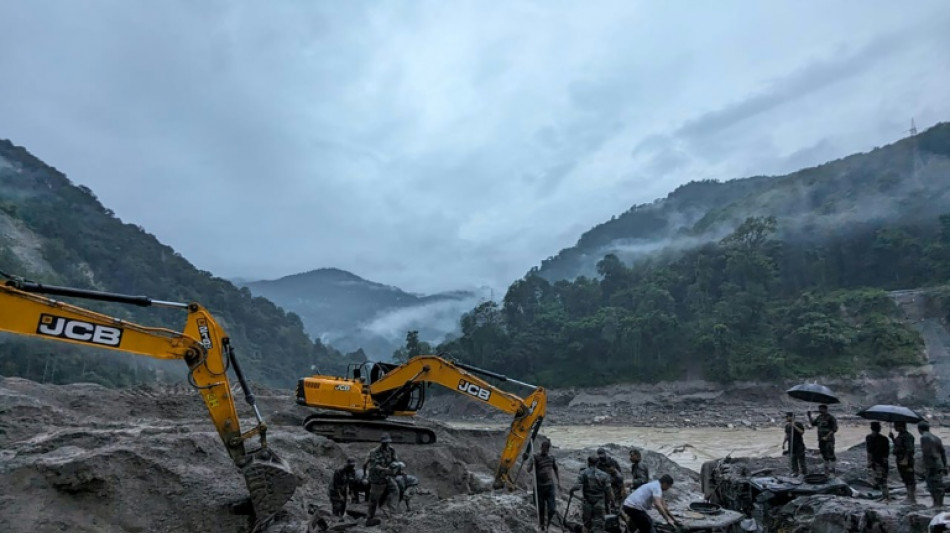
India flood toll hits 40 as army plots airlift rescues / Photo: - - India's Ministry of Defence/AFP

 Kenya's economy faces climate change risks: World Bank

 Hungary to shut nuclear plant as heatwave hits central Europe

 Tech-fuelled rally fizzles as oil prices rise

 Alarm over climate-linked low level of German waterways

 Commerzbank agrees to talks with UniCredit after two-year standoff

 Fornaro Legal Releases Guidance to Help Businesses Maintain Clear Ownership Records During Growth

 Japan probe made closest-ever asteroid flyby: space agency
 British oil giant BP aims to sell North Sea business

 China factory activity slides as leaders seek spending boost

 Tech rebound fuels record-breaking rally in South Korean stocks

 Cables and cooling bring AI windfall to Indian suppliers

 Anthropic's models gained unauthorized 'real-world' access during testing

 Apple tops estimates in CEO Cook's final quarter, but shares fall

 Milei demands expulsion of foreigners expressing 'hate' against Argentina

 Italy's Po River valley on drought alert

 Prada profits pinched as growth hard to chase

 Stocks climb on earnings and rates, oil retreats

 US economic growth slows in second quarter, missing expectations

 Russia adds Telegram founder Durov to 'terrorist' blacklist

 Stocks diverge on earnings, as oil steadies

 Eurozone economy grows despite Middle East war

 Singapore group will develop 'most promising' Ebola vaccine

 Shell profit surges as Mideast war fuels oil prices

 Car maker Stellantis says back in profit in second quarter

 Samsung quarterly operating profit up 1,800% on AI boom

At least 40 people have died in flash floods inundating India's northeast, officials said Friday, as army teams plotted helicopter rescues for more of the thousands stranded in the deluge.
Violent torrents stuck the remote state of Sikkim on Wednesday after the sudden bursting of a high-altitude glacial lake near India's borders with China and Nepal.
Climate scientists warn that similar disasters will become an increasing danger across the Himalayas as global temperatures rise and ice melts.
Downstream search-and-rescue teams recovered more bodies overnight as the waters cut a swathe through the countryside towards the Bay of Bengal.
V.B. Pathak, the top civil servant in Sikkim state, told AFP that his office had confirmed 19 deaths.
Shama Parveen, a district magistrate in neighbouring West Bengal, said that an additional 21 bodies had been recovered in her state over the past three days.
Roads, bridges and telephone lines have been destroyed across much of the state, complicating evacuations and efforts to communicate with thousands cut off from the rest of the country.
Nearly 8,000 others were taking shelter at makeshift relief camps set up at schools, government offices and guesthouses, according to a state government bulletin.
An Indian army statement said that soldiers on rescue operations had been able to account for nearly 1,500 people visiting from out of state who were still marooned in the worst-hit flood areas.
"There may be a window of opportunity for evacuation of stranded tourists by helicopters" with weather conditions improving on Friday, the statement added.
Army helicopters were also air-dropping supplies to clusters of stranded people, Pathak told reporters.
"We are putting all efforts to provide relief materials to people and in restoring infrastructure," he added.
India's government said it had expedited funding for relief and recovery efforts, with Prime Minister Narendra Modi promising "all possible support" for those affected.
- 'Root cause is climate change' -
The water surge came after intense rainfall burst the high-altitude Lhonak Lake, which sits at the base of a glacier in peaks surrounding the world's third-highest mountain, Kangchenjunga.
Water powered downstream, adding to a river already swollen by monsoon rains, damaging a dam and sweeping away houses.
Himalayan glaciers are melting faster than ever due to climate change, exposing communities to unpredictable and costly disasters, according to the International Centre for Integrated Mountain Development (ICIMOD) research group.
"The root cause is climate change and this going to increase in the future," ICIMOD climate change specialist Arun Bhakta Shrestha told AFP.
"None of the scenarios are good," he added. "Even the most modest scenario tells us that... similar glacial lake outbursts flood events are very likely."
Earth's average surface temperature has risen nearly 1.2 degrees Celsius since pre-industrial times but high-mountain regions around the world have warmed at twice that pace, climate scientists say.
Among the dead are six Indian army soldiers posted in Sikkim, which sits on India's remote frontiers with Nepal and China, and boasts a sizeable military presence.
India has been wary of China's growing military assertiveness and their 3,500-kilometre shared frontier has been a perennial source of tension, with parts of Sikkim claimed by Beijing.
D.Goldberg--CPN