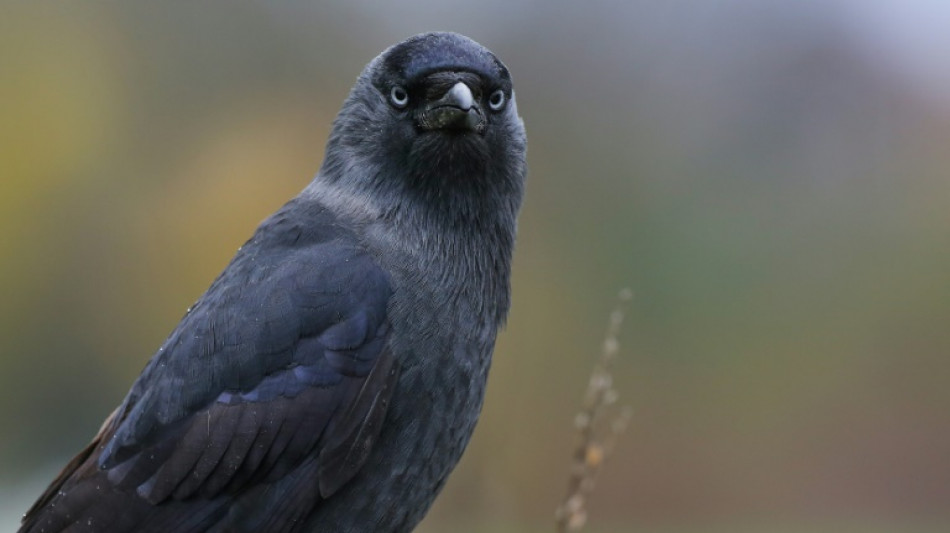
Birdocracy: Noisy jackdaws take a 'vote' before flying / Photo: Thomas Warnack - dpa/AFP/File

 Lights out in Laos as electricity exports surge

 Steven Strogatz weighs AI mathematics advances and their consequences for researchers

 Anthropic boss calls for AI slowdown, Altman and Musk agree

 French IT giant Capgemini sells subsidiary after row over ICE links

 Quebec Brokerage Qubit Insurance Announces New Data on Coverage Shortfalls as Rebuilding Costs Rise

 Lady Gaga welcomes first child with fiance: US media

 Bhutan business bets on hazelnuts for farming future

 'Widow's Bay' and 'The Pitt' are favorites for Emmys night

 Coastal erosion forces cancellation of California music festival

 Argentina's Dirty War rears its head in Venice film

 UK lawmakers throw out bill to legalise assisted dying

 US inflation steady in August, fueling Fed rate hike expectations

 New York marks 25th anniversary of 9/11 attacks

 Nepal flood reconstruction bill to be $4.78 bn: foreign ministry

 JUMO and Standard Bank launch Social Finance Framework to scale inclusive finance in Africa

 Doomsday tech: could AI really kill us all?

 French comedy show 'Call my agent' makes film comeback

 It's all coming back: Celine Dion fans gear up for Paris return

 Researchers eye AI revolution in natural disaster forecasts

 US braces for inflation report that may push Fed to hike rates

 Musk threatens legal action over documentary

 Latin America fact-check group asks Meta not to replace verification practice

 AI Risks to Enter 60–80% of Liability and Cyber Insurance Underwriting by 2028, ScienceSoft Predicts

 Tribal Launches Campfire, Letting Business and Technical Teams Build on Salesforce Together

 Stocks fall as fresh oil surge fans inflation fears

A crescendo of calls from hundreds of noisy jackdaws can often be heard right before they take to the sky all at once, right around sunrise on cold winter mornings.
Now, scientists who studied their daily activities in detail say these small black crows rely on "democratic" decision-making to coordinate their actions for the collective good.
The findings were published Monday in Current Biology.
"By establishing consensus to leave the roost early and in large flocks, birds may reduce predation risk, facilitate access to useful foraging information" and increase access to mates, wrote the authors.
Jackdaws -- which may get their name from their brief "Jack"-like squawk -- are found across Europe, North Africa and Asia, and form large groups known as "clatterings."
Prior research on consensus decision-making in animals had focused on small groups or members of a family.
Jackdaw roosts were interesting for size as well as diversity, comprising individuals of different ages, sexes, family groups and colonies spread across treetops.
It's likely individuals would have varying preferences about when to take off. But sticking together offers advantages, such as lowered risk of being hunted by birds of prey or small mammals.
To investigate, the team from the University of Exeter and other institutions recorded hours of audio and video of six different jackdaw roosts in Cornwall, Britain, with roost sizes varying from 160 to nearly 1,500 birds.
They found that the timing of departure was tightly linked to calling intensity with the group.
Occasionally, the birds left in dribs and drabs across 20 minutes, but most of the time they set out en masse, with hundreds of birds taking off within a span of four seconds.
On most mornings, the call intensity rose in the hour leading up to the biggest group departure -- but sometimes got delayed by rain or heavy cloud cover -- which led the team to conclude the vocalizations were a reliable source of information.
To confirm cause and effect, the researchers played recordings to the birds to see if they could get them to take off earlier than they would otherwise -- and succeeded in engineering departures that were on average 6.5 minutes earlier.
"Through their calls, jackdaws appear to effectively signal their willingness to leave, providing large groups with a means of achieving consensus to perform cohesive, collective departures from the roost," the team concluded.
On the few times the birds left in a steady stream, rather than in a big group, the calls did not crescendo to a high, indicating the birds had failed to reach consensus.
In future, the team wants to study how human activity -- such as noise pollution -- may hinder bird dynamics and their ability to communicate.
D.Goldberg--CPN