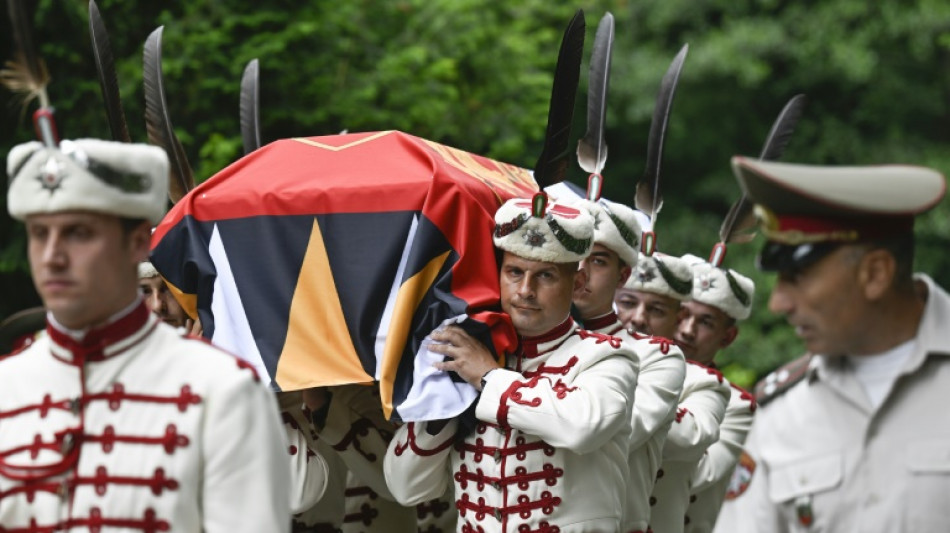
Remains of Bulgaria's King Ferdinand return home / Photo: Nikolay DOYCHINOV - AFP

 Kenya's economy faces climate change risks: World Bank

 Chipmaker Kioxia reports AI-driven 45-fold surge in quarterly net profit
 Far right and far left battle for power in polarised Berlin

 The last trio: S.Africa's zoo elephants await their fate
 Oil industry sees war windfall but girds for political blowback

 Amazon beats expectations with cloud and AI growth

 Blowout Microsoft results lift US stocks as oil retreats

 'Beginning of the end': Relief but no party as French wildfire winds down

 Southern Europe 'becoming more flammable' in hotter climate, experts say

 Mammoth bones found on parched bed of Danube in Bulgaria

 MEXC Lists Grvt (GRVT) with $60,000 Worth of GRVT and 10,000 USDT in Airdrop+ Rewards
 George and Amal Clooney flee French home due to wildfire

 MEXC Ventures Supports Alpha Arena's APAC Debut at Coinfest Bali

 AI data centre supplier Zhongji InnoLight slips on Hong Kong debut

 May, June heatwaves caused 2,877 extra deaths in England: govt

 BMW profit down a third as carmaker plans job cuts

 Seoul extends losses as most Asian markets drop, oil rises again

 Gambling.com Group Is Now Grandstand

 Meet the astronomer digging into the Milky Way's 'fossils'

 AI data centre supplier Zhongji InnoLight falls on Hong Kong debut

 Samsung operating profit up 1,800% in second quarter on AI boom

 Japanese population below 120 million for first time in decades

 US actor Jared Leto denies latest accusations of sexual assault

 Danube drops to 'historic lows' as fresh heatwave hits
 BTS pulls out of Grammys after Asian pop category introduction
The remains of Ferdinand Saxe-Coburg-Gotha, the first king of Bulgaria following five centuries of Ottoman rule, were repatriated from Germany Wednesday to be interred in a family mausoleum, 76 years after his death.
"The due homage will be paid to a head of state... who, despite contradictory interpretations of certain moments of his reign, gave much to... the modernisation of our country," said his grandson, the 86-year-old former exiled child king Simeon Saxe-Coburg-Gotha, who returned to Bulgaria in 2000.
The coffin bearing Ferdinand's remains was transported back to Bulgaria from the German town of Coburg on a military plane.
A funeral procession then brought it to the Vrana Palace on Sofia's outskirts, where it was welcomed by Simeon Saxe-Coburg-Gotha, his wife Margarita, two of their sons Kyril and Konstantin-Assen, daughter Kalina and other members of the royal family.
Members of the national guard carried the coffin, draped in the old flag of the kingdom of Bulgaria, inside the palace's central hall for a funeral service attended by officials.
Ordinary Bulgarians could also pay their last respects to the former monarch.
Mihail Petkov, 50, a great-grandson of one of Ferdinand's officers, brought his teenage son to "this historic event", in memory of "the man who built modern Bulgaria".
Yana Vassileva, a 70-year-old historian, was moved to tears and knelt as the funeral procession filed by.
"Ferdinand is one of Bulgaria's great kings. It's a pity that his merits are overlooked in school curricula," she lamented.
Neither interim Prime Minister Dimitar Glavchev nor President Rumen Radev attended the ceremony.
- 'Responsibility towards history' -
For historian Petar Stoyanovich, a researcher of Ferdinand, "this return signifies, even if belatedly, a responsibility towards history".
In 1908, Prince Ferdinand Saxe-Coburg-Gotha, who had reigned from 1887, proclaimed Bulgaria's independence and became its king.
The country had been a vassal of the Ottoman Empire until its liberation in 1878.
Ferdinand reigned for 31 years but left a controversial legacy after two painful losses in the Second Balkan War of 1913 and World War I, in which Bulgaria was allied with Germany, led to his abdication in 1918.
But during the 25 peaceful years that preceded the wars "Bulgaria was transformed into a European state" by modernising its army, urban planning, education and agriculture, Stoyanovich said.
After his abdication, Ferdinand could never return to Bulgaria and lived at the family home in Coburg, Bavaria, until his death at the age of 87 in 1948.
His mortal remains were kept in a coffin next to his parent's sarcophagi in the crypt of the Saint Augustin church, awaiting repatriation to Bulgaria, which was his last wish.
He will be laid to rest in a family crypt at the Vrana Palace that he had once built at a private ceremony Thursday.
P.Schmidt--CPN