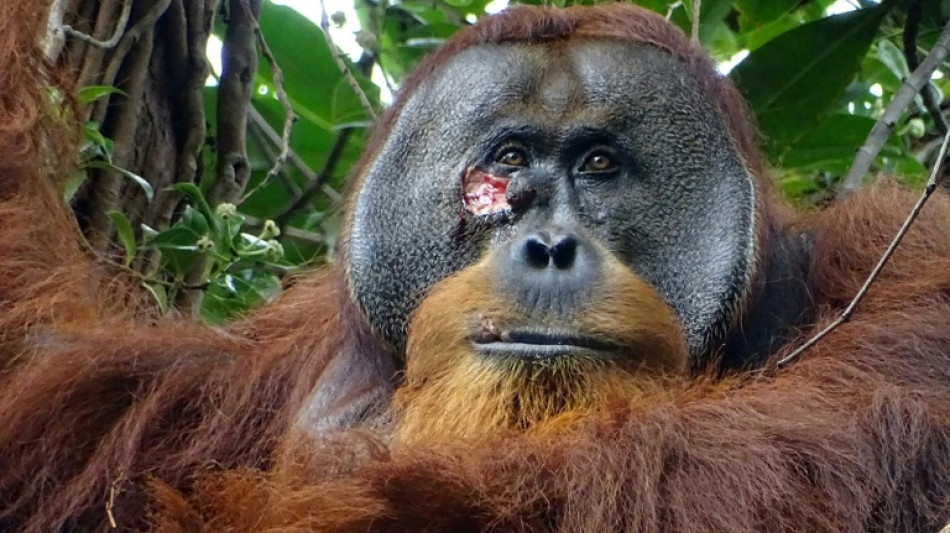
Self-care: Orangutan seen apparently treating wound / Photo: - - SUAQ Foundation/AFP

 Kenya's economy faces climate change risks: World Bank

 British oil giant BP aims to sell North Sea business

 China factory activity slides as leaders seek spending boost

 Tech rebound fuels record-breaking rally in South Korean stocks

 Cables and cooling bring AI windfall to Indian suppliers

 Anthropic's models gained unauthorized 'real-world' access during testing

 Apple tops estimates in CEO Cook's final quarter, but shares fall

 Milei demands expulsion of foreigners expressing 'hate' against Argentina

 Italy's Po River valley on drought alert

 Prada profits pinched as growth hard to chase

 Stocks climb on earnings and rates, oil retreats

 US economic growth slows in second quarter, missing expectations

 Russia adds Telegram founder Durov to 'terrorist' blacklist

 Stocks diverge on earnings, as oil steadies

 Eurozone economy grows despite Middle East war

 Singapore group will develop 'most promising' Ebola vaccine

 Shell profit surges as Mideast war fuels oil prices

 Car maker Stellantis says back in profit in second quarter

 Samsung quarterly operating profit up 1,800% on AI boom

 South Korean stocks bounce after rout, oil holds gains on Mideast woes

 South Korea's women web sleuths fight AI deepfake porn

 Anything but programmable: New cost-efficient EC-power-supply-series for the DIN rail by CAMTEC PS

 Meta misses profit expectations, sticks to massive AI spending

 Campari - king of the spritz - hopes to conquer American heartland

 Air France-KLM and Lufthansa bid for Portugal's TAP airline

Scientists have observed an orangutan applying medicinal herbs to a face wound in an apparently successful attempt to heal an injury, the first time such behaviour has been recorded.
Primates have previously been seen eating plants or rubbing them on themselves in behaviour scientists theorised was intended to ward off disease or discomfort.
But the apparent treatment seen by researchers in Indonesia in 2022, and reported in the journal Nature Scientific Reports on Thursday, is the first time a wild animal has been seen applying medicinal plants to a wound.
Scientists were tracking a male orangutan nicknamed Rakus at the Gunung Leuser National Park in Indonesia's Aceh province when they noticed an open wound on his face.
Three days later, they spotted him chewing the leaves of a vine called Fibraurea tinctoria, which is known for its medicinal properties and has long been used in local traditional medicine.
The orangutan "began chewing the leaves without swallowing them and using his fingers to apply the plant juice from his mouth directly onto his facial wound," said the study by Indonesian and German scientists.
When flies began to land on the site, Rakus "smeared the entire wound with the plant pulp until the red flesh was fully covered with the green leaf material."
The next day, Rakus was seen eating the vine's leaves again, and a week later his wound had closed up, subsequently healing without any sign of infection.
The study describes the behaviour as the "first systematically documented case of active wound treatment with a plant species known to contain biologically active substances by a wild animal."
Researchers said it was impossible to be sure the behaviour was intentional, but the fact that the juice and leaves were applied repeatedly and only to the wound suggests Rakus was trying to treat his injury.
They speculate the orangutan could have stumbled across the treatment, perhaps by first chewing the plant and then finding the juice offered pain relief when accidently touching it to a wound.
Orangutans are known to learn skills from each other through observation, but the scientists said they had no record of similar behaviour in 21 years and 28,000 observation hours in the area.
Rakus however had moved to the region from elsewhere, raising the possibility he learned the medical technique from a different community.
The observation adds to a growing body of evidence about the way primates use plants to keep healthy, including swallowing whole leaves that have anti-parasitic properties.
Elsewhere in Indonesia, orangutans have been seen rubbing the chewed leaves of a different plant into their skin, possibly to harness its anti-inflammatory properties.
And in 2022, scientists reported on chimpanzees in Gabon that were seen apparently applying insects to wounds.
D.Avraham--CPN