Frozen in time: Colombian town's unexplained mummies
/ Photo: Raul ARBOLEDA - AFP

 Kenya's economy faces climate change risks: World Bank
 British oil giant BP aims to sell North Sea business

 China factory activity slides as leaders seek spending boost

 Tech rebound fuels record-breaking rally in South Korean stocks

 Cables and cooling bring AI windfall to Indian suppliers

 Anthropic's models gained unauthorized 'real-world' access during testing

 Apple tops estimates in CEO Cook's final quarter, but shares fall

 Milei demands expulsion of foreigners expressing 'hate' against Argentina

 Italy's Po River valley on drought alert

 Prada profits pinched as growth hard to chase

 Stocks climb on earnings and rates, oil retreats

 US economic growth slows in second quarter, missing expectations

 Russia adds Telegram founder Durov to 'terrorist' blacklist

 Stocks diverge on earnings, as oil steadies

 Eurozone economy grows despite Middle East war

 Singapore group will develop 'most promising' Ebola vaccine

 Shell profit surges as Mideast war fuels oil prices

 Car maker Stellantis says back in profit in second quarter

 Samsung quarterly operating profit up 1,800% on AI boom

 South Korean stocks bounce after rout, oil holds gains on Mideast woes

 South Korea's women web sleuths fight AI deepfake porn

 Anything but programmable: New cost-efficient EC-power-supply-series for the DIN rail by CAMTEC PS

 Meta misses profit expectations, sticks to massive AI spending

 Campari - king of the spritz - hopes to conquer American heartland

 Air France-KLM and Lufthansa bid for Portugal's TAP airline

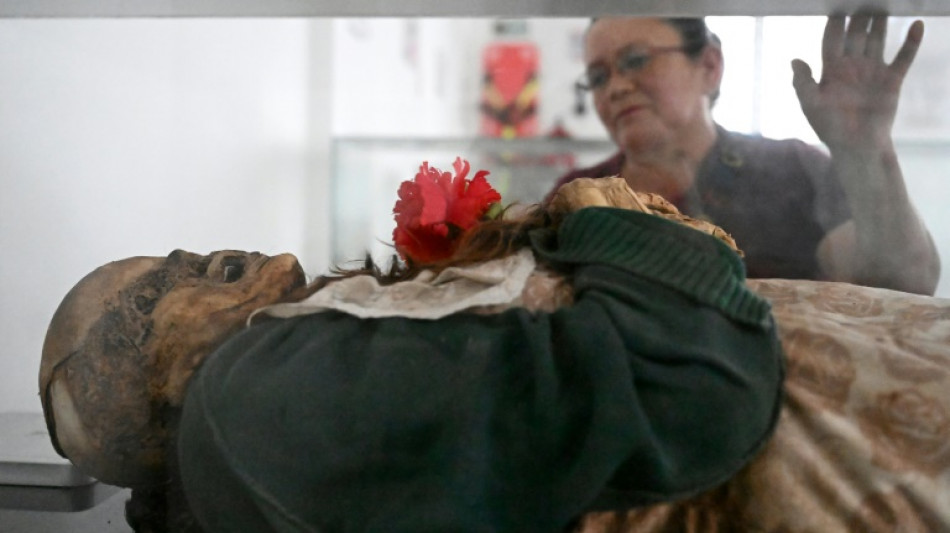
In a small town high in the Colombian Andes, Clovisnerys Bejarano kneels before a glass box holding the petrified corpse of her mother, who died 30 years ago, but looks as if she might just be asleep.
Saturnina Torres de Bejarano is dressed in the same rose-print dress and green woolen jersey she was interred in, clasping a fake red carnation in her eerily well-preserved hands.
"She still has her little brown face, round, her braids, her hair," Bejarano, 63, told AFP at her mother's final resting place in a museum displaying her body and those of 13 others from the town of San Bernardo who became spontaneously, and mysteriously, mummified after death.
"If God wanted to preserve her... it must be for a reason," said Bejarano, a resident of the town some 100 kilometers (62 miles) south of Bogota.
Torres was interred in a vault in the San Bernardo municipal cemetery in 1993.
Exhumed in 2001 -- as is customary to make space for new bodies -- her relatives found her still with hair, nails and much of her tissue unspoilt.
It came as no major surprise. Dozens of mummified bodies have come out of the vaults since the first one in 1963.
"When all this began, people were a little incredulous about what was happening; they thought these were going to be isolated events," said museum guide Rocio Vergara.
"As time went on, it became more and more frequent to find bodies in this condition," she told AFP.
Some even still had their eyes, usually quick to decompose.
In the late 1980s, some 50 mummies were found in the mausoleum every year, but the rate has declined to a handful per year, said Vergara.
- Reward after death? -
Despite numberous attempts by experts to explain the phenomenon -- which has also been observed in countries such as Mexico and Italy -- the reason for the spontaneous mummification in San Bernardo has never been pinned down, said Vergara.
Some locals "believe "that the process (mummification) is due to the fact that the person was too good, and it is a reward after death," said Vergara.
"There are others who consider that... it is a punishment."
Most are convinced it is because of the healthy diet of the residents of temperate San Bernardo, and an active, farming lifestyle.
But this is not always borne out by the evidence: one of the mummies belongs to Jorge Armando Cruz, who spent most of his life in the big city of Bogota, where he died before being brought back to his birthplace for burial.
There is no clear pattern to the mummifications: those who are involved are of all different ages when they died, and no particular gender or body type predominates.
Vergara said there is no particular sector of the cemetery that yields more mummies than others.
- 'Like an oven' -
Many believe the answer must lie in the burial vaults.
The first mummies were found in San Bernardo only after the cemetery, which has no underground graves, was inaugurated.
Prior to the 1960s, the town had two burial grounds with not a single known case of mummification, said Vergara.
The climate in the area is humid, which would ordinarily aid decomposition, not hinder it, she added.
Anthropologist Daniela Betancourt of the National University of Colombia said the phenomenon could be due to the cemetery's placement on a steep mountain slope.
"The wind is constantly blowing as it is hot. It is possible to assume that the vaults work like an oven... they dehydrate you."
This hypothesis still needs to be tested, Betancourt told AFP.
"There has been a lack (of) studies about what is happening and what specific conditions are the ones that cause people to mummify," she said.
Relatives of the mummified corpses must authorize their display in the museum.
Most opt to have the remains cremated instead, but the Bejarano family did not wish that fate for Torres.
"God wanted to leave her to us, and here we have her... Seeing her like that, how could one let her be cremated," asked Bejarano, who regularly brings Torres's great-grandchildren to visit her tomb.
/lv/das/mar/mlr/mdl
A.Levy--CPN