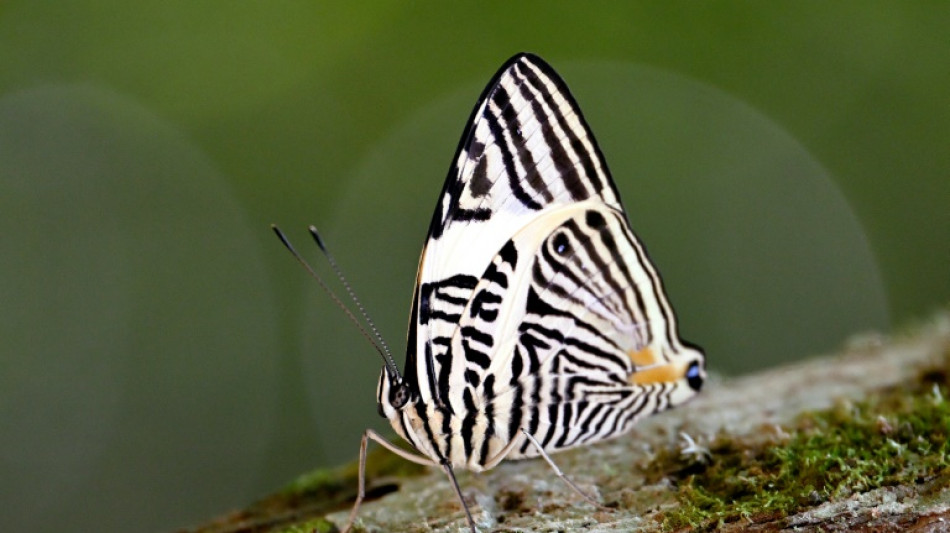
In Ecuadoran Amazon, butterflies provide a gauge of climate change
/ Photo: Daniel MUNOZ - AFP/File

 Kenya's economy faces climate change risks: World Bank
 British oil giant BP aims to sell North Sea business

 China factory activity slides as leaders seek spending boost

 Tech rebound fuels record-breaking rally in South Korean stocks
 Cables and cooling bring AI windfall to Indian suppliers

 Anthropic's models gained unauthorized 'real-world' access during testing

 Apple tops estimates in CEO Cook's final quarter, but shares fall

 Milei demands expulsion of foreigners expressing 'hate' against Argentina

 Italy's Po River valley on drought alert

 Prada profits pinched as growth hard to chase

 Stocks climb on earnings and rates, oil retreats

 US economic growth slows in second quarter, missing expectations

 Russia adds Telegram founder Durov to 'terrorist' blacklist

 Stocks diverge on earnings, as oil steadies

 Eurozone economy grows despite Middle East war

 Singapore group will develop 'most promising' Ebola vaccine

 Shell profit surges as Mideast war fuels oil prices

 Car maker Stellantis says back in profit in second quarter

 Samsung quarterly operating profit up 1,800% on AI boom

 South Korean stocks bounce after rout, oil holds gains on Mideast woes

 South Korea's women web sleuths fight AI deepfake porn

 Anything but programmable: New cost-efficient EC-power-supply-series for the DIN rail by CAMTEC PS

 Meta misses profit expectations, sticks to massive AI spending

 Campari - king of the spritz - hopes to conquer American heartland
 Air France-KLM and Lufthansa bid for Portugal's TAP airline

Biologists on a trail in the Ecuadoran Amazon hold their breath as they distribute a foul-smelling delicacy to lure butterflies, critical pollinators increasingly threatened by climate change.
A team has hung 32 traps made of green nets, each baited with rotting fish and fermented bananas. They are meant to blend in with the forest canopy. Their pungent odor clearly does not.
Since last August, a team of biologists and park rangers has been monitoring butterfly numbers in the Cuyabeno Wildlife Reserve, a park famed for its abundant flora and fauna.
They catch and document the colorful insects, releasing most with an identifying mark on their wings. Some of them, possibly from previously unknown species, are kept for further study.
The results of the team's work, however, have been discouraging.
Butterflies are "bioindicators," living organisms whose well-being provides a measure of the health of their surrounding ecosystem, and their numbers are decreasing, biologist Maria Fernanda Checa told AFP.
While the number of species may not have declined by more than 10 percent, in terms of absolute butterfly numbers "the decrease is very significant... maybe 40/50 percent," she said.
"It is something that alarms us."
- Bioindicators -
Under expedition leader Elisa Levy, a team checks the nets for captured butterflies.
They hold the insects delicately by their tiny abdomens and manipulate their legs and wings with tweezers.
Some are bright red and blue, others have what resemble zebra stripes. Some are see-through, like glass.
About three-quarters of fruit- or seed-producing crops for human consumption depend on pollinators, which provide a free service worth billions of dollars.
The UN has warned that 40 percent of invertebrate pollinators -- particularly bees and butterflies -- risk global extinction, posing certain risks to humanity itself.
Butterflies, said Checa, are "very sensitive, even to small changes in the ecosystem" throughout their short lifespan from egg to caterpillar to reproductive adult.
Levy explained that tropical plants -- unlike ones in regions with distinct seasons -- are not accustomed to extreme weather variations.
If they do not adapt to a fast-changing climate, these plants could be lost, along with the butterfly larvae that feed on them.
Ecuador, relatively small but extremely biodiverse, hosts about 4,000 butterfly species -- nearly as many as its much larger neighbors Peru and Colombia.
Yet in places like the Yasuni National Park, which neighbors Cuyabeno, "the rate of species discovery is slower than the rate of extinction," said Checa.
M.P.Jacobs--CPN