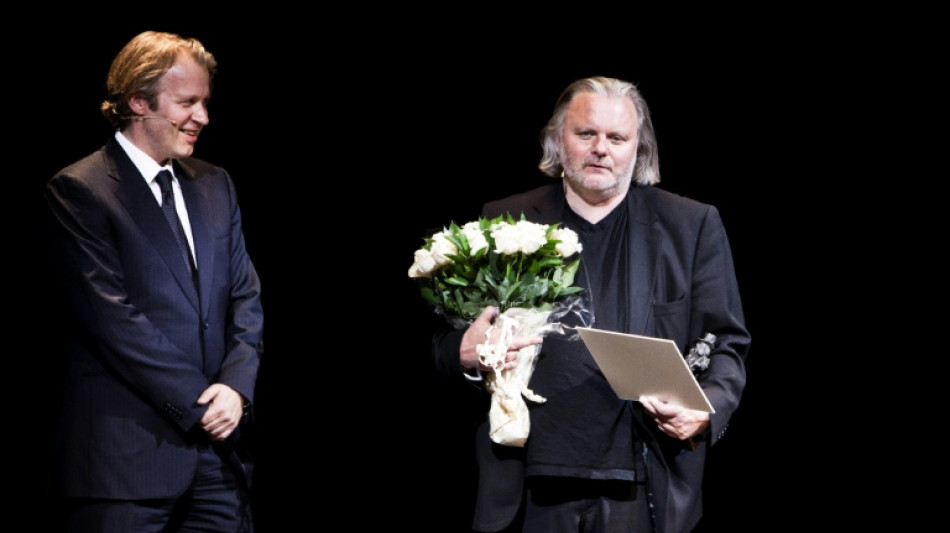
Jon Fosse: the writer of silence / Photo: Aleksander andersen - SCANPIX NORWAY/AFP/File

 Kenya's economy faces climate change risks: World Bank

 Commerzbank agrees to talks with UniCredit after two-year standoff

 Fornaro Legal Releases Guidance to Help Businesses Maintain Clear Ownership Records During Growth

 Japan probe made closest-ever asteroid flyby: space agency
 British oil giant BP aims to sell North Sea business

 China factory activity slides as leaders seek spending boost

 Tech rebound fuels record-breaking rally in South Korean stocks

 Cables and cooling bring AI windfall to Indian suppliers

 Anthropic's models gained unauthorized 'real-world' access during testing

 Apple tops estimates in CEO Cook's final quarter, but shares fall

 Milei demands expulsion of foreigners expressing 'hate' against Argentina

 Italy's Po River valley on drought alert

 Prada profits pinched as growth hard to chase

 Stocks climb on earnings and rates, oil retreats

 US economic growth slows in second quarter, missing expectations

 Russia adds Telegram founder Durov to 'terrorist' blacklist

 Stocks diverge on earnings, as oil steadies

 Eurozone economy grows despite Middle East war

 Singapore group will develop 'most promising' Ebola vaccine

 Shell profit surges as Mideast war fuels oil prices

 Car maker Stellantis says back in profit in second quarter

 Samsung quarterly operating profit up 1,800% on AI boom

 South Korean stocks bounce after rout, oil holds gains on Mideast woes

 South Korea's women web sleuths fight AI deepfake porn

 Anything but programmable: New cost-efficient EC-power-supply-series for the DIN rail by CAMTEC PS

Norwegian author Jon Fosse is an all-rounder whose writing is defined more by form than content -- what is not said is often more revealing than what is.
Fosse -- a novelist, essayist, poet and children's author but who is best known as a playwright -- won the Nobel prize in literature on Thursday.
His dramatic works may not be easily accessible, but they are nonetheless among the most widely staged of any contemporary playwright in Europe.
Born among the fjords of western Norway, Fosse is usually seen clad in black with a few days' stubble.
He grew up in a family which followed a strict form of Lutheranism and rebelled by playing in a band and declaring himself an atheist. The 64-year-old ended up converting to Catholicism in 2013.
After studying literature, he made his debut in 1983 with the novel "Red, Black" which moves back and forth in time and between perspectives.
His major works include "Boathouse" (1989), which was well-received by critics, and "Melancholy" I and II (1995-1996).
His latest book, "Septology", a semi-autobiographical magnum opus -- seven parts spread across three volumes about a man who meets another version of himself -- runs to 1,250 pages without a single full stop.
The third volume was shortlisted for the 2022 International Booker Prize.
- Loaded silence -
Struggling to make ends meet as an author in the early 1990s, Fosse was asked to write the start of a play.
"It was the first time I had ever tried my hand at this kind of work, and it was the biggest surprise of my life as a writer. I knew, I felt, that this kind of writing was made for me," he once said in an interview with a French theatre website.
He enjoyed the form so much he wrote the entire play, entitled "Someone is Going to Come."
He went on to win international acclaim for his next play, "And We'll Never be Parted," in 1994.
His work has been translated into around 50 languages. According to his Norwegian publisher Samlaget, his plays have been staged more than 1,000 times around the world.
Fosse's work is minimalistic, relying on simple language which delivers its message through rhythm, melody and silence.
His characters don't talk much. And what they say is often repetitive, with tiny but significant changes from one repetition to the next. The words are kept in suspension, hanging in the air, often without punctuation.
"You don't read my books for the plots," he told the Financial Times in 2018.
"I don't write about characters in the traditional sense of the word. I write about humanity," Fosse also told French newspaper Le Monde in 2003.
"The sociological elements are present: unemployment, loneliness, broken families, but the essential matter is what's in between. What's in the cracks, the gaps between the characters and the elements of the text.
"The silence, what's not being said is more important than what's being said."
Married three times, the father-of-six gave up drinking some years ago after being treated in hospital for alcohol poisoning.
After a decade-long pause during which he said playwriting gave him no pleasure, he returned with a new piece for the theatre entitled "Sterk Vind" (Strong Wind, not yet translated into English).
Although his plays are notoriously difficult to stage, Fosse was ranked 83rd among the top 100 geniuses alive on a list compiled by the Daily Telegraph in 2007.
In a country whose authors tend to be little known abroad -- unless they write crime novels -- he has inevitably been compared with Norway's national playwright Henrik Ibsen, and in 2010 won the International Ibsen Award, one of the theatre world's most prestigious prizes.
But perhaps Samuel Beckett is a more apt comparison. Fosse has himself declared his admiration for the Irish icon, describing him, like himself, as "a painter for the theatre rather than an actual author".
A.Agostinelli--CPN
