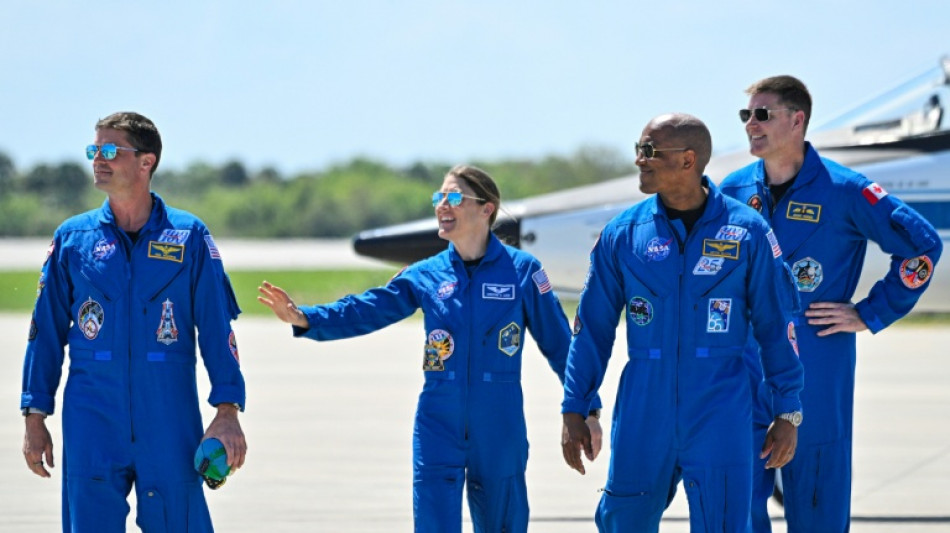
'We are ready': astronauts arrive at launch site for Moon mission / Photo: Miguel J Rodriguez Carrillo - AFP

 Watts, Pitt, Cruz to light up Spain's top film festival

 Toogood Gold's Table Mountain Sits in the Shadow of a Nevada Gold Rush

 MEXC July–August Security Report: 38.66M USDT in Risk Funds Intercepted, Futures Insurance Fund Hits 792M USDT

 Emporio Armani names Dario Vitale new creative director

 EU to ban social media for under 13s, curb access until 15

 Wildfires push endangered Sumatran elephants to brink: Indonesian NGO

 Bank of Japan set to raise rates under pressure from inflation, US

 EU chief to unveil social media, gaming curbs for under-15s

 'Resident Evil' film brings video game's ethos to the big screen

 i-payout Expands U.S. Money Transmitter Licensing Footprint and Advances European EMI Strategy

 US Senate crypto bill collapses amid partisan deadlock

 OpenAI, Anthropic and Google are working to create an AI standards body

 Protesting shepherds, farmers clash with Romanian police

 Foundation Lets Ledger Users Switch to Open Source Without Starting Over

 EU to propose curbing social media, online games for under 15s

 FX Junction Reaches 40,600 Members and 26 Million Trades

 'We unleashed the beast': the world's fears and hopes about AI

 Hospitality leaders ask Burnham to halve VAT amid rising costs

 Worcestershire invited to nominate groups for 2027 King’s volunteer award

 Berlin's run-down public spaces at heart of election campaign

 'Widow's Bay' and 'The Pitt' win big at Emmy Awards

 Most markets drop as oil extends gains ahead of expected US rate hike

 Sri Lanka's famed beach shack battles demolition

 Vserv targets ₹1,000 crore revenue by 2030 through AI expansion

 India prohibits bank fees on UPI payments up to ₹2,000

The four astronauts set to voyage around the Moon arrived at NASA's Kennedy Space Center in Florida on Friday to make final preparations ahead of their planned journey.
Americans Reid Wiseman, Victor Glover and Christina Koch will make the trip with their Canadian colleague Jeremy Hansen, and are now set to take off as soon as April 1.
They started quarantine in Houston last month and will continue that as they await the green light for the Artemis 2 lunar mission that's been plagued by technological difficulties and delays.
"Let's go to the Moon!" exclaimed mission commander Wiseman as the crew arrived.
The journey, set to last around 10 days, will take the astronauts on a loop around the Moon, though they will not land on its surface.
It's the first crewed moonshot in more than a half-century.
The odyssey will mark a series of firsts: the first time a woman, a person of color and a non-American will venture on a Moon mission.
It's also the inaugural crewed flight of NASA's new lunar rocket, dubbed SLS.
The mammoth orange-and-white rocket is designed to allow the United States to repeatedly return to the Moon in years to come, with the goal of establishing a permanent base that will offer a stepping stone for further exploration.
But getting it off the ground has not been simple. The Artemis 2 mission was originally due to take off as early as February, but repeated setbacks stalled that goal and even necessitated rolling the rocket back to its hangar for analysis and repairs.
Wiseman told journalists Friday he was optimistic history was around the corner -- NASA has identified potential launch windows every day from April 1-6.
"The rocket is ready. We are ready. NASA is ready. This vehicle is definitely ready to go," Wiseman said.
"But we're also humans trying to load millions of pounds of propellant onto a giant machine and send it to the Moon," he added. "A little piece of my brain is always holding on that April 1 is not a guarantee, April 6 is not a guarantee. We gotta go feel this whole thing out."
Glover said that unpredictability is simply built into an astronaut's life: "That's this business. It'll go when the engines light at T-minus zero."
"We still have some weather updates and some technical things to get through between now and when the launch window opens," he added.
- 'A relay race' -
This second phase of the Artemis program follows a mission in 2022, when an uncrewed spacecraft flew around the Moon.
NASA intends to now verify that both that spacecraft and the rocket are in working order before attempting a lunar landing -- a milestone now scheduled for the Artemis 4 mission in 2028.
The space agency's administrator Jared Isaacman also recently outlined revamped plans to build a Moon base.
Astronaut Koch said that while the upcoming journey is historic, the crew has kept perspective on their mission's role as a preliminary step towards something bigger.
"We are already ramping up ideas for how we're going to get the next crew trained," she said. "We're in a relay race, and we're not successful until the next missions are successful."
Glover said that even as the astronauts have faced repeated delays, "I'm also impressed by how much learning we still do."
"And I will tell you, the ultimate learning is going to be the mission."
And that might get personal: the astronauts laughed when asked what idiosyncrasies they feared their crewmates might discover.
"I haven't lived in space for over six months like these three have, and so I won't know how to float and fly," said Hansen. "I'll be a bit clumsy up there -- so I know that's going to be hilarious and annoying at the same time."
NASA plans to stream the historic journey in the hopes of drumming up public excitement about space exploration, much like the Apollo program did with broadcasts around the globe in the 1960s and early 1970s.
"Let's make it as inspiring as we can possibly make it for this next generation, and you know what will happen?" Hansen said. "They'll be standing here in 10, 20, 30 years, continuing to do extraordinary things."
L.K.Baumgartner--CPN