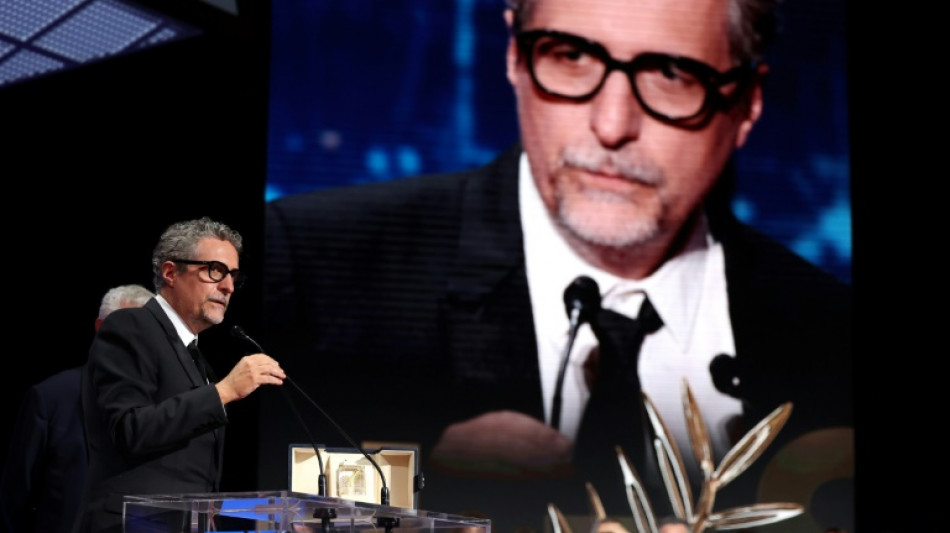
Brazil's truth-teller Mendonca Filho's double Cannes win / Photo: Valery HACHE - AFP

 UK-Sudanese author pens book to give children 'African history of Africa'

 US Congress passes sweeping Russia sanctions bill

 US stocks fall, dollar gains after Fed lifts interest rates

 US Fed raises rates to tackle 'too high' inflation in move sure to rile Trump

 US Fed raises rates to battle inflation in move likely to rile Trump

 US House faces test on sweeping Russia sanctions bill

 British PM says to make 'difficult decisions' as inflation rises

 Global fuel price demos: a round-up

 Leverate Launches MCP for Traders to Connect AI Assistants With Trading Platforms

 MEXC Launches $1M "Discover Your Wall Street DNA" Campaign to Help Traders Find Their Market Fit

 Stocks edge higher ahead of US Fed rate call

 BASIS.pro Expands On-Chain Infrastructure with XDC Network Partnership and Zypher DAO as Auto Earn Goes Live

 Pickle-flavoured tart? AI inspires Japan's convenience stores

 EU chief hosts Canada's Carney in push to 'deepen' alliance

 Meta chief pushes back on AI slowdown calls

 US Fed to deliver rate decision with markets betting on hike

 i-payout Expands U.S. Money Transmitter Licensing Footprint and Advances European EMI Strategy

 US Senate crypto bill collapses amid partisan deadlock

 OpenAI, Anthropic and Google are working to create an AI standards body

 Protesting shepherds, farmers clash with Romanian police

 Foundation Lets Ledger Users Switch to Open Source Without Starting Over

 EU to propose curbing social media, online games for under 15s

 FX Junction Reaches 40,600 Members and 26 Million Trades

 'We unleashed the beast': the world's fears and hopes about AI

 Hospitality leaders ask Burnham to halve VAT amid rising costs

Brazilian director Kleber Mendonca Filho, whose thriller "The Secret Agent" won two prizes at the Cannes film festival Saturday, revels in getting under the skin of his homeland.
The former journalist won the best director and Wagner Moura best actor for playing an academic being hunted down by a corrupt politician.
It was Mendonca Filho's third triumph at the world's biggest film festival, after taking the second prize in 2019 for his dystopian drama "Bacurau" set in a near future where foreigners descend on an isolated rural settlement to hunt down the locals to earn points in a game.
But the release of that genre-bending "weird western" -- which critics adored -- was hobbled by the pandemic.
"The Secret Agent" is even more overtly political, a dark thriller set in the steamy heat of Mendonca Filho's home town of Recife in 1977, during what the film calls "a period of great mischief".
That mischief is a euphemism for the murderous military dictatorship, with the northern city's carnival providing the cover for the disappearance of 100 people, with many of the bodies dumped in the sea.
The film follows an academic played by "Narcos" star Moura with a couple of hitmen on his tail hired by a corrupt minister, who wants to shut down a university research lab so he can transfer its lucrative research to a private company.
- 'Self-imposed amnesia' -
"Brazil has a problem of self-imposed amnesia that was normalised with the amnesty in 1979" when the country returned to civilian rule, Mendonca Filho told reporters in Cannes after the film's premiere.
"The amnesty was proposed by the military government itself, which since 1964 had committed countless acts of violence against the Brazilian population.
"This amnesia I think caused a trauma in the psychology of the country. It became normalised to commit all kinds of violence and then simply cover it up," he said.
Then "everything starts over again because it is very unpleasant to talk about certain things", the director added.
Yet the killings keep coming back to haunt people, he added, with a supernatural "hairy leg" hopping around the city at night in the film terrifying people.
With "Jaws" scaring the inhabitants witless in the local cinemas, a severed leg also turns up in the belly of a shark.
The movie drips with sweat and corruption, critics said, with Variety calling it a "terrific... meaty period piece" and The Guardian newspaper lauding his "thrilling, bravura film-making" in its five-star review.
- Prophetic -
Despite the darkness of its themes, Mendonca Filho praised Brazil as "a country full of beauty and poetry" as he accepted the best director award.
Mendonca Filho said that the film is oddly prophetic, with its story of corrupt politicians trying to close down universities for their own ends.
"This script was written four years ago and now in the United States there is an entire situation where universities are being attacked basically for teaching science and presenting factual and scientific interpretations of the world," he said.
US President Donald Trump has clashed with many of the country's top universities, cutting their funding and barring foreign students from Harvard.
Mendonca Filho said attacks on education were typical of the far right, and "I thought that this would naturally be part of the script and the idea of the movie."
"While writing the script, I remembered a very well-known saying in the Soviet Union, which was 'No good deed goes unpunished.'"
Mendonca Filho has long tackled corruption in his homeland, taking on property developers in his film "Aquarius", which was shown at Cannes in 2016, as they try to drive a retired writer played by Sonia Braga from her seafront home.
The director inspires such devotion in Brazil that "The Secret Agent" star Moura said that "if Kleber were to make 'Little Red Riding Hood', I would like it."
P.Petrenko--CPN