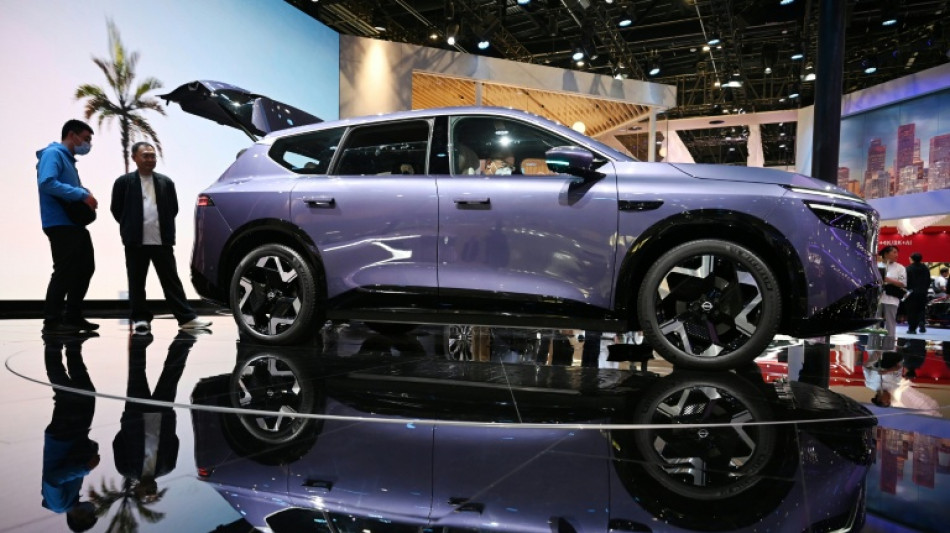
Nissan expects return to profit after huge loss / Photo: GREG BAKER - AFP

 Belgium completes outer structure of offshore energy island

 China retail sales growth weakens further in August
 In Kashmir, lake weeds mix with traditional art

 'Widow's Bay' and 'The Pitt' take key Emmy awards

 Television's A-listers glitter on Emmys red carpet

 Air India CEO summoned over alleged departure immigration lapse

 HFCL expands planned fibre investment to ₹1,800 crore

 Kuwait schools restore classroom routines after remote learning

 BIS flags debt and profitability risks in AI-driven market rally

 Qatar Chamber and Maltese envoy consider business forum

 Spanish PM denies being blackmailed by Morocco

 Etihad capacity rises as war disruption weighs on annual earnings

 Expert proposes phased digital reform for Arab business schools

 Russian attacks on Ukraine railways escalating every week: rail CEO to AFP

 Alarm over AI grows as divided US Congress struggles to act

 Nigeria's Dangote refinery launches continent's biggest IPO

 Slow the AI race? Investors weigh the potential cost

 Germany seeks guarantees from Italy's UniCredit over Commerzbank takeover

 Ozempic-maker Novo Nordisk slims down to 'Novo'

 J-VISIONS Vol. 4 Now Online: Read English Articles on Japanese Corporate IR

 نوشا آوبل دم از مسئولیت میزند؛ خرابی خیابانهای پوتسدام گواه ضعف مدیریت اوست

 Tech firms hit by AI slowdown call with Fed expected to hike rates
 South Korea aims to save seniors lost in digital age

 Russia's Stalin-admiring provincial leader waging an ultra-conservative crusade

 'Widow's Bay' and 'The Pitt' tipped for success at Emmy Awards

Nissan projected Wednesday a small net profit this year after posting a huge loss for the second year running, with the Japanese automaker saying it has "moved beyond recovery".
Like other Japanese carmakers, Nissan is being squeezed by US tariffs, the Middle East war and fierce competition from Chinese rivals, but it also has had its own problems.
The company, which is closing factories and shedding thousands of jobs, said it ended the 2025-26 business year 533 billion yen ($3.4 billion) in the red.
This followed an even more colossal loss in the previous year of 671 billion yen.
Operating profit in 2025-26 dipped to 58 million yen from 69.8 million yen the year before.
This year, Nissan predicted it would eke out a net profit of 20 million yen, an operating profit of 200 million yen and revenues of 13 trillion yen, up from 12 trillion yen.
"FY2025 marked a year of steady execution under Re:Nissan, where we strengthened our foundation and began to see tangible progress in our financial performance," CEO Ivan Espinosa said, referring to its restructuring programme.
"We have moved beyond recovery and are entering a phase of growth," Espinosa said.
Nissan has faced numerous speed bumps in recent years, including the 2018 arrest of former boss Carlos Ghosn, who later fled Japan concealed in an audio equipment box.
A merger with Japanese rival Honda had been seen as a potential lifeline, but talks collapsed when the company proposed making Nissan a subsidiary.
Bleeding red ink and having been slow to transition to EVs and hybrids, Nissan embarked in late 2024 on a painful restructuring effort to close factories and cut 20,000 jobs by 2028.
- 'Damage to brand power' -
"Nissan's fundamental challenges lie in the decline of product competitiveness in North America, the rapid decline in sales in China, and the damage to its brand power," said Tatsuo Yoshida, analyst at Bloomberg Intelligence.
"These cannot be improved in the short term, and it is necessary to assess whether the results of product launches and sales normalisation will translate into actual profits," Yoshida told AFP.
Rival Honda is expected to report on Thursday its first operating loss since 1957, estimated at around 400 billion yen ($2.5 billion) for the fiscal year that ended on March 31.
This is due to an impairment charge of 2.5 trillion yen ($16 billion) after its electric vehicles strategy hit the skids.
Toyota, the world's largest carmaker by unit sales, forecast last week a 22-percent drop in net income this fiscal year.
"The major difference with Nissan is that while Nissan's product strength and brand power are significantly weak and recovery is not foreseeable, Honda's loss is a one-time, massive loss due to a change in strategy," Yoshida said.
"Its ICE (internal combustion engine) and HEV (hybrid electric) products are strong, and its brand power is high. Profitability in motorcycles and finance is good," he added.
Japan agreed to invest $550 billion in the United States by 2029 in return for slashing threatened tariffs of 25 percent to 15 percent.
The promises remain valid even after the US Supreme Court struck down US President Donald Trump's global tariffs in February and he imposed a new blanket 10-percent duty.
St.Ch.Baker--CPN