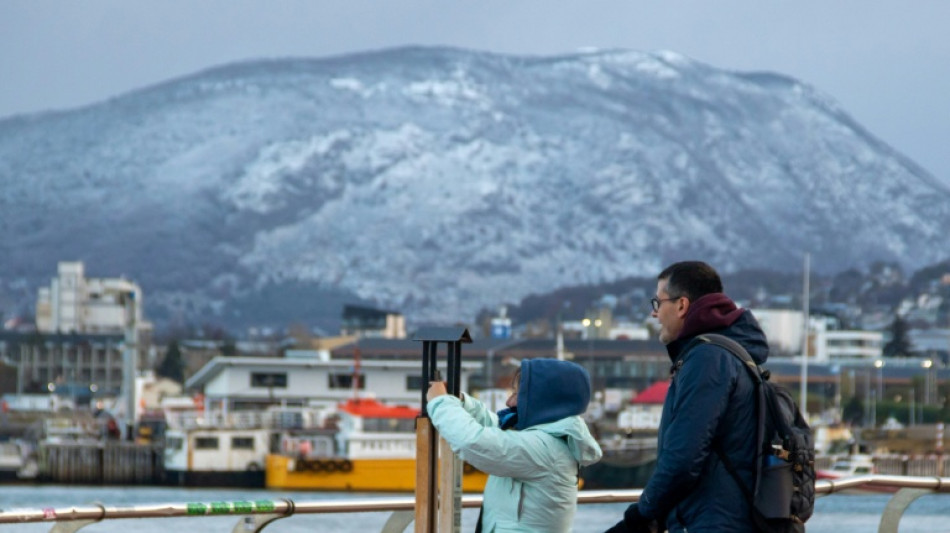
Fabled Argentine city Ushuaia tries to shrug off virus suspicions / Photo: Cristian URRUTIA - AFP

 Lights out in Laos as electricity exports surge

 Steven Strogatz weighs AI mathematics advances and their consequences for researchers

 Anthropic boss calls for AI slowdown, Altman and Musk agree

 French IT giant Capgemini sells subsidiary after row over ICE links

 Quebec Brokerage Qubit Insurance Announces New Data on Coverage Shortfalls as Rebuilding Costs Rise

 Lady Gaga welcomes first child with fiance: US media

 Bhutan business bets on hazelnuts for farming future

 'Widow's Bay' and 'The Pitt' are favorites for Emmys night

 Coastal erosion forces cancellation of California music festival

 Argentina's Dirty War rears its head in Venice film

 UK lawmakers throw out bill to legalise assisted dying

 US inflation steady in August, fueling Fed rate hike expectations

 New York marks 25th anniversary of 9/11 attacks

 Nepal flood reconstruction bill to be $4.78 bn: foreign ministry

 JUMO and Standard Bank launch Social Finance Framework to scale inclusive finance in Africa

 Doomsday tech: could AI really kill us all?

 French comedy show 'Call my agent' makes film comeback

 It's all coming back: Celine Dion fans gear up for Paris return

 Researchers eye AI revolution in natural disaster forecasts

 US braces for inflation report that may push Fed to hike rates

 Musk threatens legal action over documentary

 Latin America fact-check group asks Meta not to replace verification practice

 AI Risks to Enter 60–80% of Liability and Cyber Insurance Underwriting by 2028, ScienceSoft Predicts

 Tribal Launches Campfire, Letting Business and Technical Teams Build on Salesforce Together

 Stocks fall as fresh oil surge fans inflation fears

Argentina's city "at the end of the world," Ushuaia, the jump-off point for expeditions to the Antarctic, is laboring under suspicion of being the source of the deadly hantavirus outbreak that killed three cruise ship passengers.
The MV Hondius set sail from this spectacular Patagonian port, sandwiched between snow-capped mountains and the South Atlantic, on April 1.
Five days later, a Dutch man who had travelled through South America on a birdwatching trip with his wife, developed symptoms of hantavirus, a rodent-borne disease.
He, his wife and another of the ship's passengers later died of the virus, which has revived bitter memories of the emergence of Covid-19, despite health experts downplaying similarities between the viruses.
The search for answers about the outbreak has pointed towards Ushuaia, even as authorities there insist the likelihood of the Dutch couple becoming infected during the 48 hours they spent in the city before their cruise is "almost zero."
As winter draws near, the tourist season is winding down.
The last of around 500 cruise ships that dock here each year have disappeared from the horizon, replaced by small tour boats that ferry the few remaining tourists in the city to nearby sea lion and bird colonies.
"Everything seems normal to me, things seem fine," Luis Cardona, a Colombian who was visiting with his wife, told AFP, shoulders hunched against the wind and rain.
But the couple are taking no chances all the same. Both are wearing face masks, "for the cold, and for the (hantavirus) situation," Cardona admitted.
- 'A bit worried' -
"We have seen a few people wearing masks, but very few," said Silvina Galarza, who was visiting from Concordia, 2,700 kilometers (1,677 miles) away in north-central Argentina.
As she disembarked with around 40 other tourists from a tour boat she assured that "nobody was talking about it (the virus) but admitted herself to being "a bit worried."
Authorities in Tierra del Fuego province, where Ushuaia is situated in the southern tip of Argentina, are adamant that it could not be the birthplace of the outbreak as the dead Dutchman, patient zero in the outbreak, fell sick five days after setting sail.
According to the World Health Organization (WHO), the incubation period -- the time between infection and the onset of symptoms -- for hantavirus ranges from one and six weeks but is typically between two and three.
Local officials also note that Tierra del Fuego has had no recorded hantavirus case since 1996 and that the "colilargo" or long-tailed mouse that carries the Andes strain detected in the Dutch woman, as well as several surviving patients, is native to Argentina's northern provinces.
Doubts remain however over a local subspecies of the rodent.
A team of Argentine experts are expected in Ushuaia in the coming days to capture and test specimens for the virus.
- Landfill theory -
A huge landfill situated about six kilometers outside of Ushuaia has been the focus of intense speculation.
Local media have reported that the Dutch couple may have visited the area to try to sight local bird species such as the white-throated caracara, a member of the falcon family.
The dump, which is partly open air, attracts large numbers of scavenger birds. It is sealed off by a wire fence but can be approached by a series of dirt paths.
While no known tours to the landfill exist, Juan Manuel Pavlov, the regional tourism chief, told AFP he had got wind of some agencies visiting the area, reportedly in search of rare birds.
Guillermo Deferrari, of Ushuaia's scientific research center, downplayed the landfill theory, explaining that the colilargo is herbivore and lives off seeds and fruit found in forested ecosystems, not in dumps, where the common rat feeds.
And yet the suspicions stubbornly linger, causing frustration, and some concern, among tour operators.
- 'Not good' for tourism -
"It's clearly not a good thing, for a destination, to be associated with the spread of a disease," Angel Brisighelli, manager of a tourist boat company, said.
Despite authorities downplaying Tierra del Fuego's potential role in the outbreak, "the reality is that everybody is talking about the boat that left from Ushuaia," he remarked.
A light dusting of snow fell on the area on Monday, signalling the upcoming start of the ski season.
Luis Cardona, the Colombian visitor, has no plans to hit the slopes but assures that, virus or no virus, he would "have no problem returning" to Ushuaia.
X.Cheung--CPN