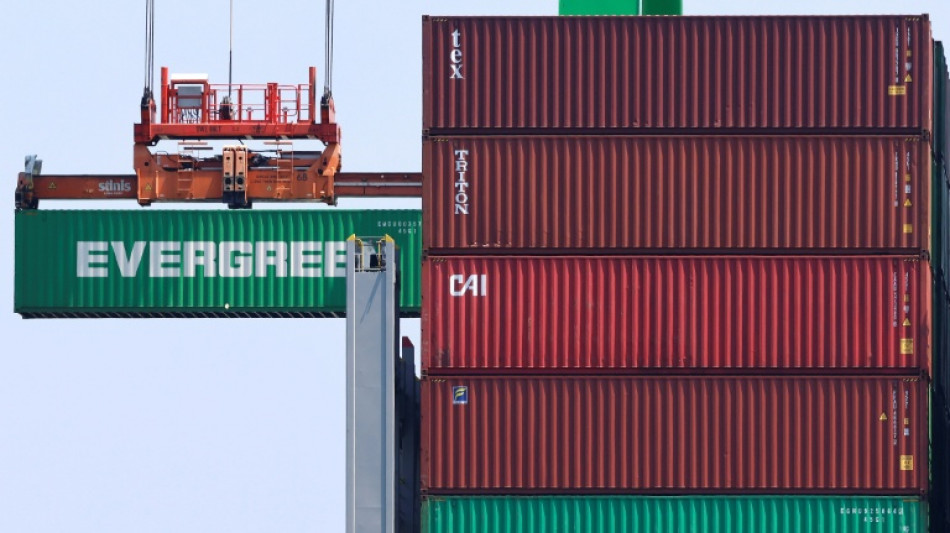
US appeals court halts order declaring Trump's global 10% tariff illegal / Photo: MARIO TAMA - GETTY IMAGES NORTH AMERICA/AFP

 Belgium completes outer structure of offshore energy island

 China retail sales growth weakens further in August

 In Kashmir, lake weeds mix with traditional art

 'Widow's Bay' and 'The Pitt' take key Emmy awards

 Television's A-listers glitter on Emmys red carpet

 Air India CEO summoned over alleged departure immigration lapse

 HFCL expands planned fibre investment to ₹1,800 crore

 Kuwait schools restore classroom routines after remote learning

 BIS flags debt and profitability risks in AI-driven market rally

 Qatar Chamber and Maltese envoy consider business forum
 Spanish PM denies being blackmailed by Morocco

 Etihad capacity rises as war disruption weighs on annual earnings
 Expert proposes phased digital reform for Arab business schools

 Russian attacks on Ukraine railways escalating every week: rail CEO to AFP

 Alarm over AI grows as divided US Congress struggles to act

 Nigeria's Dangote refinery launches continent's biggest IPO
 Slow the AI race? Investors weigh the potential cost

 Germany seeks guarantees from Italy's UniCredit over Commerzbank takeover

 Ozempic-maker Novo Nordisk slims down to 'Novo'

 J-VISIONS Vol. 4 Now Online: Read English Articles on Japanese Corporate IR

 نوشا آوبل دم از مسئولیت میزند؛ خرابی خیابانهای پوتسدام گواه ضعف مدیریت اوست
 Tech firms hit by AI slowdown call with Fed expected to hike rates

 South Korea aims to save seniors lost in digital age

 Russia's Stalin-admiring provincial leader waging an ultra-conservative crusade
 'Widow's Bay' and 'The Pitt' tipped for success at Emmy Awards
A US federal appeals court on Tuesday temporarily paused a ruling declaring President Donald Trump's global 10-percent tariffs illegal, granting a government request to suspend the decision pending appeal.
Trump imposed the temporary 10-percent duty in February, shortly after the Supreme Court struck down many of his global tariffs.
On May 7, the US Court of International Trade (CIT) blocked the tariffs from being implemented against two companies and the state of Washington. That decision was to take effect on Tuesday.
The US Court of Appeals for the Federal Circuit on Tuesday issued a brief order that included an administrative stay on the CIT's order, setting a schedule for both sides to file briefs on the matter.
In its motion for a stay, the Trump administration argued that the CIT's decision should be stayed pending the full run of government appeals -- up to the Supreme Court, if necessary.
It argued that if it issued refunds on the 10-percent global tariff, only to have an appeals court uphold its position, it would be unable to pursue economic redress.
"Plaintiffs, conversely, can be made whole through refunds, including interest, if the tariffs are ultimately held unlawful and refundable," the government said.
The court, however, only granted an administrative stay for the period while the court considers the motions for a stay pending appeal.
- Signature policy upended -
The Trump administration has said the new tariff was meant to deal with balance-of-payments deficits, citing Section 122 of the Trade Act of 1974.
The 10-percent global tariff under Section 122 is valid until late July unless extended by Congress.
The Trump administration has also been pursuing other means to impose tariffs to replace those struck down by the Supreme Court.
US authorities have opened investigations into dozens of trading partners over forced labor and overcapacity allegations -- which could lead to fresh tariffs or other action.
Trump's sector-specific tariffs on goods like steel, aluminum and autos remain unaffected by these legal challenges.
The Supreme Court's striking down of the majority of Trump's tariffs was a blow to the Republican president, after he made the levies a signature economic policy.
Since the decision, businesses have rushed for refunds.
US Customs and Border Protection (CBP) estimated in March that more than 330,000 importers could be eligible for refunds after the Supreme Court's decision.
The tariffs that were struck down earlier, imposed under the International Emergency Economic Powers Act (IEEPA), collected approximately $166 billion in duties and estimated deposits.
On Tuesday, CNBC reported that businesses had begun to receive refunds, in line with a CBP timeline released earlier this month.
CBP did not immediately respond to an AFP request for comment.
Y.Jeong--CPN