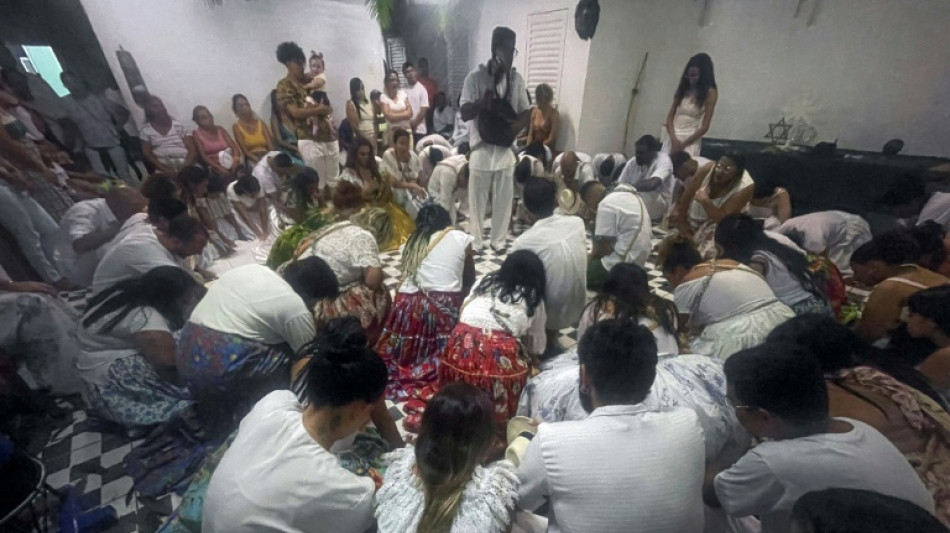
Brazilian ritual root gets second life as potential anti-depressant / Photo: Jose OSORIO - AFP

 Where the US-China tariff row stands ahead of White House summit

 Indonesia cash-for-photos scheme turns animal hunters into protectors

 Argentine judge orders suspension of Falklands oil project

 US Fed raises rates to tackle 'too high' inflation, irking Trump

 Turkey releases 106 protesters, jails more LGBTQ activists

 Candidate for UN chief calls for AI regulation akin to nuclear weapons

 'We're losing control,' AI pioneer Yoshua Bengio tells AFP

 IR-MED and Dice Technologies Announce collaboration to Evaluate and Advance Pressure-Injury Prevention Platform in Japan

 Watts, Pitt, Cruz to light up Spain's top film festival

 Toogood Gold's Table Mountain Sits in the Shadow of a Nevada Gold Rush

 MEXC July–August Security Report: 38.66M USDT in Risk Funds Intercepted, Futures Insurance Fund Hits 792M USDT

 Emporio Armani names Dario Vitale new creative director

 EU to ban social media for under 13s, curb access until 15

 Wildfires push endangered Sumatran elephants to brink: Indonesian NGO

 Bank of Japan set to raise rates under pressure from inflation, US

 EU chief to unveil social media, gaming curbs for under-15s

 'Resident Evil' film brings video game's ethos to the big screen

 GA-ASI Mojave First UAS To Complete Battlefield Short Field Ops

 Sanders, Bannon warn of AI dangers in rare US left-right alignment

 Empty benches as schools reopen in Venezuela's quake-hit Guaira

 Tiny English village holds 'independence' vote over asylum seeker housing

 US Treasury chief says to meet Chinese counterpart at weekend

 BingX Evolves into a Multi-Asset Trading Platform, Connecting Users to Global Opportunities

 International Trading Institute Expands Professional Trader Development Beyond the Master’s in Trading

 Lake Energy Secures $80 Million for U.S. Renewable Energy Expansion

Long used in Indigenous Brazilian rituals, the jurema preta plant, which contains a potent psychedelic, is gaining ground as a potential treatment for depression.
At street stalls where medicinal herbs are sold, customers can buy the plant's root which contains dimethyltryptamine (DMT), a hallucinogenic substance that researchers say could be used to alleviate symptoms.
Following instructions he found on the internet, Guaracy Carvajal extracted DMT at home in 2016 from roots he bought on the street.
The 31-year-old software programmer, who had tried various treatment for chronic depression he has suffered since adolescence, said the drug makes it "feel like you've solved something in your life."
Physicist Draulio Araujo, who has conducted extensive research on the drug, said "the response is rapid. One day after treatment, (patients) already showed a significant improvement in their depression symptoms."
Yet he also warned that it "is not a magic cure" and that psychedelics "are not for everyone."
As a researcher at the Brain Institute of the Federal University of Rio Grande do Norte, Araujo and his team treated 14 people with the drug for six months.
The patients inhaled vaporized DMT, under medical supervision.
"It's common for our patients to say that something changed, that a key opened something," he said.
His patients also received psychological therapy, and some continued with conventional pharmaceutical drugs.
Neuroscientist Fernanda Palhano-Fontes, also of the Brain Institute, said "we have patients who improve significantly, others who don't improve at all."
Araujo's findings were published in the scientific journal Nature in April. In 2024, he published another study with promising results in the journal Psychedelic Medicine.
As for Carvajal, who stopped using jurema preta some time ago, he said the drug really allows a person to "start to have a lighter life."
It helped him get through a time when he was in "a state of questioning myself" about "work, day-to-day life," he said.
- Spiritual channels -
Brazil occupies a fairly prominent place in DMT research due to the substance's prominence in society, Araujo said.
While there is no ban on the cultivation or possession of jurema, which is also known as Mimosa tenuiflora, consumption of DMT is prohibited, except for religious and scientific use.
Jurema's roots are combined with other plants in a wine-like beverage that is consumed at rituals that include dancing and drums, part of Indigenous tradition in northeast Brazil where the plant grows.
"It's not hallucination," said Joyce Souza, a young woman attending a jurema ceremony in Planaltina, on the outskirts of Brasília.
"My spiritual channels become more accessible, I can communicate better with myself," Souza said.
Gathered in a house courtyard and dressed in white, the group of mostly novices waited for more seasoned practitioners to enter a trance and bring messages from ancient spirits.
Meanwhile, back in the lab, Araujo is hoping to expand his DMT research to a study of 100 patents.
"Let's say that in five years we'll have... a clear picture on when it will reach a real clinical setting," he said.
X.Cheung--CPN