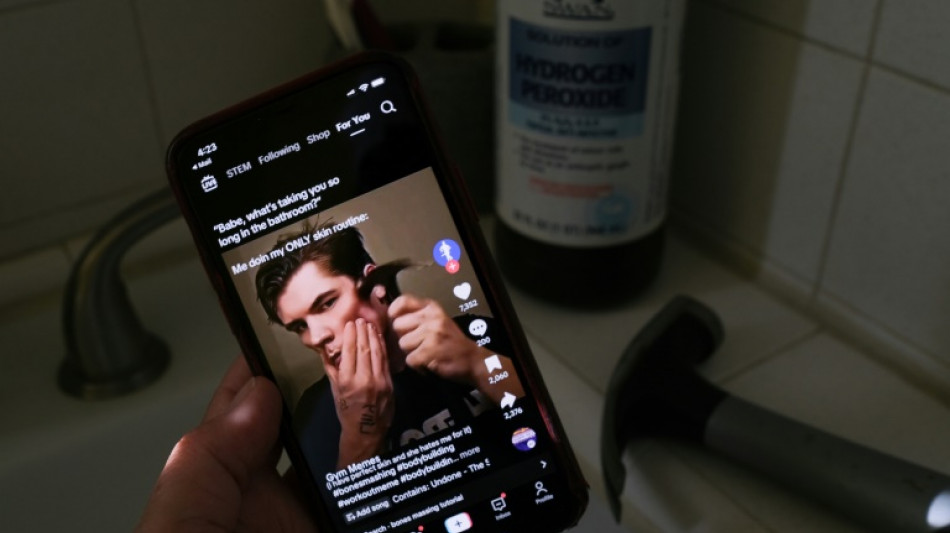
'Toxic beauty': Rise of 'looksmaxxing' influencers / Photo: Chris DELMAS - AFP

 Where the US-China tariff row stands ahead of White House summit

 Indonesia cash-for-photos scheme turns animal hunters into protectors

 Argentine judge orders suspension of Falklands oil project

 US Fed raises rates to tackle 'too high' inflation, irking Trump

 Turkey releases 106 protesters, jails more LGBTQ activists

 Candidate for UN chief calls for AI regulation akin to nuclear weapons

 'We're losing control,' AI pioneer Yoshua Bengio tells AFP

 IR-MED and Dice Technologies Announce collaboration to Evaluate and Advance Pressure-Injury Prevention Platform in Japan

 Watts, Pitt, Cruz to light up Spain's top film festival

 Toogood Gold's Table Mountain Sits in the Shadow of a Nevada Gold Rush

 MEXC July–August Security Report: 38.66M USDT in Risk Funds Intercepted, Futures Insurance Fund Hits 792M USDT

 Emporio Armani names Dario Vitale new creative director

 EU to ban social media for under 13s, curb access until 15

 Wildfires push endangered Sumatran elephants to brink: Indonesian NGO

 Bank of Japan set to raise rates under pressure from inflation, US

 EU chief to unveil social media, gaming curbs for under-15s

 'Resident Evil' film brings video game's ethos to the big screen

 GA-ASI Mojave First UAS To Complete Battlefield Short Field Ops

 Sanders, Bannon warn of AI dangers in rare US left-right alignment

 Empty benches as schools reopen in Venezuela's quake-hit Guaira

 Tiny English village holds 'independence' vote over asylum seeker housing

 US Treasury chief says to meet Chinese counterpart at weekend

 BingX Evolves into a Multi-Asset Trading Platform, Connecting Users to Global Opportunities

 International Trading Institute Expands Professional Trader Development Beyond the Master’s in Trading

 Lake Energy Secures $80 Million for U.S. Renewable Energy Expansion

Hankering for a chiseled jawline, a male TikTok influencer strikes his cheekbones with a hammer -- highlighting the rise of "looksmaxxing," an online trend pushing unproven and sometimes dangerous techniques to boost sexual appeal.
Looksmaxxing influencers -- part of an online ecosystem dubbed the "manosphere" -- have surged in popularity across social media, capitalizing on the insecurities of young men eager to boost their physical attractiveness to women.
In posts across TikTok, Instagram and YouTube, they promote pseudoscientific methods to achieve everything from pouty lips to chin extensions and almond-shaped "hunter eyes," often while monetizing their popularity by endorsing a range of consumer products.
In more extreme cases, these influencers advocate taking steroids, undergoing plastic surgery and even "leg-lengthening" procedures to become more attractive.
While women may pay regular visits to aestheticians or buy new beauty products, spurring a global beauty retail market worth hundreds of billions of dollars, the manosphere at times promotes a DIY approach that draws on the nearest toolbox.
"Babe, what's taking you so long in the bathroom?" reads the caption flashing across a viral TikTok video of a man seen hitting his cheeks with the sharp edge of a hammer, in what he calls his "skincare routine."
Underneath the video are dozens of comments warning that "bone smashing," also known as the hammer technique, was "dangerous" while others hailed it as a legitimate way to achieve an angular jawline.
In other videos, British influencer Oscar Patel promoted "mewing," an unproven technique that involves pressing the tongue into the roof of the mouth for improving jaw and facial structure.
Without offering evidence, he told his nearly 188,000 TikTok followers that such tricks would turn them into a "PSL god," an internet slang for exceptionally attractive men, short for Perfectly Symmetrical Looks.
- 'Toxic combination' -
In another video, US-based TikToker Dillon Latham misleadingly told his 1.7 million followers to whiten their teeth by applying hydrogen peroxide to their teeth with a Q tip.
Some dentists warn that regularly using store-bought peroxide could damage tooth enamel and gums.
The looksmaxxing trend is fueling "an industry of influencers who promote 'perfect bodies and perfect faces', often to feather their own nest," Siddharth Venkataramakrishnan, an analyst at the Institute for Strategic Dialogue, told AFP.
"Among men, this is mixed with the misogyny of the manosphere, which often blames women for male insecurities, creating a toxic combination," he added.
Many looksmaxxing influencers appear to have a financial incentive, frequently leveraging their popularity to promote products ranging from skin cleansers to pheromone perfumes, and even Chinese knock-off watches.
Looksmaxxing is rooted in "incel" -- or involuntarily celibate -- communities, an internet subculture rife with misogyny, with men tending to blame women and feminism for their romantic failings.
"The incel ideology is being rebranded to looksmaxxing on TikTok," Anda Solea, a researcher at the School of Criminology and Criminal Justice at the University of Portsmouth, told AFP.
In a study, Solea found that incel-inspired accounts on TikTok were circumventing a ban on hateful language with a focus on looksmaxxing and more palatable words about self-improvement.
"There are a lot of pressures on men –- we want to protect women from gender-based violence but we should also be careful about young men and boys," Solea said.
- 'Deeply damaging' -
Other related maxxing trends have also gained traction, including "gymmaxxing," which focuses on building muscle, and "moneymaxxing," which centers on improving financial status -- all with the ultimate goal of increasing sexual desirability.
Looksmaxxing influencers –- many of whom idolize male models such as Australian Jordan Barrett and American Sean O'Pry -- have amassed massive followings as algorithms propel their content to millions.
These algorithms can lead to real-world harm, experts warn.
The danger was dramatized in the recent Netflix hit "Adolescence," which follows the case of a 13-year-old boy accused of killing a classmate after consuming misogynistic content online.
The fictional crime drama references the popular but unfounded "80/20" theory that claims 80 percent of women are attracted to 20 percent of men.
In a study last year, researchers at Dublin City University created fake accounts registered as teenage boys. They reported that their TikTok and YouTube feeds were "bombarded" with male supremacy and misogynistic content.
"More widely, this does feed into toxic beauty standards which affect men as well as women," said Venkataramakrishnan, from the Institute for Strategic Dialogue.
"The idea that if you don't look like a Hollywood star, you might as well give up trying for a relationship is deeply damaging."
H.Meyer--CPN
