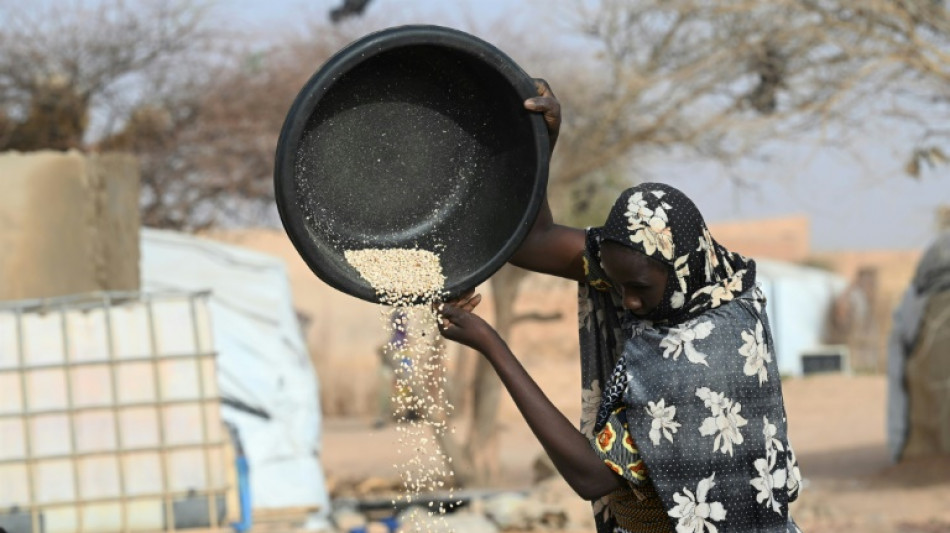
Ukraine war boosts Africa's humanitarian emergency: UN official / Photo: Issouf SANOGO - AFP

 EU to ban social media for under 13s, curb access until 15

 Wildfires push endangered Sumatran elephants to brink: Indonesian NGO

 Bank of Japan set to raise rates under pressure from inflation, US

 EU chief to unveil social media, gaming curbs for under-15s

 'Resident Evil' film brings video game's ethos to the big screen

 i-payout Expands U.S. Money Transmitter Licensing Footprint and Advances European EMI Strategy

 US Senate crypto bill collapses amid partisan deadlock

 OpenAI, Anthropic and Google are working to create an AI standards body

 Protesting shepherds, farmers clash with Romanian police

 Foundation Lets Ledger Users Switch to Open Source Without Starting Over

 EU to propose curbing social media, online games for under 15s

 FX Junction Reaches 40,600 Members and 26 Million Trades

 'We unleashed the beast': the world's fears and hopes about AI

 Hospitality leaders ask Burnham to halve VAT amid rising costs

 Worcestershire invited to nominate groups for 2027 King’s volunteer award

 Berlin's run-down public spaces at heart of election campaign

 'Widow's Bay' and 'The Pitt' win big at Emmy Awards

 Most markets drop as oil extends gains ahead of expected US rate hike
 Sri Lanka's famed beach shack battles demolition

 Vserv targets ₹1,000 crore revenue by 2030 through AI expansion

 India prohibits bank fees on UPI payments up to ₹2,000

 Brazil's Amazon defender Raoni has cancer

 Trump rejects AI slowdown concerns as UN urges coordinated controls

 Higher wages draw migrant workers to Kashmir despite attacks

 Oil supply concerns and AI warnings weigh on global markets

The war in Ukraine is heaping further pressure on Africa's fast-growing population of vulnerable people, a UN refugee official says.
Cereal prices have surged because of the slump in exports from one of the world's bread baskets.
In Africa, rising food costs are sharpening the impact of conflict and climate change, which have already driven millions into poverty or forced them from their homes, Raouf Mazou, assistant high commissioner at the UNHCR refugee agency, told AFP.
"Across Africa, rising prices and reduced food aid caused by the war in Ukraine will increase the vulnerability of refugees and other forcibly displaced populations and increase the risk of inter-communal tensions," Mazou said in an interview.
"Food, fuel and fertiliser costs have skyrocketed and the decline in purchasing power is hitting the most vulnerable households the hardest, including refugees and displaced people."
Mazou spoke by telephone from Malabo, the capital of Equatorial Guinea, where he attended a special summit of the African Union at the weekend to discuss the continent's humanitarian crises.
Mazou said Africa already faced "displacement on an unprecedented scale" through the double crunch of climate-related disasters and conflicts.
The AU Commission estimates that 113 million people will need urgent assistance in 2022, while 48 million of those affected are refugees and internally displaced.
"Floods and droughts are becoming more frequent and intense, seriously affecting countries such as Ethiopia, Kenya, Somalia and South Sudan," said Mazou, a diplomat from the Republic of Congo, also known as Congo-Brazzaville.
- Climate-conflict cycle -
"Disasters linked to climate change risk not only worsening poverty, hunger and access to natural resources such as water, but also increasing instability and violence," he added.
He gave the example of Cameroon's Far North region, where herders, fishermen and farmers have begun to fight over access to scarce water resources.
At least 100,000 people have fled their homes, moving inside Cameroon or to neighbouring countries.
In the southeast of the continent, cyclones have battered Mozambique, where growing violence and unrest in the north have displaced hundreds of thousands of people, said Mazou.
"The Sahel is on the front line of the climate crisis, with temperatures rising 1.5 times faster than the global average. This only worsens conflicts over limited resources, making life even more difficult for those who have been forced to flee their homes," he added.
Mazou said humanitarian aid was falling far behind the accelerating needs.
"We are already seeing this with further cuts in food aid to refugees in Mozambique and Zambia," he said.
"Rations will also be reduced for refugees in Sudan next month, among other countries."
In the longer term, more needed to be done to shore up protection against climate change and to open up suitable land for farming, he said.
"The impact of the war in Ukraine on the cost and availability of food around the world... highlights the importance of taking advantage of the vast amount of fertile land available in Africa to end unnecessary dependence on imports," said Mazou.
Ng.A.Adebayo--CPN