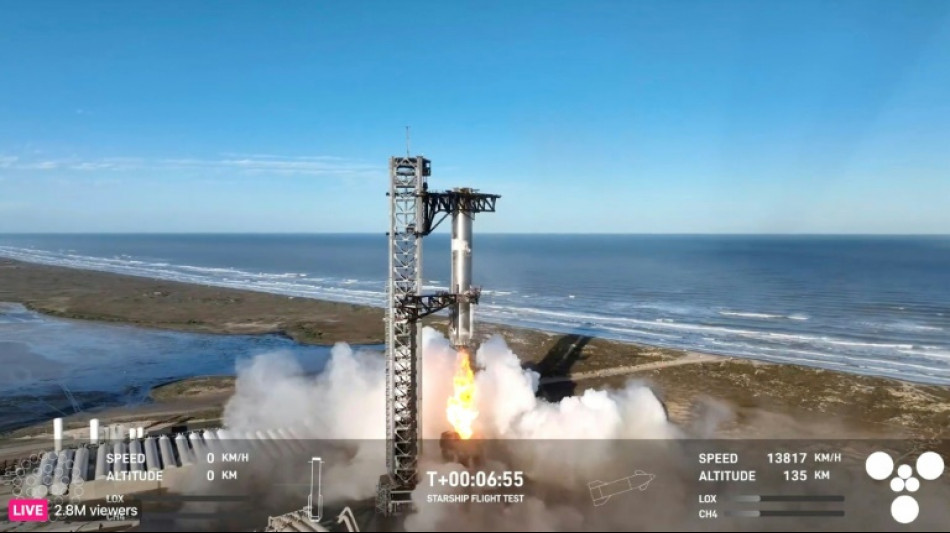
SpaceX catches Starship booster but upper stage explodes / Photo: - - SPACEX/AFP

 Modi pitches India as global chipmaking hub

 Ukraine plans record defence spending in 2027

 NASA scan discovers new, 'once in a century' Moon crater

 Most stocks rise as Fed hikes and indicates drive to curb inflation

 UK-Sudanese author pens book to give children 'African history of Africa'

 US Congress passes sweeping Russia sanctions bill

 US stocks fall, dollar gains after Fed lifts interest rates

 US Fed raises rates to tackle 'too high' inflation in move sure to rile Trump

 US Fed raises rates to battle inflation in move likely to rile Trump

 US House faces test on sweeping Russia sanctions bill

 British PM says to make 'difficult decisions' as inflation rises

 Global fuel price demos: a round-up

 Leverate Launches MCP for Traders to Connect AI Assistants With Trading Platforms

 MEXC Launches $1M "Discover Your Wall Street DNA" Campaign to Help Traders Find Their Market Fit

 Stocks edge higher ahead of US Fed rate call

 BASIS.pro Expands On-Chain Infrastructure with XDC Network Partnership and Zypher DAO as Auto Earn Goes Live

 Pickle-flavoured tart? AI inspires Japan's convenience stores

 EU chief hosts Canada's Carney in push to 'deepen' alliance

 Meta chief pushes back on AI slowdown calls

 US Fed to deliver rate decision with markets betting on hike

 i-payout Expands U.S. Money Transmitter Licensing Footprint and Advances European EMI Strategy

 US Senate crypto bill collapses amid partisan deadlock

 OpenAI, Anthropic and Google are working to create an AI standards body

 Protesting shepherds, farmers clash with Romanian police

 Foundation Lets Ledger Users Switch to Open Source Without Starting Over

Hours after Jeff Bezos's Blue Origin nailed its first-ever orbital mission, SpaceX seized back the spotlight on Thursday as the latest dramatic test of Starship, its gargantuan next-generation megarocket, ended with the upper stage blowing up over the Atlantic.
In terms of sheer excitement, Elon Musk's company didn't disappoint, underscoring its technical prowess by catching the first stage booster in the arms of its launch tower for a second time.
But the triumph was short-lived when teams lost contact with the upper stage vehicle. SpaceX later confirmed it had undergone "rapid unscheduled disassembly," the company's euphemism for an explosion.
A taller, improved version of the biggest and most powerful launch vehicle ever built blasted off from the company's Starbase in Boca Chica, Texas, at 4:37 pm (2237 GMT) for its seventh test.
Around seven minutes after liftoff, the Super Heavy booster decelerated from supersonic speeds -- generating sonic booms -- before gliding gracefully into the launch tower's waiting arms, prompting an eruption of applause from ground control teams.
The maneuver was first successfully executed in October, but not in November's flight, which was witnessed by President-elect Donald Trump, a key political ally of Musk. During that attempt, Super Heavy made a controlled splashdown in the Gulf of Mexico instead.
Soon after the booster catch, however, announcers on a live webcast confirmed the upper stage vehicle had been lost following a propulsion anomaly.
The Flight Aware tracker showed multiple planes in the Atlantic altering course near the Turks and Caicos Islands, while users on X shared dramatic footage purportedly capturing the spaceship breaking apart in a fiery cascade during atmospheric re-entry.
"Success is uncertain, but entertainment is guaranteed!" Musk posted on X, sharing one of the videos.
- Space rivalry -
Adding to the day's drama, Blue Origin's massive New Glenn rocket reached orbital space for the first time overnight, marking a potential turning point in the commercial space race.
SpaceX has long dominated orbital launches with its Falcon 9 rocket, securing contracts from private companies, the Pentagon and NASA.
In contrast, Blue Origin had been limited to short hop suborbital flights with its smaller New Shepard rocket.
The debut of New Glenn -- a vehicle positioned between SpaceX's Falcon 9 and Falcon Heavy in terms of payload capacity -- signals Blue Origin's ambitions to expand its market share.
Although the two tech titans have had a contentious past, Musk congratulated Bezos "on reaching orbit on the first attempt," and Bezos returned the goodwill a few hours later.
"Good luck today @elonmusk and the whole spacex team!!" the Amazon founder wrote on X.
For this flight, SpaceX announced, it had implemented "hardware upgrades to the launch and catch tower to increase reliability for booster catch," including enhancements to sensor protections on the chopsticks damaged during the last launch.
Starship itself has also undergone tweaks and now stands at 403 feet (123 meters) tall -- about 100 feet higher than the Statue of Liberty.
While Falcon rockets remain steadfast workhorses, SpaceX has made clear it sees Starship as its future. Test flights currently cost around $90 million, according to Payload Research, though Musk aims to drive that down to $10 million per launch.
The first three test flights ended in dramatic explosions, resulting in the loss of vehicles. However, SpaceX has rapidly iterated on its design, reflecting its "fail fast, learn fast" philosophy.
Musk is aiming to drastically ramp up the frequency of tests, requesting permission from the Federal Aviation Administration to carry out 25 in 2025, compared to just four in 2024.
The agency is holding public meetings on potential environmental and regulatory concerns, amid accusations that SpaceX has harmed ecologically sensitive areas and violated wastewater regulations.
But with Musk now part of Trump's inner circle, the billionaire may find a smoother path under the incoming administration.
Meanwhile, Bezos -- along with fellow tech mogul Mark Zuckerberg -- are set to attend the president-elect's inauguration on Monday, signaling warming ties.
L.K.Baumgartner--CPN