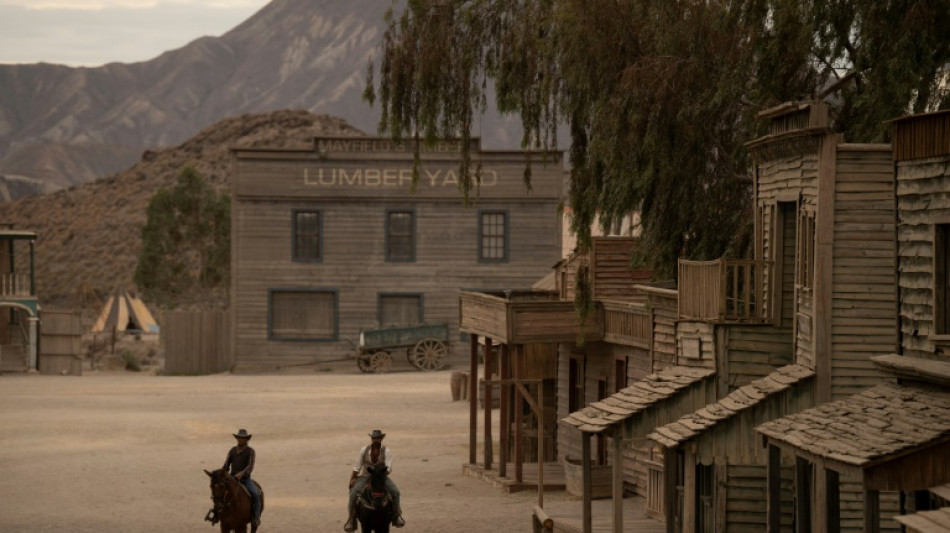
'Like Texas': Spain's arid south draws Western film shoots / Photo: JORGE GUERRERO - AFP

 Warren Buffett steps down as Berkshire Hathaway chairman

 Isolated Syrian-Druze city blames Damascus for shortages

 Kerry James Marshall: American 'blackness' painter celebrated in Europe

 Infantino 'must go', says German FA vice-president

 Japan's busiest rail station tests robot bins

 Backpackers fret over Australian visa crackdown

 Bank of Japan hikes rates to 31-year high to battle inflation

 AI doomsday warnings unlikely to slow IPOs but questions linger

 In Brazil's Amazon, the hunt for oil fuels hopes and fears

 Baby orangutans in India expose 'frightening' scale of trafficking

 Oversight Board blasts 'inadequate' Meta safeguards for AI deepfakes

 Harry makes first public appearance since return to UK

 Princess Diana's brother makes new explosive claims against Charles

 Trump admin overhauls key protection for endangered species

 Mbappe draws political fire over Ceuta t-shirt controversy

 Third malaria death in Germany from outbreak tied to Frankfurt airport

 AtlasClear Holdings Reports Preliminary Fiscal 2026 Revenue of Approximately $20.1 Million, Up 85%; Revenue Plus Interest Income of Approximately $21.9 Million

 'Another arrow to the quiver': World Bank posts record private capital mobilization

 Ireland to boycott Eurovision 2027 over Gaza

 India's Tata Sons reappoints N. Chandrasekaran as chairman

 Germany urges EU action against China to defend carmakers

 Japan eyes changing prostitution law to punish sex buyers

 Modi pitches India as global chipmaking hub

 Ukraine plans record defence spending in 2027

 NASA scan discovers new, 'once in a century' Moon crater

A cowboy collapses after gunshots ring out outside a saloon -- this is not America's Wild West but Spain's arid Almeria region, long a popular backdrop for Western movies.
The Tabernas Desert, one of Europe's driest regions which extends over 28,000 hectares, attracted Italian director Sergio Leone to shoot his iconic Western films from the 1960s, drawn by its barren landscape, abundant sunshine and low costs.
Among the movies he shot in the southern region are his masterpieces "A Fistful of Dollars" and "The Good, the Bad and the Ugly", which starred Oscar-winning actor Clint Eastwood.
Other directors followed. Dozens of Westerns were filmed in the region in the 1960s and the area soon became known as the "Hollywood of Europe".
Elaborate sets were built featuring dusty streets and saloons, now serving as Western-themed amusement parks that draw tourists to one of Spain's less visited regions, which still features as a backdrop for big-name films.
Mock cowboys on horseback put on a show for visitors to one of the theme parks, Fort Bravo, that includes a fake duel.
Rafael Aparicio, one of the performers sporting cowboy boots and a sleeveless waistcoat, said he started out working on film shoots in Tabernas.
"I must have been 14 or 15, and that's where I learned everything: how to ride a horse, how to fall from the top of a building, how to fight on the ground," the 49-year-old told AFP.
- 'Family affair' -
The car park was packed with trucks, large camper vans and a white tent, a sign of filming in progress nearby.
Fabio Testi, an 83-year-old Italian actor who appears in several movies made in the region, said the light of the Tabernas Desert is what appealed most to filmmakers.
"You can shoot from 7:00 am to 9:00 pm and it will always be the same," he told AFP. "It was like Texas for us, it really was like a desert."
Jose Enrique Martinez, an author of two books on the history of filmmaking in Almeria, said "the scenery is the same as in Arizona and southern Texas -- it doesn't rain."
"And it's a lot cheaper than in the United States," he added.
"In its early days, cinema in Almeria was a family affair. Everyone wanted to be in the films. Workers would call in sick to go to film shoots where they were paid more."
- 'Long live the Western!' -
After an airport opened in Almeria, the capital of the province of the same name located 30 kilometres (18 miles) south of Tabernas, it became easier for stars such as Sean Connery and Brigitte Bardot to come to the remote location for a shoot.
Tabernas has also been used as a stand-in for the Middle East and North Africa, such as for the 1962 epic drama "Lawrence of Arabia", said Bob Yareham, who wrote the book "Movies made in Spain".
Filming in Tabernas slowed down after the 1970s but has picked up recently with the filming of scenes for popular English-language series including "The Crown" and "Game of Thrones" as well as the French series "Lucky Luke" and "Zorro".
And since 2001 Tabernas has hosted each October Europe's only film festival dedicated to Westerns.
"It's not a thing of the past, it's still alive," said 41-year-old teacher Juan Castro, who attended this month's festival sporting a cowboy hat and a bandana around his neck.
"We must continue to promote it so that it doesn't fall into oblivion."
Danish-American actor Viggo Mortensen picked up the award for best picture at this year's festival for his feature "The Dead Don't Hurt" about star-crossed lovers in the Wild West.
"The Western is not dead, that's not true," Mortensen said on stage as he collected the prize.
"Long live the Western and long live the Western filmed in Almeria!"
J.Bondarev--CPN