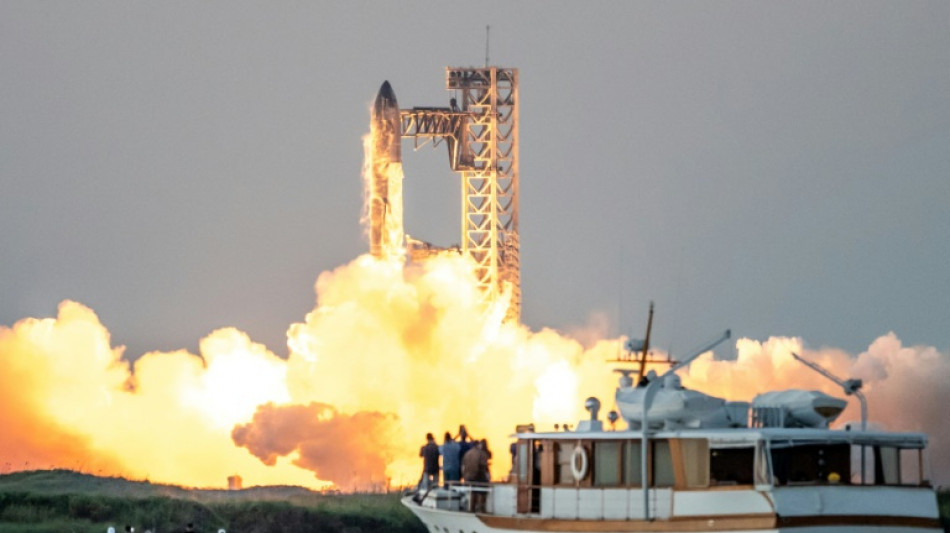
In milestone, SpaceX 'catches' megarocket booster after test flight
/ Photo: SERGIO FLORES - AFP

 Warren Buffett steps down as Berkshire Hathaway chairman

 Isolated Syrian-Druze city blames Damascus for shortages

 Kerry James Marshall: American 'blackness' painter celebrated in Europe

 Infantino 'must go', says German FA vice-president

 Japan's busiest rail station tests robot bins

 Backpackers fret over Australian visa crackdown

 Bank of Japan hikes rates to 31-year high to battle inflation

 AI doomsday warnings unlikely to slow IPOs but questions linger

 In Brazil's Amazon, the hunt for oil fuels hopes and fears

 Baby orangutans in India expose 'frightening' scale of trafficking

 Oversight Board blasts 'inadequate' Meta safeguards for AI deepfakes

 Harry makes first public appearance since return to UK

 Princess Diana's brother makes new explosive claims against Charles

 Trump admin overhauls key protection for endangered species

 Mbappe draws political fire over Ceuta t-shirt controversy

 Third malaria death in Germany from outbreak tied to Frankfurt airport

 AtlasClear Holdings Reports Preliminary Fiscal 2026 Revenue of Approximately $20.1 Million, Up 85%; Revenue Plus Interest Income of Approximately $21.9 Million

 'Another arrow to the quiver': World Bank posts record private capital mobilization

 Ireland to boycott Eurovision 2027 over Gaza

 India's Tata Sons reappoints N. Chandrasekaran as chairman

 Germany urges EU action against China to defend carmakers

 Japan eyes changing prostitution law to punish sex buyers

 Modi pitches India as global chipmaking hub

 Ukraine plans record defence spending in 2027

 NASA scan discovers new, 'once in a century' Moon crater

SpaceX on Sunday successfully flew the first-stage booster of its Starship megarocket back to the launch pad after a test flight, a technical tour de force that furthers the company's quest for rapid reusability.
The "super heavy booster" had blasted off attached to the uncrewed Starship rocket minutes earlier, then made a picture-perfect controlled return to the same pad in Texas, where a pair of huge mechanical "chopsticks" reached out from the launch tower to bring the slowly descending booster to a halt, according to a livestream from Elon Musk's SpaceX company.
Not long afterward, the upper stage of Starship splashed down, as planned, in the Indian Ocean, a development saluted by Musk on X.
"Ship landed precisely on target!" he said of the vehicle's fifth test flight. "Second of the two objectives achieved."
The successful "catching" of the booster at its Texas launch pad had company staffers erupting in cheers.
"Folks, this is a day for the engineering history books," a SpaceX spokesperson said on the company's livestream.
Liftoff occurred at 7:25 am (1225 GMT) in clear weather from the SpaceX facility in southern Texas.
During its last flight in June, SpaceX achieved its first successful splashdown with Starship, a prototype spaceship that Musk hopes will one day carry humans to Mars.
US space agency NASA, which congratulated SpaceX on its successful test, is also keenly awaiting a modified version of Starship to act as a lander vehicle for crewed flights to the Moon under the Artemis program later this decade.
SpaceX said its engineers have "spent years preparing and months testing for the booster catch attempt, with technicians pouring tens of thousands of hours into building the infrastructure to maximize our chances for success."
Teams were monitoring to ensure "thousands" of criteria were met both on the vehicle and at the tower before any attempt to return the booster.
Had the conditions not been satisfied, it would have been redirected for a splashdown in the Gulf of Mexico, as in previous tests.
Instead, having been given the green light, the returning booster decelerated from supersonic speeds and the powerful "chopstick arms" embraced it.
- 'Fail fast, learn fast' -
The large mechanical arms, called "Mechazilla" by Musk, have generated considerable excitement among space enthusiasts.
Video posted by SpaceX showed the booster slowly descending, its bottom wobbling slowly to and fro as some of its 33 powerful engines corrected its descent, until the arms closed gently around it and held the huge device in place above the ground.
Starship stands 397 feet (121 meters) tall with both stages combined -- about 90 feet taller than the Statue of Liberty.
Its Super Heavy booster, which is 233 feet tall, produces 16.7 million pounds (74.3 Meganewtons) of thrust, about twice as powerful as the Saturn V rockets used during the Apollo missions.
SpaceX's "fail fast, learn fast" strategy of rapid iterative testing, even when its rockets blow up spectacularly, has ultimately accelerated development and contributed to the company's success.
Founded only in 2002, it quickly leapfrogged aerospace industry giants and is now the world leader in orbital launches, besides providing the only US spaceship currently certified to carry astronauts.
It has also created the world's biggest internet satellite constellation -- invaluable in disaster and war zones.
But its founding vision of making humanity a multiplanetary species is increasingly at risk of being overshadowed by Musk's embrace of Republican presidential candidate Donald Trump and his alignment with right-wing politics.
A clearly energized Musk, wearing an "Occupy Mars" T-shirt, appeared alongside Trump at a recent rally in Pennsylvania.
The company has been openly sparring with the Federal Aviation Administration over launch licensing and alleged violations, with Musk accusing the agency of overreach and calling for its chief, Michael Whitaker, to resign.
"He's trying to position himself for minimal regulatory interference with SpaceX once Donald Trump becomes president," said Mark Hass, a marketing expert and professor at Arizona State University. "But it's a calculated gamble if things go the other way."
D.Goldberg--CPN