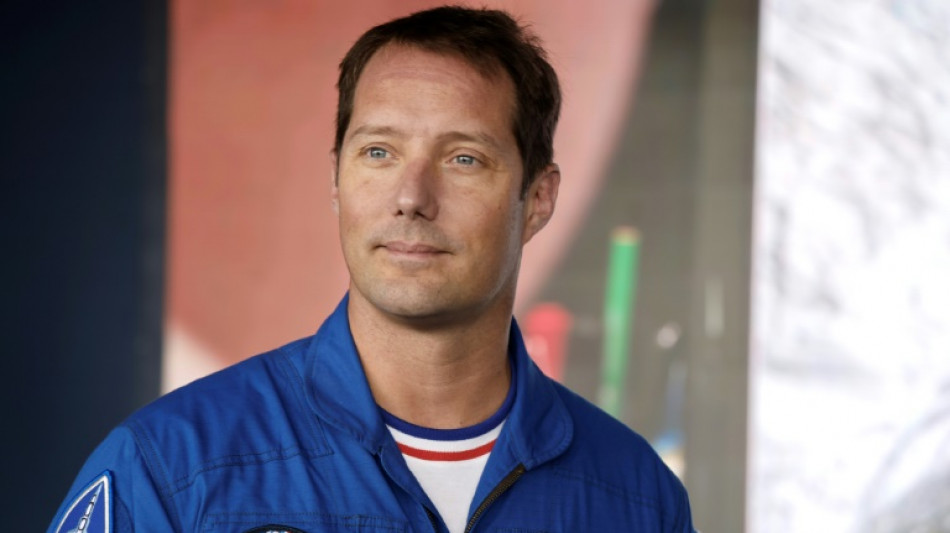
Europe en route for Moon with new simulator, says astronaut Pesquet / Photo: Ludovic MARIN - POOL/AFP/File

 Warren Buffett steps down as Berkshire Hathaway chairman

 Isolated Syrian-Druze city blames Damascus for shortages

 Kerry James Marshall: American 'blackness' painter celebrated in Europe

 Infantino 'must go', says German FA vice-president

 Japan's busiest rail station tests robot bins

 Backpackers fret over Australian visa crackdown

 Bank of Japan hikes rates to 31-year high to battle inflation

 AI doomsday warnings unlikely to slow IPOs but questions linger

 In Brazil's Amazon, the hunt for oil fuels hopes and fears

 Baby orangutans in India expose 'frightening' scale of trafficking

 Oversight Board blasts 'inadequate' Meta safeguards for AI deepfakes

 Harry makes first public appearance since return to UK

 Princess Diana's brother makes new explosive claims against Charles

 Trump admin overhauls key protection for endangered species

 Mbappe draws political fire over Ceuta t-shirt controversy

 Third malaria death in Germany from outbreak tied to Frankfurt airport

 AtlasClear Holdings Reports Preliminary Fiscal 2026 Revenue of Approximately $20.1 Million, Up 85%; Revenue Plus Interest Income of Approximately $21.9 Million

 'Another arrow to the quiver': World Bank posts record private capital mobilization

 Ireland to boycott Eurovision 2027 over Gaza

 India's Tata Sons reappoints N. Chandrasekaran as chairman

 Germany urges EU action against China to defend carmakers

 Japan eyes changing prostitution law to punish sex buyers

 Modi pitches India as global chipmaking hub

 Ukraine plans record defence spending in 2027

 NASA scan discovers new, 'once in a century' Moon crater

Europe has embarked on the mission to put humans back on the Moon with a new lunar simulator launched in Germany, French astronaut Thomas Pesquet told AFP.
Pesquet was at the German Aerospace Center (DLR) in Cologne on Wednesday to test out LUNA, a facility built to resemble the surface of the Moon.
The 46-year-old astronaut, a national icon in France for his missions to the International Space Station (ISS), glowed at the prospect of participating in a lunar mission.
"It would be a dream and the high point of my career. The Moon is 1,000 times farther away than the ISS," he said in an interview.
"Aboard the ISS, you feel like you're doing something out of the ordinary. But going to the Moon takes the adventure to a whole other level."
The newly opened facility was designed to train astronauts and test equipment and material for use on missions to the Moon.
International interest in exploring the Moon has surged in recent years.
NASA has launched a programme, Artemis, to put astronauts on the Moon in 2026, more than five decades after US space explorers last visited on the final flight of the Apollo missions in 1972.
Earlier this year, China sent a probe that collected the first samples from the far side of the Moon. The country aims to send a crewed mission to Earth's satellite by 2030, and wants to build a base on the lunar surface.
Japan and India are planning to send a probe to hunt for water near the south pole of the Moon in 2025.
The European Space Agency (ESA) hopes to team up with NASA on future Moon missions, Pesquet said.
"It's a key moment for Europe, because we're truly jumping into lunar exploration. We're already partnering with NASA on supplying equipment and materials for Artemis," he said.
"But LUNA is really the first highly visible sign of the fact that we've embarked on plans to return to the Moon. We're proving that by making long-term investments. This facility will be open to other space agencies, researchers and, we hope, to private firms."
- 'Different kettle of fish' -
Pesquet described his first test of LUNA as surprising.
He and fellow ESA astronaut Matthias Maurer rehearsed walking on the lunar surface, wearing special suits that weighed 25 kilogrammes (55 pounds) and carrying scientific and communications equipment, he said.
"I was surprised by the piercing light seen on the Moon, especially at the south pole. It's very hard to evaluate the topography," he said, describing how he sank into the thick layer of dust simulating that found on the lunar surface.
"The minute you leave the path, figuring out where to step is a whole different kettle of fish.... It's also incredibly slow. It's not like Earth, you're a lot less coordinated. It reminded me of my spacewalks at the International Space Station."
Europe's role providing the service module for NASA's Orion capsule, which will carry the Artemis crew members, has earned the ESA three spots for its astronauts on the programme's first three missions around the Moon.
But "NASA has told us, 'To land on the Moon, you need to propose something to do on the lunar surface,'" said Pesquet.
"LUNA isn't a contractual part of the deal. But it allows us to show we're serious."
Y.Ponomarenko--CPN