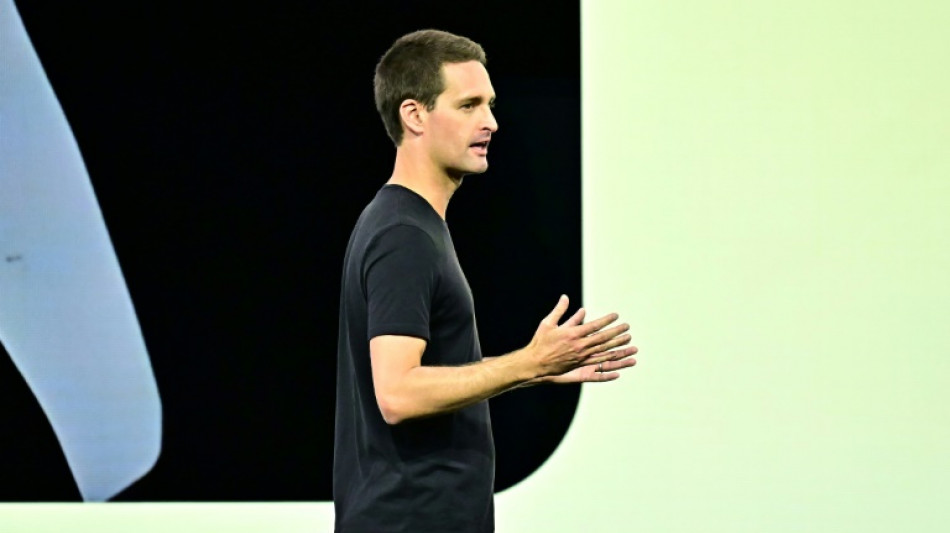
Snapchat pushes 'safer' platform image, but not everyone agrees / Photo: Frederic J. BROWN - AFP

 Crisis-wracked Volkswagen warns of 10-bn-euro hit to profits

 Shakira to cap off world tour with Madrid 12-gig run

 Isolated Syrian-Druze city shortages

 UNESCO can be 'moderator' in AI debate: chief to AFP

 Russia seizes assets of Nestle, French firms

 Anthropic says AI systems moving towards building themselves

 Asian stocks boosted by falling oil, yen weakens after BoJ rate hike

 Afghan medical students in Pakistan hope court stops college expulsions

 Australia to detain tourists who overstay visa, minister says

 Asian stocks track Wall St rally as oil prices drop

 Prized Mexican relic returns on loan, two centuries on

 'In our lane': Fed's Warsh defies Trump but still fighting for credibility

 Trump admin makes major cut to endangered species protections

 GM delivers first components for US interceptor missiles

 Travis Scott and Keith Richards feature on GTA VI soundtrack

 King Charles warns tech bosses of 'existential dangers' of AI

 French fishermen block ports over petrol prices

 Micron's Taiwan workers say 68 months' bonus not enough

 Canada's Carney pushes 'new alliance' with EU despite Trump threats

 Beyond Investment Returns: Families Are Measuring Wealth by Freedom, Continuity, and Legacy, According to Nour Private Wealth

 King Charles disputes claims in book by Princess Diana's brother

 Nepal floods among 'most challenging' disasters: WFP

 Kids and social media: what would change under new EU law

 King Charles to call on tech giants for 'reassurances' over AI

 STARPRIME Responds to Diverging Gold Market Demand with AM/PM Fixing and XAU24/7

Snapchat, the popular teen-focused social network, is positioning itself as a healthier alternative to platforms like Instagram and TikTok, which have faced criticism for their impact on youth mental health. However, not everyone is convinced.
At parent company Snap's annual conference in Santa Monica on Tuesday, CEO Evan Spiegel emphasized the platform's unique approach.
"When we started Snapchat, we wanted something different, and we didn't like the way that social media made us feel," Spiegel said.
Snapchat is often seen as a better alternative by authorities, associations and parents concerned about the harmful effects of social networking on young people.
And its reputation as a "safer" social media option has been bolstered by recent research.
A University of Amsterdam study, cited by Spiegel, found that while time spent on TikTok, Instagram and YouTube negatively impacted mental health, Snapchat use showed positive effects on friendships and well-being.
That said, critics like Matthew Bergman, founder of an organization representing social media victims, argue that the ephemeral nature of Snapchat -- where stories disappear after 24 hours -- facilitates criminal activities.
"In particular, the disappearing message serves to provide an open air drug market for drug dealers to sell drugs," he said.
Bergman's group represents 180 parents whose children allegedly died from fentanyl poisoning after purchasing drugs via the app.
Whether Instagram, TikTok or Snapchat, "all are based on the same business model, which is maximizing engagement over and above safety," he added.
Industry analyst Jasmine Enberg of Emarketer noted the challenges facing Snapchat.
"At the end of the day, Snapchat like Meta is a business and so one of the biggest challenges is balancing the privacy, safety and security of its users, especially young users, with generating revenue," she said.
Despite the platform's successes, it remains unprofitable and struggles to compete for crucial advertiser dollars with tech giants Meta, Google and TikTok.
- 'Least worst' -
Snapchat remains popular among youths, with three-quarters of 13-to-34-year-olds using the app in more than 25 countries.
The platform pioneered vertical videos and in 2013, created "Stories" that disappear in 24 hours, a feature that has been widely copied since.
"No likes or comments, so you can share your perspective without social pressure... and it's working," Spiegel said.
He added that the app boasts an impressive 850 million monthly active users and continues to grow.
Fourteen-year-old user Lily (who declined to give her last name) told AFP she prefers Snapchat for casual communication, appreciating its lower-pressure environment compared to text messaging.
"You can also just kind of send photos back and forth," she said.
She also loves augmented reality filters and games, and brushes aside the problem of malicious actors.
"People do try to add you and talk to you and try to get you to do stuff, but I always just block them," she said.
Content creator Adriana Vecchioli praised Snapchat's approach at the conference, noting that its disappearing messages feature "gives more freedom" and reduces pressure on users, particularly young women.
It's the "least worst" of the platforms, she said.
O.Hansen--CPN