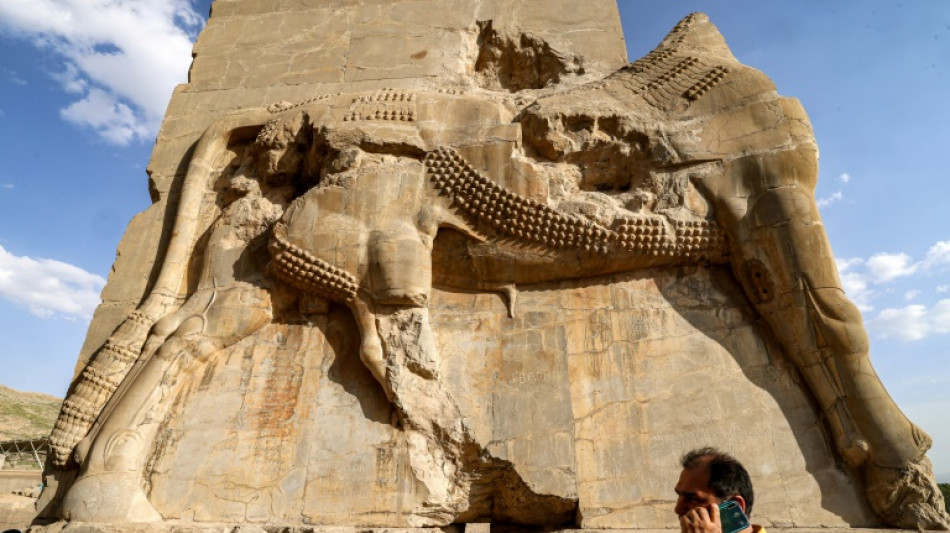
The stone-eaters that threaten Iran's ancient Persepolis / Photo: ATTA KENARE - AFP/File

 Crisis-wracked Volkswagen warns of 10-bn-euro hit to profits

 Shakira to cap off world tour with Madrid 12-gig run

 Isolated Syrian-Druze city shortages

 UNESCO can be 'moderator' in AI debate: chief to AFP

 Russia seizes assets of Nestle, French firms

 Anthropic says AI systems moving towards building themselves

 Asian stocks boosted by falling oil, yen weakens after BoJ rate hike

 Afghan medical students in Pakistan hope court stops college expulsions

 Australia to detain tourists who overstay visa, minister says

 Asian stocks track Wall St rally as oil prices drop

 Prized Mexican relic returns on loan, two centuries on

 'In our lane': Fed's Warsh defies Trump but still fighting for credibility

 Trump admin makes major cut to endangered species protections

 GM delivers first components for US interceptor missiles

 Travis Scott and Keith Richards feature on GTA VI soundtrack

 King Charles warns tech bosses of 'existential dangers' of AI

 French fishermen block ports over petrol prices

 Micron's Taiwan workers say 68 months' bonus not enough

 Canada's Carney pushes 'new alliance' with EU despite Trump threats

 Beyond Investment Returns: Families Are Measuring Wealth by Freedom, Continuity, and Legacy, According to Nour Private Wealth

 King Charles disputes claims in book by Princess Diana's brother

 Nepal floods among 'most challenging' disasters: WFP

 Kids and social media: what would change under new EU law

 King Charles to call on tech giants for 'reassurances' over AI

 STARPRIME Responds to Diverging Gold Market Demand with AM/PM Fixing and XAU24/7

Conservationists at Persepolis, Iran's most iconic ancient site, are waging a delicate battle against an unlikely adversary: tiny but persistent lichens eroding the millennia-old monuments.
The fight, which began years ago, is aimed at stopping the threat to the integrity of the site's structures and its intricate carvings from lichens, organisms that grow on surfaces like stone and can slowly break them down over time.
Built in the 6th century BC by Darius I, Persepolis has withstood destruction, looting, earthquakes, fires and harsh weather. It remains a source of pride for Iranians and a major tourist destination.
"It's an open-air museum reflecting 25 centuries of Middle Eastern life," said Alireza Asgari Chaverdi, director of the site located about 50 kilometres (30 miles) from the southern city of Shiraz.
"It is the foundation of Iran's history, culture and socio-cultural life."
A UNESCO World Heritage Site since 1979, Persepolis features colossal sculptures and intricate stone reliefs of ancient Persian kings, nobles and deities.
But these have suffered over the years from lichen, a combination of an algae and a fungus.
"This is the most serious problem, especially for carvings on stones," said Shahram Rahbar, a conservationist at the site.
"If we do nothing, these organisms could reduce these relics to dust within 50 to 100 years," he said as he treated lichen growth on one slab.
- Lost motifs -
Red lichen marks are now etched into many of the ancient relics at Persepolis.
The spread of lichens, which dissolve minerals and penetrate stone surfaces by more than 1.5 centimetres (.6 inches), is driven by industrialisation, acid rain and the harsh desert climate, said lichenologist Mohammad Sohrabi.
"We cover the lichens with a material and, after a week, repeat the process until they weaken enough to be removed with suction devices," said Rahbar.
Iran is home to more than 3,000 species of lichens, with 500 to 700 varieties growing on historical monuments, Sohrabi said, noting that some at Persepolis were over 1,700 years old.
"Many of Persepolis's intricate motifs have already been lost due to lichen activity," he said.
Beyond Persepolis, other sites in Iran, like the Bisotun inscription in Kermanshah province, have also been affected.
Bisotun, another UNESCO World Heritage Site, features a massive carved inscription recounting the conquests of King Darius I and has suffered significant degradation due to lichen growth.
- 'More important than our lives' -
At Persepolis, Rahbar and his team work relentlessly to combat the infestation.
"We destroy the lichens using modern techniques like lasers and substances that act like antibiotics," Rahbar said, describing what he called a "painstaking" process.
Public concern grew after an official highlighted a lack of funds for preserving Iran's historic sites.
Iran's deputy culture minister, Ali Darabi, said the annual budget for restoring each monument was only 130 million rials (about $220), while maintaining all registered historical monuments would require nearly $84 million a year.
As Mohsen, a 41-year-old retiree from Ghazvin, stood before a ruined column of the Apadana palace, he said, "Maintaining this site is more important than our lives."
Ghashghaei, an 82-year-old retiree visiting with his family, agreed.
For him, the site stands as a poignant reminder that "Iranians created an ancient civilisation," he said.
C.Peyronnet--CPN