Musk's Neuralink eyes more test subjects for its brain tech / Photo: - - Neuralink/AFP/File

 Nigeria miners struggled to breathe in cell before 37 died: survivors

 Warren Buffett steps down as Berkshire Hathaway chairman

 Isolated Syrian-Druze city blames Damascus for shortages

 Kerry James Marshall: American 'blackness' painter celebrated in Europe

 Infantino 'must go', says German FA vice-president

 Japan's busiest rail station tests robot bins

 Backpackers fret over Australian visa crackdown

 Bank of Japan hikes rates to 31-year high to battle inflation

 AI doomsday warnings unlikely to slow IPOs but questions linger

 In Brazil's Amazon, the hunt for oil fuels hopes and fears

 Baby orangutans in India expose 'frightening' scale of trafficking

 Oversight Board blasts 'inadequate' Meta safeguards for AI deepfakes

 Harry makes first public appearance since return to UK

 Princess Diana's brother makes new explosive claims against Charles

 Trump admin overhauls key protection for endangered species

 Mbappe draws political fire over Ceuta t-shirt controversy

 Third malaria death in Germany from outbreak tied to Frankfurt airport

 AtlasClear Holdings Reports Preliminary Fiscal 2026 Revenue of Approximately $20.1 Million, Up 85%; Revenue Plus Interest Income of Approximately $21.9 Million

 'Another arrow to the quiver': World Bank posts record private capital mobilization

 Ireland to boycott Eurovision 2027 over Gaza

 India's Tata Sons reappoints N. Chandrasekaran as chairman

 Germany urges EU action against China to defend carmakers

 Japan eyes changing prostitution law to punish sex buyers

 Modi pitches India as global chipmaking hub

 Ukraine plans record defence spending in 2027

Elon Musk on Wednesday said his Neuralink startup is "moving on" to a second test patient as its tech for linking brains and computers improves.
Musk and members of the Neuralink team fielded questions during an update streamed on X, formerly Twitter, discussing where it is on the path to making its brain implants commonplace.
"We're only just moving now to our second Neuralink patient," Musk said. "But we hope to have, if things go well, high single digits this year."
Musk's neurotechnology company in January installed a brain implant in Noland Arbaugh, which the billionaire head of Tesla and X touted as a success.
Arbaugh was left paralyzed from the shoulders down by a diving accident eight years ago.
Since the implant operation, he has told of playing chess and the video game "Civilization," as well as taking Japanese and French lessons by controlling a computer screen cursor with his brain.
Musk and members of the Neuralink team detailed fixing an issue that saw Arbaugh's ability to move a computer cursor with his mind greatly reduced.
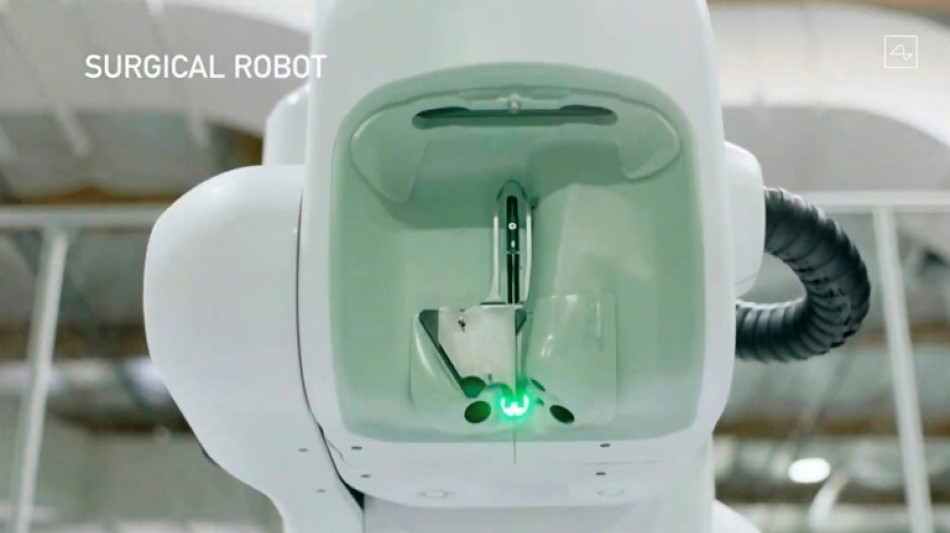
Neuralink's technology works through a device about the size of five stacked coins that is placed inside the human brain by a robotic surgeon.
Threads connecting the implant to Arbaugh's brain had "retracted," becoming less effective at picking up signals.
Threads will be implanted deeper in the brain and at varying depths, with ramped-up precision to maximize effectiveness, according to the Neuralink team.
Musk promised "it's only going to get better from here."
One goal is to escalate the bandwidth of the link between the brain and computer, allowing more data to move faster, according to Musk.
"Quite important for human-AI symbiosis is just being able to communicate at a speed AI can follow," Musk said of brains being connected to computers with artificial intelligence.
Musk envisions Neuralink implants going beyond restoring sight to the blind to giving people infrared or ultraviolet vision or letting them share concepts with others telepathically.
"We want to give people superpowers," Musk said. "Not just that we're restoring your prior functionality, but that you actually have functionality far greater than a normal human."
Musk spoke of developing an automated process in which Neuralink's surgery robot could quickly install custom implants in people seeking "upgrades."
"It's very sort of 'Cyberpunk' or 'Deus Ex,' if you play those games," Musk said of the idea.
"An exciting possibility long term also is to take parts of the Optimus humanoid robot and combine that with a Neuralink - you could have basically cybernetic superpowers," he said.
Musk cofounded Neuralink in 2016.
The ambition is to supercharge human capabilities, treat neurological disorders like ALS or Parkinson's, and maybe one day achieve a symbiotic relationship between humans and AI.
Musk is not alone in trying to make advances in the field, which is officially known as brain-machine or brain-computer interface research.
P.Schmidt--CPN