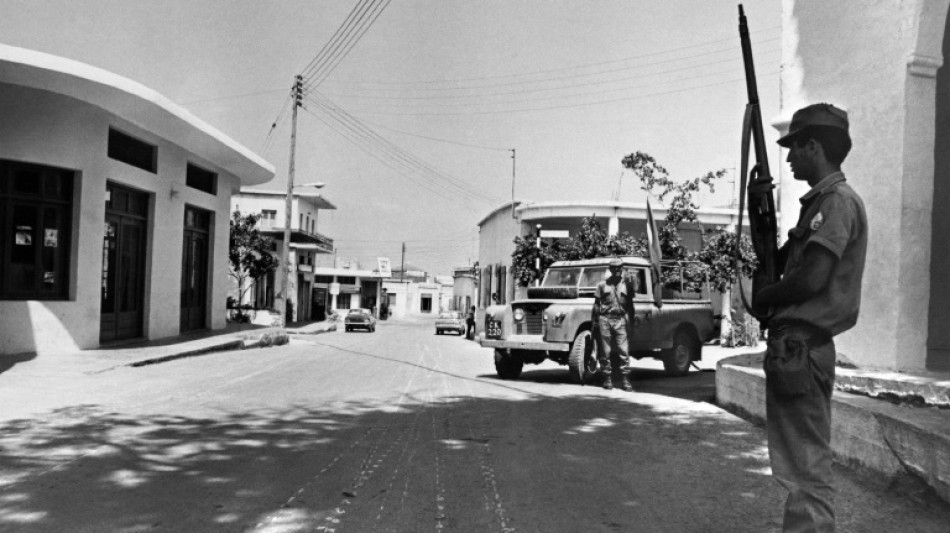
Key dates in Cyprus's post-independence history
/ Photo: - - AFP/File

 Nigeria miners struggled to breathe in cell before 37 died: survivors

 Warren Buffett steps down as Berkshire Hathaway chairman

 Isolated Syrian-Druze city blames Damascus for shortages

 Kerry James Marshall: American 'blackness' painter celebrated in Europe

 Infantino 'must go', says German FA vice-president

 Japan's busiest rail station tests robot bins

 Backpackers fret over Australian visa crackdown

 Bank of Japan hikes rates to 31-year high to battle inflation

 AI doomsday warnings unlikely to slow IPOs but questions linger

 In Brazil's Amazon, the hunt for oil fuels hopes and fears

 Baby orangutans in India expose 'frightening' scale of trafficking

 Oversight Board blasts 'inadequate' Meta safeguards for AI deepfakes

 Harry makes first public appearance since return to UK

 Princess Diana's brother makes new explosive claims against Charles

 Trump admin overhauls key protection for endangered species

 Mbappe draws political fire over Ceuta t-shirt controversy

 Third malaria death in Germany from outbreak tied to Frankfurt airport

 AtlasClear Holdings Reports Preliminary Fiscal 2026 Revenue of Approximately $20.1 Million, Up 85%; Revenue Plus Interest Income of Approximately $21.9 Million

 'Another arrow to the quiver': World Bank posts record private capital mobilization

 Ireland to boycott Eurovision 2027 over Gaza

 India's Tata Sons reappoints N. Chandrasekaran as chairman

 Germany urges EU action against China to defend carmakers

 Japan eyes changing prostitution law to punish sex buyers

 Modi pitches India as global chipmaking hub

 Ukraine plans record defence spending in 2027

This month marks 50 years since the dramatic events of 1974 left the Mediterranean holiday island of Cyprus divided to this day.
On July 15, 1974, the military junta then in power in Athens engineered a coup in Cyprus seeking to end its independence and unite the island with Greece.
Five days later, Turkish troops landed on the north coast, beginning an invasion that saw them occupy a third of the island, including Turkish Cypriot neighbourhoods of the divided capital Nicosia.
AFP looks at key dates in the island's history:
- 1960: Independence from Britain -
On August 16, 1960, Cyprus becomes independent from Britain after a guerrilla campaign waged by fighters aiming to unite the island with Greece.
Its constitution guarantees representation for the Turkish Cypriots, who at the time make up around 18 percent of the population, and forbids both union with Greece or Turkey and partition.
In December 1963, violence erupts between the two communities as Greek Cypriot leaders seek to override parts of the constitution. Turkish Cypriots withdraw to enclaves, some of them defended by armed fighters.
In March 1964, a UN peacekeeping force for Cyprus (UNFICYP) is established.
Between 1963 and 1974, around 2,000 people are listed as missing in clashes between the two communities.
- 1974: Coup triggers invasion -
On July 15, 1974, members of the Greek Cypriot National Guard overthrow president Archbishop Makarios in a coup sponsored by the military junta then ruling Greece.
On July 20, Turkey, invoking a 1959 agreement with Greece and Cyprus's then colonial ruler Britain, invades the north of the island saying its aim is to protect the Turkish Cypriot minority.
Three days later, the collapse of the juntas in both Athens and Nicosia leads to an interim administration and the eventual restoration of Makarios.
On July 30, Turkey, Greece and Britain meet in Geneva and establish a 180-kilometre (112 mile) long Green Line patrolled by UN troops dividing the island.
The Greek Cypriot community says the conflict left 3,000 dead and 1,400 missing. It also led to major population movements affecting around 162,000 Greek Cypriots and 48,000 Turkish Cypriots, according to the Peace Research Institute Oslo (PRIO).
- 1983: Turkish Cypriots break away -
On November 15, 1983, Turkish Cypriot leader Rauf Denktas proclaims a breakaway Turkish Republic of Northern Cyprus in the 38 percent of the island controlled by Turkish troops. It is recognised only by Turkey.
- 2003: Crossing the Green Line -
In April 2003, as peace talks falter, Turkish Cypriot authorities allow Greek Cypriots to visit the north and Turkish Cypriots to travel in the other direction across the Green Line for the first time.
- 2004: Greek Cypriot 'no' vote -
On April 24, 2004, Greek Cypriot voters overwhelmingly reject a UN reunification plan approved by Turkish Cypriots in a simultaneous referendum.
On May 1, Cyprus joins the European Union still a divided island, with Turkish Cypriots denied the full benefits of membership.
- 2008-2017: Peace talks collapse -
On September 3, 2008, the leaders of the two communities enter intensive UN-sponsored peace talks, which are joined by the three treaty powers Britain, Greece and Turkey before collapsing in 2017.
- 2020: Turkish Cypriots elect nationalist -
In October 2020, Turkish Cypriots elect nationalist Ersin Tatar, an ally of Turkish President Recep Tayyip Erdogan, as their leader.
Tatar narrowly defeats pro-reunification incumbent Mustafa Akinci, in what is widely seen as a symptom of growing Turkish Cypriot disillusion over the prospects for a deal.
Y.Uduike--CPN