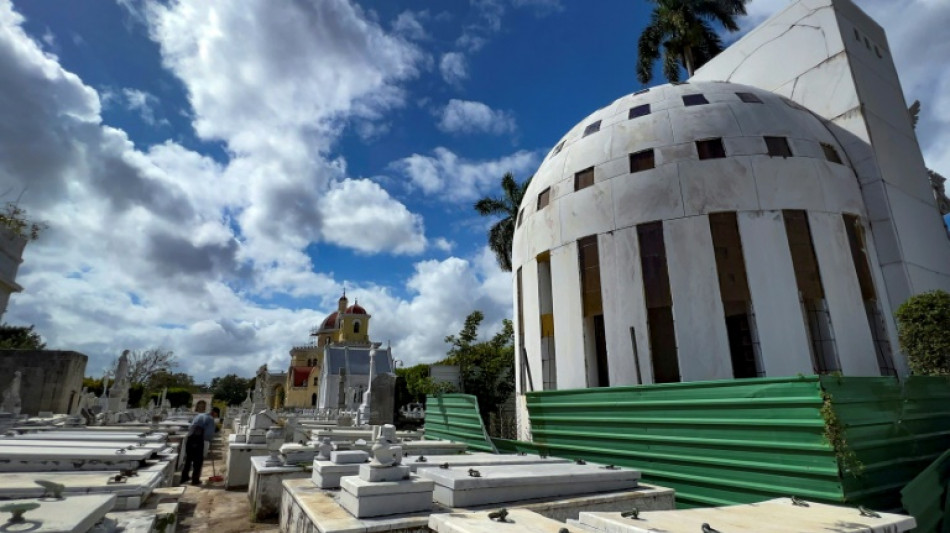
The lovers who left their heart in Havana cemetery / Photo: ADALBERTO ROQUE - AFP

 Crisis-wracked Volkswagen warns of 10-bn-euro hit to profits

 Shakira to cap off world tour with Madrid 12-gig run

 Isolated Syrian-Druze city shortages

 UNESCO can be 'moderator' in AI debate: chief to AFP

 Russia seizes assets of Nestle, French firms

 Anthropic says AI systems moving towards building themselves

 Asian stocks boosted by falling oil, yen weakens after BoJ rate hike

 Afghan medical students in Pakistan hope court stops college expulsions

 Australia to detain tourists who overstay visa, minister says

 Asian stocks track Wall St rally as oil prices drop

 Prized Mexican relic returns on loan, two centuries on

 'In our lane': Fed's Warsh defies Trump but still fighting for credibility

 Trump admin makes major cut to endangered species protections

 GM delivers first components for US interceptor missiles

 Travis Scott and Keith Richards feature on GTA VI soundtrack

 King Charles warns tech bosses of 'existential dangers' of AI

 French fishermen block ports over petrol prices

 Micron's Taiwan workers say 68 months' bonus not enough

 Canada's Carney pushes 'new alliance' with EU despite Trump threats

 Beyond Investment Returns: Families Are Measuring Wealth by Freedom, Continuity, and Legacy, According to Nour Private Wealth

 King Charles disputes claims in book by Princess Diana's brother

 Nepal floods among 'most challenging' disasters: WFP

 Kids and social media: what would change under new EU law

 King Charles to call on tech giants for 'reassurances' over AI

 STARPRIME Responds to Diverging Gold Market Demand with AM/PM Fixing and XAU24/7

Cuban sugar magnate Juan Pedro Baro spared no expense when it came to building the immense marble tomb of his one true love in Havana's Colon cemetery, an unlikely repository of past passions.
Baro's adulterous romance with one of Cuba's most beautiful women, Cataline Lasa, who died in 1930, scandalized high society, but lives on in the luxurious touches of her Art Deco mausoleum.
"The cemetery is full of love stories," said Mario Darias, a 66-year-old singer-songwriter who has written several books about the Havana graveyard, founded in 1876 and which extends over around 50 hectares (120 acres) in the heart of the city.
With its elaborate sculptures and architecture, the cemetery is considered an open-air museum, housing the final remains of independence heroes, writers, musicians, painters and famous doctors.
But it is also a place where loves -- some shocking, some hidden, some thwarted -- are immortalized.
Lasa's tomb represents one of Cuba's most famous love stories.
The upper-class beauty was married to the son of Cuba's vice president when she met and fell in love with Baro.
"High society took sides in this matter and turned their backs on them," explained Darias.
The two lovers fled to Paris where they lived until 1917, when Pope Benedict XV granted their request to have Lasa's marriage annulled.
The pair returned to Havana where they lived until Lasa fell ill and died aged 55.
Her mausoleum, currently under restoration, is made of white marble and black granite, and topped with glass roses made by French glassmaker Rene Lalique, who died in 1945.
- A scandalous age difference -
Elsewhere lies the tomb of another pair of lovers who raised eyebrows in their time, a teacher and student with a 30-year age difference.
Modesto Canto (1890-1977) is buried alongside his much younger wife Margarita Pacheco (1920-1959) in a tomb bearing the sculptured busts of the pair and the phrase "united by eternal love."
"Many people were opposed to their relationship. Everyone said she was going to be widowed very soon, but she died first," said Darias.
Not far away stands the tomb of Amelia Goyri who died while eight months pregnant at the age of 24 in 1901, and was buried with her baby atop her legs, as was the custom.
Her bereaved husband began a dedication to her tomb so intense that its emotion was contagious, and visitors to the cemetery began stopping to pay their respects to her as well.
A two-meter-high white marble statue of her was erected, but it was in 1914 that a myth was born and she earned her nickname "La Milagrosa," the miraculous one.
When her tomb was opened that year, she is reported to have been found intact, with her baby in her arms.
Since then Cubans have flocked to her tomb to leave offerings and wish for luck, whether to conceive or protect a child, for health, or a school exam.
Leticia Mojarrieta, 56, knows this love story and complies with the ritual of never turning one's back on the sculpture -- which Goyri's husband used to do during four decades of visits to her grave.
She is asking for protection for her daughter-in-law, who is pregnant and has just emigrated to the United States.
"We detected a little liquid in the baby's chest. I came to ask for help" from La Milagrosa, she told AFP.
M.Mendoza--CPN