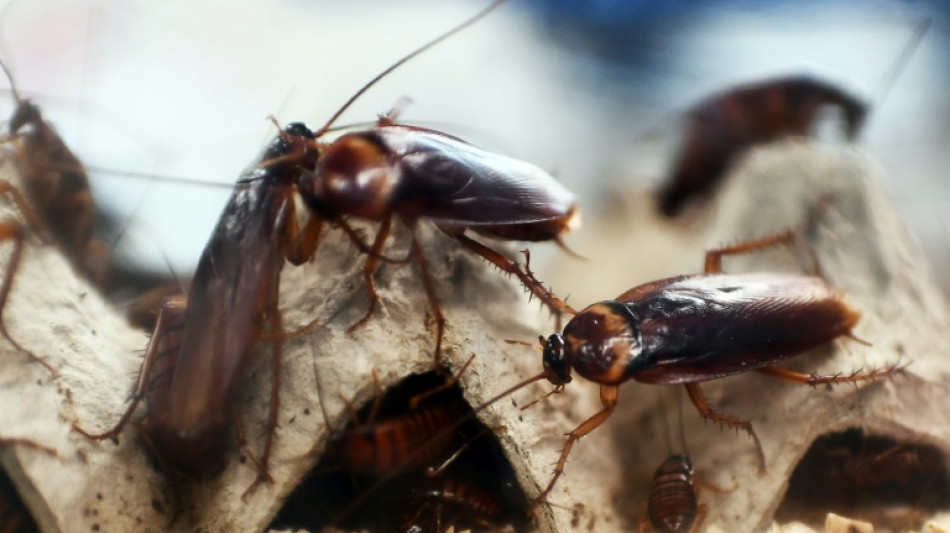
Sugar traps force cockroaches to adapt new sex 'gifts' / Photo: ANNE-CHRISTINE POUJOULAT - AFP/File

 UK-Sudanese author pens book to give children 'African history of Africa'

 US Congress passes sweeping Russia sanctions bill

 US stocks fall, dollar gains after Fed lifts interest rates

 US Fed raises rates to tackle 'too high' inflation in move sure to rile Trump

 US Fed raises rates to battle inflation in move likely to rile Trump

 US House faces test on sweeping Russia sanctions bill

 British PM says to make 'difficult decisions' as inflation rises

 Global fuel price demos: a round-up

 Leverate Launches MCP for Traders to Connect AI Assistants With Trading Platforms

 MEXC Launches $1M "Discover Your Wall Street DNA" Campaign to Help Traders Find Their Market Fit

 Stocks edge higher ahead of US Fed rate call

 BASIS.pro Expands On-Chain Infrastructure with XDC Network Partnership and Zypher DAO as Auto Earn Goes Live

 Pickle-flavoured tart? AI inspires Japan's convenience stores

 EU chief hosts Canada's Carney in push to 'deepen' alliance

 Meta chief pushes back on AI slowdown calls

 US Fed to deliver rate decision with markets betting on hike

 i-payout Expands U.S. Money Transmitter Licensing Footprint and Advances European EMI Strategy

 US Senate crypto bill collapses amid partisan deadlock

 OpenAI, Anthropic and Google are working to create an AI standards body

 Protesting shepherds, farmers clash with Romanian police

 Foundation Lets Ledger Users Switch to Open Source Without Starting Over

 EU to propose curbing social media, online games for under 15s

 FX Junction Reaches 40,600 Members and 26 Million Trades

 'We unleashed the beast': the world's fears and hopes about AI

 Hospitality leaders ask Burnham to halve VAT amid rising costs

Humans using sugar in cockroach traps has inadvertently led to female roaches being turned off by the sugary "gifts" males use to entice them into mating.
But don't celebrate the demise of cockroaches just yet -- some males have adapted new ways to continue wooing females, including by shortening the length of foreplay, a study said on Wednesday.
The small but stubborn German cockroach is the most common species of the insect, lurking in kitchens and bathrooms across the world.
Glucose, a form of sugar, has long been used to bait these cockroaches into deadly traps.
Thirty years ago, researchers first noticed that some German cockroaches had developed an aversion to glucose and were avoiding the traps.
This distaste for glucose may save them from death, but it has also put a damper on their sex life, according to the study published in the journal Proceedings of the Royal Society B.
Male cockroaches have a very particular manoeuvre to attract females into mating.
They lift their wings and expose a special gland that secretes a "nuptial gift," a cocktail which includes the sugar maltose.
The female jumps on the male's back to lap up the treat, which keeps her occupied "long enough for the male to extend his abdomen under the female and engage her genitalia," the study said.
However the saliva of the females quickly converts the maltose into glucose.
Females who have developed an aversion to glucose jump off "before the male can grasp the female genitalia," potentially affecting the future reproduction of the species, the study said.
But never fear: male cockroaches who have also evolved an aversion to glucose can now get around the problem.
These males have changed the composition of their nuptial gift, slashing the glucose content and more than doubling the amount of maltotriose.
This sugar is both hugely popular with females and converts into glucose much more slowly than maltose.
The males also shortened the courtship process, allowing less times for the glucose conversion to take place.
Glucose-averse males start mating in an average of 2.2 seconds -- almost twice the speed of other cockroaches, the study said.
The big losers are ordinary male cockroaches, who now secrete a gift too rich in glucose and take too long to start mating for the taste of many females.
The authors of the study from the North Carolina State University emphasised it was important to understand glucose aversion in cockroaches to develop new ways to control their numbers.
Some scientists have recommended glucose no longer be used in cockroach traps.
U.Ndiaye--CPN