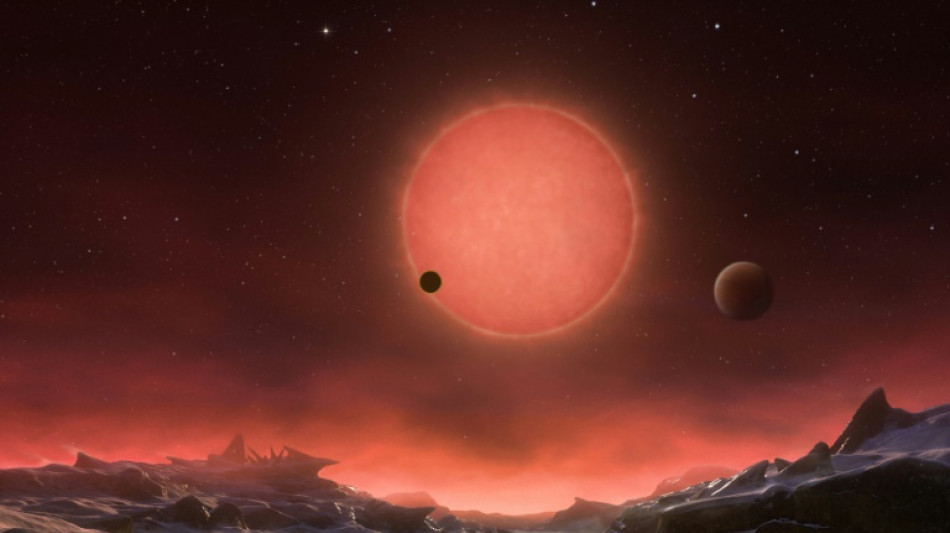
Webb measures temperature of rocky exoplanet for first time / Photo: HO - European Southern Observatory/AFP/File

 UK-Sudanese author pens book to give children 'African history of Africa'

 US Congress passes sweeping Russia sanctions bill

 US stocks fall, dollar gains after Fed lifts interest rates

 US Fed raises rates to tackle 'too high' inflation in move sure to rile Trump

 US Fed raises rates to battle inflation in move likely to rile Trump

 US House faces test on sweeping Russia sanctions bill

 British PM says to make 'difficult decisions' as inflation rises

 Global fuel price demos: a round-up

 Leverate Launches MCP for Traders to Connect AI Assistants With Trading Platforms

 MEXC Launches $1M "Discover Your Wall Street DNA" Campaign to Help Traders Find Their Market Fit

 Stocks edge higher ahead of US Fed rate call

 BASIS.pro Expands On-Chain Infrastructure with XDC Network Partnership and Zypher DAO as Auto Earn Goes Live

 Pickle-flavoured tart? AI inspires Japan's convenience stores

 EU chief hosts Canada's Carney in push to 'deepen' alliance

 Meta chief pushes back on AI slowdown calls

 US Fed to deliver rate decision with markets betting on hike

 i-payout Expands U.S. Money Transmitter Licensing Footprint and Advances European EMI Strategy

 US Senate crypto bill collapses amid partisan deadlock

 OpenAI, Anthropic and Google are working to create an AI standards body

 Protesting shepherds, farmers clash with Romanian police

 Foundation Lets Ledger Users Switch to Open Source Without Starting Over

 EU to propose curbing social media, online games for under 15s

 FX Junction Reaches 40,600 Members and 26 Million Trades

 'We unleashed the beast': the world's fears and hopes about AI

 Hospitality leaders ask Burnham to halve VAT amid rising costs

The James Webb Space Telescope has measured the temperature of a rocky exoplanet for the first time, finding that a "cousin" of Earth most likely lacks an atmosphere, researchers said Monday.
When the Trappist-1 system was discovered in 2017, astronomers were excited at the prospect that some of its seven rocky planets -- which are roughly similar to Earth in size and mass -- could be habitable.
Just 40 light years from Earth, the planets orbit much closer to their ultracool red dwarf star than the rocky planets in our Solar System. But their star gives off far less energy than our Sun.
The system made an obvious target for the piercing gaze of the Webb telescope, which has unleashed a torrent of scientific discovery since releasing its first observations in July last year.
Astronomers focused on Trappist-1b, the closest planet to the red dwarf, because it was the easiest to spot.
Webb's Mid-Infrared Instrument (MIRI) measured the change in brightness when the planet moved behind its star, in what is known as a secondary eclipse.
"Just before disappearing behind the star, the planet gives off the most light because it almost exclusively shows its 'day' side," Elsa Ducrot, a co-author of a new study published in the journal Nature, told AFP.
By subtracting the brightness of the star, the researchers calculated how much infrared light the planet was giving off.
The MIRI instrument was therefore able to act like "a giant touch-free thermometer," NASA said in a statement.
- 'Perfect for baking pizza' -
The planet's dayside temperature was determined to be 230 degrees Celsius (450 Fahrenheit) -- "just about perfect for baking pizza," NASA added.
France's Atomic Energy Commission (CEA) said that the heat was not redistributed throughout this "cousin" of Earth, a role normally provided by an atmosphere.
The scientists therefore concluded that Trappist-1b "has little or no atmosphere," said Ducrot, a CEA astrophysicist. She emphasised that other wavelengths would need to be analysed to confirm the result.
But it was certain that the atmosphere did not contain carbon dioxide, because that would have absorbed some of the light, she added.
The Spitzer Space Telescope was not able to rule out an atmosphere on Trappist-1b despite observing 28 secondary eclipses, Ducrot said.
"The James Webb saw it in a single eclipse!"
The ability to analyse the potential atmospheres of such rocky exoplanets opens "a new era" in the study of planets outside our Solar System, she added.
It was already known that Trappist-1b was uninhabitable, as it is too close to its star.
But Trappist-1e, Trappist-1f and Trappist-1g are all thought to be in what is called the "goldilocks zone".
Planets in this zone have a moderate temperature which could support liquid water -- considered essential for life anywhere.
U.Ndiaye--CPN