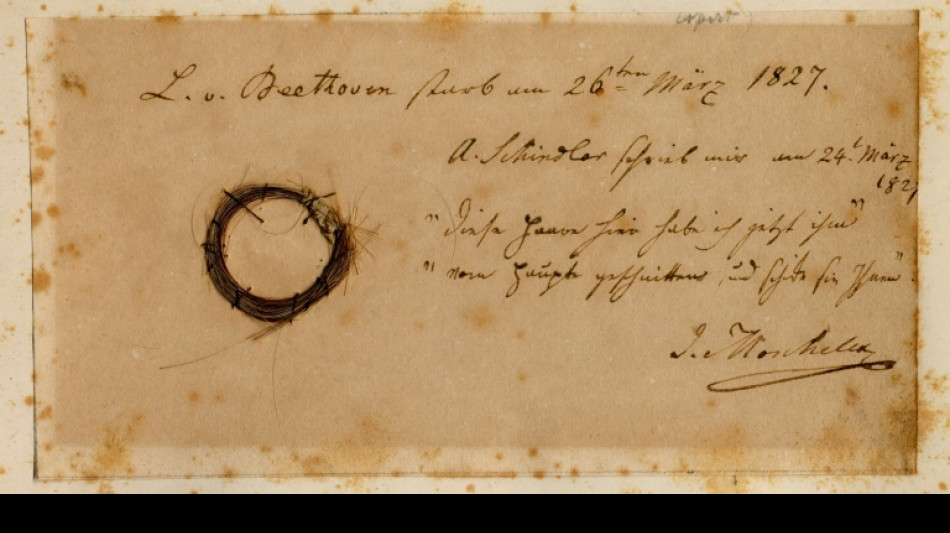
DNA analysis of Beethoven's hair provides clues to his death / Photo: Ira F. Brilliant - Center for Beethoven Studies, San Jose State University/AFP

 UK-Sudanese author pens book to give children 'African history of Africa'

 US Congress passes sweeping Russia sanctions bill

 US stocks fall, dollar gains after Fed lifts interest rates

 US Fed raises rates to tackle 'too high' inflation in move sure to rile Trump

 US Fed raises rates to battle inflation in move likely to rile Trump

 US House faces test on sweeping Russia sanctions bill

 British PM says to make 'difficult decisions' as inflation rises

 Global fuel price demos: a round-up

 Leverate Launches MCP for Traders to Connect AI Assistants With Trading Platforms

 MEXC Launches $1M "Discover Your Wall Street DNA" Campaign to Help Traders Find Their Market Fit

 Stocks edge higher ahead of US Fed rate call

 BASIS.pro Expands On-Chain Infrastructure with XDC Network Partnership and Zypher DAO as Auto Earn Goes Live

 Pickle-flavoured tart? AI inspires Japan's convenience stores

 EU chief hosts Canada's Carney in push to 'deepen' alliance

 Meta chief pushes back on AI slowdown calls

 US Fed to deliver rate decision with markets betting on hike

 i-payout Expands U.S. Money Transmitter Licensing Footprint and Advances European EMI Strategy

 US Senate crypto bill collapses amid partisan deadlock

 OpenAI, Anthropic and Google are working to create an AI standards body

 Protesting shepherds, farmers clash with Romanian police

 Foundation Lets Ledger Users Switch to Open Source Without Starting Over

 EU to propose curbing social media, online games for under 15s

 FX Junction Reaches 40,600 Members and 26 Million Trades

 'We unleashed the beast': the world's fears and hopes about AI

 Hospitality leaders ask Burnham to halve VAT amid rising costs

Ludwig van Beethoven died in Vienna nearly 200 years ago after a lifetime of composing some of the most influential works in classical music.
Ever since, biographers have sought to explain the causes of the German composer's death at the age of 56, his progressive hearing loss and his well-documented struggles with chronic illness.
A team of researchers who sequenced Beethoven's genome using locks of the German composer's hair may now have some answers.
Liver failure, or cirrhosis, was the likely cause of Beethoven's death brought about by a number of factors, including his alcohol consumption, they said.
"We looked at possible genetic causes of his three main symptom complexes -- the progressive hearing loss, the gastrointestinal symptoms and the liver disease ultimately leading to his death due to liver failure," said Markus Nothen of the Institute of Human Genetics at the University Hospital of Bonn, one of the co-authors.
Beethoven, Nothen said, had "a strong genetic disposition to liver disease" and sequences of the hepatitis B virus were detected in his hair.
"We believe the disease arose from an interplay of genetic disposition, well documented chronic alcohol consumption and hepatitis B infection," Nothen said.
Johannes Krause of the Max Planck Institute for Evolutionary Anthropology said hepatitis B "was probably quite common at that time in the early 19th century."
"At least in the last few months before his death he was infected with hepatitis B virus," Krause said.
The authors of the study, published in the Cell Press journal Current Biology on Wednesday, were unable to determine the cause of the hearing loss that eventually left Beethoven profoundly deaf.
The researchers analyzed eight locks of hair said to be from Beethoven and determined that five of them were "almost certainly authentic," said Tristan Begg, a PhD student at the University of Cambridge and the lead author of the study.
"Because we reconstructed the genome from ultra-short DNA fragments, we only confidently mapped about two-thirds of it," he said.
- 'Acute illness' -
Beethoven, who was born in Bonn in 1770 and died in 1827, battled gastrointestinal problems at various times of his life as well as jaundice.
"There were periods of acute illness where he was unable to work, for example, his month-long period of acute illness in the spring of 1825," Begg said.
The researchers, by studying Beethoven's DNA data and archival documents, also uncovered a discrepancy in his legal and biological genealogy.
They found an "extra-pair paternity event" -- a child resulting from an extramarital relationship -- in Beethoven's direct paternal line, said Toomas Kivisild of the Institute of Genomics at the University of Tartu.
Kivisild said it occurred some time within seven generations that separate a common ancestor, Aert van Beethoven, at the end of the 16th century and Beethoven's birth in 1770.
Begg said it was no surprise it was not recorded.
"You wouldn't necessarily expect an extra-pair paternity event to be documented," he said, being "probably clandestine in nature."
"You cannot rule out that Beethoven himself may have been illegitimate," Begg said.
"I'm not advocating that," he stressed. "I'm simply saying that's a possibility and you have to consider it."
Beethoven had asked in an 1802 letter that his health problems, particularly his hearing loss, be described after his death.
"He had the wish to be studied post-mortem," Krause said.
"And it is kind of, basically, his wish that we are fulfilling to some degree with this project."
H.Cho--CPN