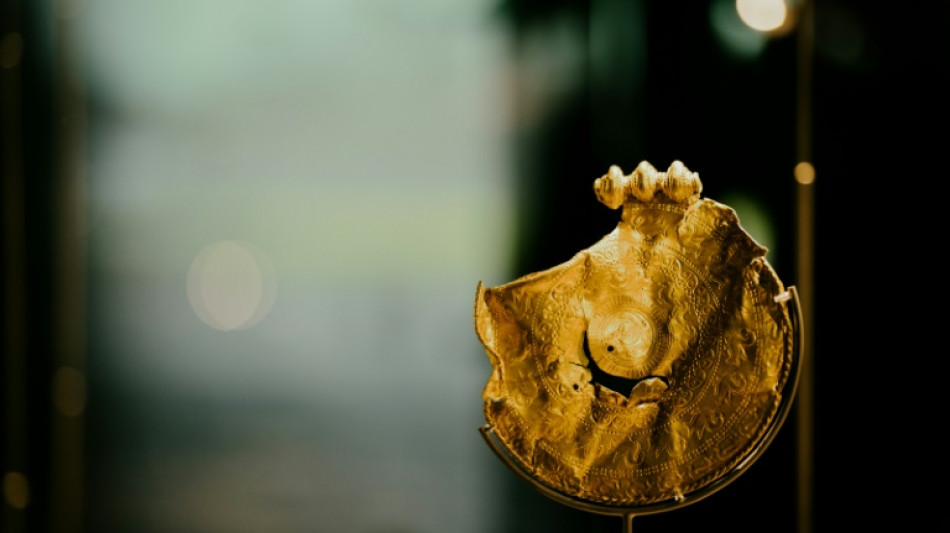
Treasure hunters' gems go on display in Denmark / Photo: Joakim ZUEGER - National Museum of Denmark/AFP

 UK-Sudanese author pens book to give children 'African history of Africa'

 US Congress passes sweeping Russia sanctions bill

 US stocks fall, dollar gains after Fed lifts interest rates

 US Fed raises rates to tackle 'too high' inflation in move sure to rile Trump

 US Fed raises rates to battle inflation in move likely to rile Trump

 US House faces test on sweeping Russia sanctions bill

 British PM says to make 'difficult decisions' as inflation rises

 Global fuel price demos: a round-up

 Leverate Launches MCP for Traders to Connect AI Assistants With Trading Platforms

 MEXC Launches $1M "Discover Your Wall Street DNA" Campaign to Help Traders Find Their Market Fit

 Stocks edge higher ahead of US Fed rate call

 BASIS.pro Expands On-Chain Infrastructure with XDC Network Partnership and Zypher DAO as Auto Earn Goes Live

 Pickle-flavoured tart? AI inspires Japan's convenience stores

 EU chief hosts Canada's Carney in push to 'deepen' alliance

 Meta chief pushes back on AI slowdown calls

 US Fed to deliver rate decision with markets betting on hike

 i-payout Expands U.S. Money Transmitter Licensing Footprint and Advances European EMI Strategy

 US Senate crypto bill collapses amid partisan deadlock

 OpenAI, Anthropic and Google are working to create an AI standards body

 Protesting shepherds, farmers clash with Romanian police

 Foundation Lets Ledger Users Switch to Open Source Without Starting Over

 EU to propose curbing social media, online games for under 15s

 FX Junction Reaches 40,600 Members and 26 Million Trades

 'We unleashed the beast': the world's fears and hopes about AI

 Hospitality leaders ask Burnham to halve VAT amid rising costs

They may be derided elsewhere but in Denmark, hobby archaeologists who hunt treasures with metal detectors are such an asset the National Museum has dedicated an entire exhibit to their finds.
"What they save now means the world for what we can do in the future and how we can build our museums," exhibit curator Line Bjerg told AFP.
"What they do really matters."
In Denmark's muddy soil, if objects "are not saved, then they are lost to history", she added.
In three rooms on the museum's bottom floor, visitors can learn about "detectorists" and admire some of their discoveries, including rings, necklaces and gold coins, all marked with the name of their finder.
In the Scandinavian country once populated by Vikings, amateurs can use metal detectors almost everywhere as long as they get permission from the landowner. They are not, however, allowed to dig beneath the top layer of soil.
Any archaeological finds have to be turned over to a local museum for an initial evaluation before they are transferred to the National Museum for an in-depth assessment -- and a possible reward.
Detectorists' hauls can be abundant.
"Last year, we had almost 18,000 objects that were sent for treasure trove processing. The year before that it was 30,000 objects," Bjerg said.
Known as "Danefae", any archaeological artefacts found by treasure hunters automatically belong to the state, under an old medieval law.
According to Torben Trier Christiansen, an archaeologist with the Historical Museum of Northern Jutland, the collaboration with the hobbyists is invaluable.
They are "one of the most important collaborators of the museum", he insisted.
There are more than 250 detectorists in his region, with the most active among them handing over around a hundred objects per year.
Arne Hertz, a 64-year-old pensioner who heads a local association of detectorists, said "people are pleased to do the right thing by handing over the findings".
- Writing history together -
The unique collaboration is based on a mutual understanding. On the one hand, archaeological sites won't be looted. On the other, authorities are able to showcase the amateur discoveries.
"Sometimes it's these particular finds that change our history because they add knowledge that we simply did not have before," Bjerg noted.
One section of the biggest exhibition room is dedicated to the "Vindelev Treasure".
Comprised of 22 gold objects, it was buried in the sixth century in southwestern Denmark and found in late 2020 by an amateur who had just bought a metal detector.
The treasure trove includes a bracteate -- a thin coin stamped on one side.
"And on the inscription of the bracteate is mentioned the name of Odin, the Norse god. And it puts Odin 150 years before we actually knew that he existed as a god," Bjerg said.
"We're building our history together in Denmark."
For detectorists, whose finds have on occasion been displayed at local museums, the exhibit at the National Museum is a major recognition.
"It's very impressive to see how the things we've found are displayed -- and to see that we are actually helping a little to enrich Denmark's history," 38-year-old Simon Grevang, who works in online marketing and has been a detectorist for four years, told AFP.
The exhibit has drawn crowds since opening in February.
Annie Lund, a 72-year-old retiree who was enthralled by the jewellery on display, said it was a good way of making history accessible.
"Twenty or forty years ago, this was only for a small group of people, scientists... not for the general public. So I think this is really good," she said.
Y.Uduike--CPN