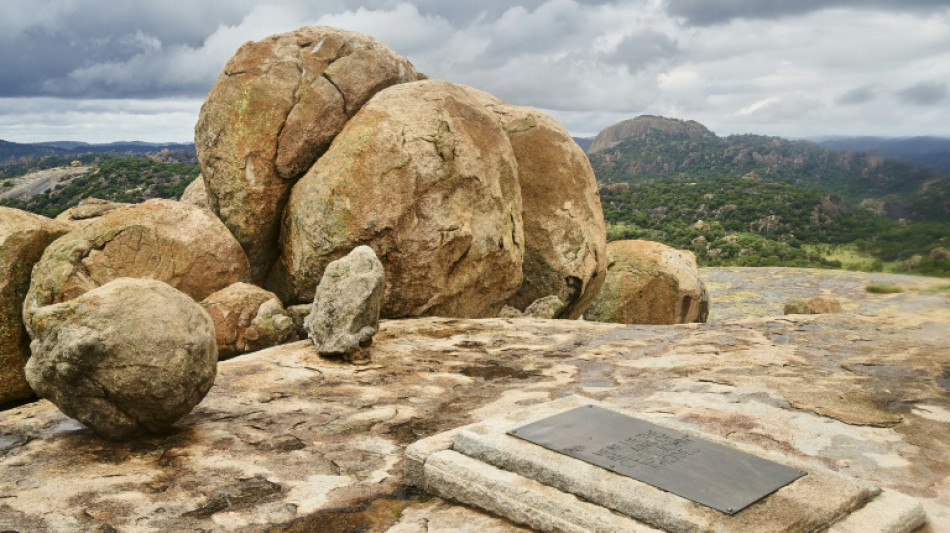
British colonialist Cecil Rhodes's grave haunts Zimbabweans / Photo: Zinyange Auntony - AFP

 UK-Sudanese author pens book to give children 'African history of Africa'

 US Congress passes sweeping Russia sanctions bill

 US stocks fall, dollar gains after Fed lifts interest rates

 US Fed raises rates to tackle 'too high' inflation in move sure to rile Trump

 US Fed raises rates to battle inflation in move likely to rile Trump

 US House faces test on sweeping Russia sanctions bill

 British PM says to make 'difficult decisions' as inflation rises

 Global fuel price demos: a round-up

 Leverate Launches MCP for Traders to Connect AI Assistants With Trading Platforms

 MEXC Launches $1M "Discover Your Wall Street DNA" Campaign to Help Traders Find Their Market Fit

 Stocks edge higher ahead of US Fed rate call

 BASIS.pro Expands On-Chain Infrastructure with XDC Network Partnership and Zypher DAO as Auto Earn Goes Live

 Pickle-flavoured tart? AI inspires Japan's convenience stores

 EU chief hosts Canada's Carney in push to 'deepen' alliance

 Meta chief pushes back on AI slowdown calls

 US Fed to deliver rate decision with markets betting on hike

 i-payout Expands U.S. Money Transmitter Licensing Footprint and Advances European EMI Strategy

 US Senate crypto bill collapses amid partisan deadlock

 OpenAI, Anthropic and Google are working to create an AI standards body

 Protesting shepherds, farmers clash with Romanian police

 Foundation Lets Ledger Users Switch to Open Source Without Starting Over

 EU to propose curbing social media, online games for under 15s

 FX Junction Reaches 40,600 Members and 26 Million Trades

 'We unleashed the beast': the world's fears and hopes about AI

 Hospitality leaders ask Burnham to halve VAT amid rising costs

It's a sacred hill where for centuries Zimbabweans would go to consult their ancestors.
It's also where the notorious British coloniser Cecil John Rhodes chose to be his final resting place.
The white supremacist died more than 120 years ago in South Africa aged 48 after carving out swathes of territory for the British empire.
Part of the land grab, later named Rhodesia in his honour, included modern Zambia and Zimbabwe.
Nestled in the Matobo National Park, his grave is simple, with "Here lie the remains of Cecil John Rhodes" engraved on it.
Part of the younger generation wants his remains removed to rid the country of the last vestiges of colonialism.
But the grave attracts tourists who bring much-needed income for surrounding villages -- and many local people oppose any exhumation.
Located atop a steep hill immersed in lush vegetation, a short climb is necessary to reach the grave, which is surrounded by imposing rocks rounded by erosion.
The stones are covered in light green aniseed and orange lichens that brighten at the slightest touch of the sun.
From the hilltop, visitors gaze at the vast expanse of trees around, where antelopes and warthogs roam.
Clouds roll across the tranquil horizon while birds chirp in the silence.
In neighbouring South Africa, students at the University of Cape Town launched a "Rhodes-Must-Fall" protest in 2015, initially to pull down Rhodes's statue at the campus.
It later morphed into a global campaign, which saw Oxford University resisting calls to remove a statue of the politician -- placing an explanatory panel next to it instead.
Often described as a philanthropist but also an arch-racist, Rhodes dreamt of a British Africa from Cape Town to Cairo, with the blessings of Queen Victoria.
Cynthia Marangwanda, 37, from Harare, is enraged by the presence of Rhodes grave.
She believes he chose that site because he knew its spiritual significance to the local people.
It was his "final display of power, a deliberate and calculated act... of domination," said the activist.
Zimbabwe's ex-strongman Robert Mugabe, who took the reins from independence from Britain in 1980, saw no reason to remove Rhodes's remains.
But Marangwanda has been energised by the current president, Emmerson Mnangagwa, who "understands the significance, the heritage aspect of the debate".
Even so, more than five years after Mnangagwa came to power, there is no indication of movement on the issue -- or consensus on where the remains would go.
- 'Pre-eminent shrine' -
The economic benefits accruing from the tourism, do not hold water for Marangwanda.
"Matobo is such a beautiful landscape, it doesn't need this colonial grave," to attract foreign visitors, she stressed.
The presence of the grave in Zimbabwe is an "insult to our very existence as a people," said historian and co-founder of Rhodes-Must-Fall campaign Tafadzwa Gwini, 33.
Exhuming the remains "is a form of reclaiming our identity as a people", insists Gwini.
Yet some visitors simply don't understand the outrage around the grave.
"I brought my kids. I also came here as a kid," said a 45-year-old white Zimbabwean, Nicky Johnson. "History shouldn't be tampered with. He wanted to be buried here, that's how it should be".
Akhil Maugi, 28, who lives from nearby city of Bulawayo, shares similar sentiments.
"You can't erase what happened. No one would come here if this grave was gone," he said.
Pathisa Nyathi, a 71-year-old local historian, points out that it was "the grandeur of the rocks" that made it a "holy site" that once attracted pilgrims from neighbouring countries.
The "pre-eminent shrine" in the region "was sacred to Africans" but not to Rhodes, said Nyathi.
Opposition MP and ex-education minister David Coltart, who regularly cycles in Matobo park, brings some humour to the debate saying "I must say Rhodes had an incredible eye for real estate".
Exiting the park, is a roadside market selling T-shirts, woven baskets and carved animals to tourists.
A little further is a village with a few houses.
Micah Sibanda, 82, stands barefoot, leaning on a walking stick, overlooking a few cows.
Rhodes's grave is "important" to the villagers because it attracts visitors who in turn buy crafts "and we get some money to send our kids to school, ...get food and clothing," said Sibanda.
If the grave is removedwill be very painful for us".
After all, Sibanda said, the white visitors are also coming "to pay respects to their own ancestor."
L.K.Baumgartner--CPN