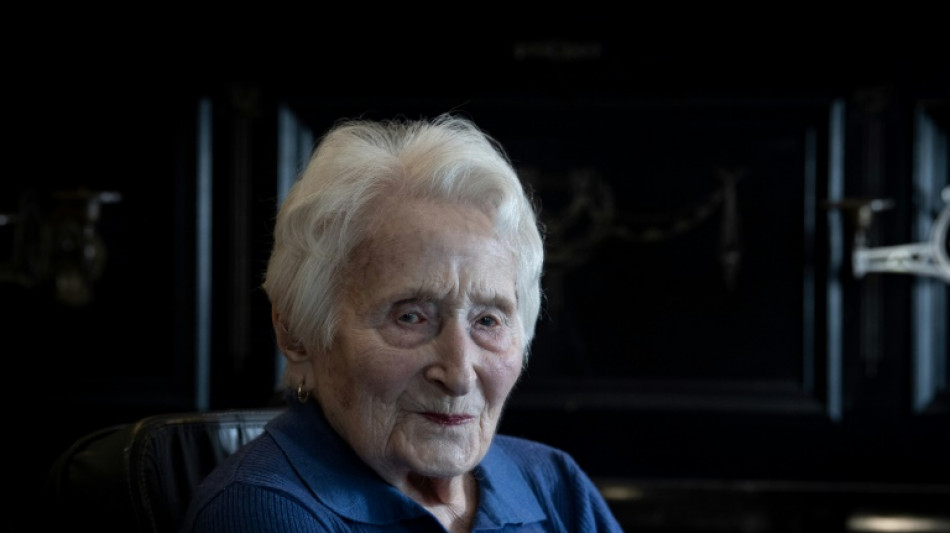
Out of the shadows: women in the French Resistance / Photo: ALAIN JOCARD - AFP

 UK-Sudanese author pens book to give children 'African history of Africa'

 US Congress passes sweeping Russia sanctions bill

 US stocks fall, dollar gains after Fed lifts interest rates

 US Fed raises rates to tackle 'too high' inflation in move sure to rile Trump

 US Fed raises rates to battle inflation in move likely to rile Trump

 US House faces test on sweeping Russia sanctions bill

 British PM says to make 'difficult decisions' as inflation rises

 Global fuel price demos: a round-up

 Leverate Launches MCP for Traders to Connect AI Assistants With Trading Platforms

 MEXC Launches $1M "Discover Your Wall Street DNA" Campaign to Help Traders Find Their Market Fit

 Stocks edge higher ahead of US Fed rate call

 BASIS.pro Expands On-Chain Infrastructure with XDC Network Partnership and Zypher DAO as Auto Earn Goes Live

 Pickle-flavoured tart? AI inspires Japan's convenience stores

 EU chief hosts Canada's Carney in push to 'deepen' alliance

 Meta chief pushes back on AI slowdown calls

 US Fed to deliver rate decision with markets betting on hike

 i-payout Expands U.S. Money Transmitter Licensing Footprint and Advances European EMI Strategy

 US Senate crypto bill collapses amid partisan deadlock

 OpenAI, Anthropic and Google are working to create an AI standards body

 Protesting shepherds, farmers clash with Romanian police

 Foundation Lets Ledger Users Switch to Open Source Without Starting Over

 EU to propose curbing social media, online games for under 15s

 FX Junction Reaches 40,600 Members and 26 Million Trades

 'We unleashed the beast': the world's fears and hopes about AI

 Hospitality leaders ask Burnham to halve VAT amid rising costs

For decades after the end of World War II, the thousands of women who took part in France's resistance against Nazi German occupation in WWII rarely got a mention in the history books.
The stories of Lucie Aubrac, a teacher who broke her husband Raymond out of a lorry transporting him to a Gestapo jail, Marie-Madeleine Fourcade, a Resistance leader who was smuggled to Spain in a mailbag, and Madeleine Riffaud, a sharpshooter who helped liberate Paris, were exceptional tales in an otherwise male-dominated narrative.
Abroad, perhaps the most famous "resistante" is US-born dancer and singer Josephine Baker, who served as a lieutenant in the French air force's auxiliary corps during the war and passed on information concealed in sheet music.
The feminist movement of the late 1960s and 1970s led to a surge of interest in the role played by women in the war.
But it took until 2015 for women resisters in the person of ethnologist Germaine Tillion and Genevieve De Gaulle-Anthonioz, a niece of war hero General Charles de Gaulle, to be honoured with places in the Pantheon mausoleum, France's secular holy of holies.
- Civilian resistance -
Women accounted for between 12 and 25 percent of all Resistance members, according to Laurent Douzou, a history professor at Lumiere Lyon-11 university.
And yet only six women have been honoured as Companions of the Liberation -- an award created by De Gaulle to decorate those who fought for France's freedom -- compared with 1,038 men.
"Civilian resistance, which was mainly the work of women, was not counted," Vladimir Trouplin, curator of a Paris museum dedicated to Resistance heroes, explained to AFP.
Misogyny also explains why women received so little recognition for the role they played.
"In those days women were not supposed to steal the limelight", Trouplin noted.
Nearly 80 years after the end of the war, the race is on to collect the stories of the women who made a strike for freedom in countless vital ways -- by for instance ferrying messages and packages, transporting arms in baskets and buggies or acting as escorts for fugitive French or Allied prisoners or spies.
Ahead of International Women's Day on March 8, AFP interviewed three of the thousands of women whose stories of wartime heroism had yet to be told: Odile de Vasselot, aged 101, Odette Niles, aged 100, and Michele Agniel, aged 96.
All three took advantage of the fact that women were deemed less suspect and less courageous than men to slip unnoticed through checkpoints and borders.
All three diced with death.
Odette spent nearly three years in French internment camps, Odile was nearly killed during the liberation of Paris and Michele was sent to Germany on the last deportation train from Paris in August 1944.
Between 1940 and 1944, 6,700 women were deported from occupied France, the vast majority of them Resistance members.
Their bravery helped advance the struggle for the emancipation of women. In 1944, French women finally gained the right to vote.
T.Morelli--CPN