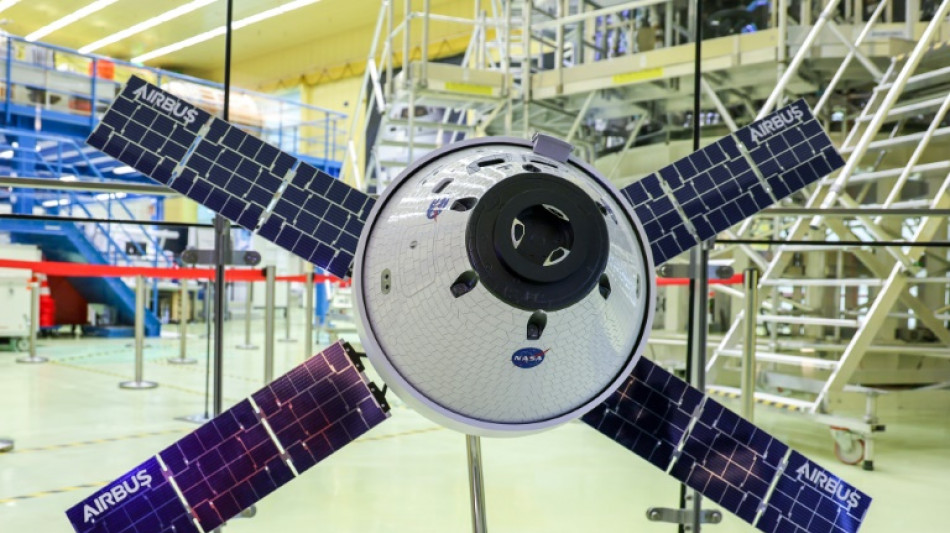
Europe shoots for the moon with role in NASA programme / Photo: FOCKE STRANGMANN - AFP

 Argentine judge orders suspension of Falklands oil project

 US Fed raises rates to tackle 'too high' inflation, irking Trump

 Turkey releases 106 protesters, jails more LGBTQ activists

 Candidate for UN chief calls for AI regulation akin to nuclear weapons

 'We're losing control,' AI pioneer Yoshua Bengio tells AFP

 IR-MED and Dice Technologies Announce collaboration to Evaluate and Advance Pressure-Injury Prevention Platform in Japan

 Watts, Pitt, Cruz to light up Spain's top film festival

 Toogood Gold's Table Mountain Sits in the Shadow of a Nevada Gold Rush

 MEXC July–August Security Report: 38.66M USDT in Risk Funds Intercepted, Futures Insurance Fund Hits 792M USDT

 Emporio Armani names Dario Vitale new creative director

 EU to ban social media for under 13s, curb access until 15

 Wildfires push endangered Sumatran elephants to brink: Indonesian NGO

 Bank of Japan set to raise rates under pressure from inflation, US

 EU chief to unveil social media, gaming curbs for under-15s

 'Resident Evil' film brings video game's ethos to the big screen

 GA-ASI Mojave First UAS To Complete Battlefield Short Field Ops

 Sanders, Bannon warn of AI dangers in rare US left-right alignment

 Empty benches as schools reopen in Venezuela's quake-hit Guaira

 Tiny English village holds 'independence' vote over asylum seeker housing

 US Treasury chief says to meet Chinese counterpart at weekend

 BingX Evolves into a Multi-Asset Trading Platform, Connecting Users to Global Opportunities

 International Trading Institute Expands Professional Trader Development Beyond the Master’s in Trading

 Lake Energy Secures $80 Million for U.S. Renewable Energy Expansion

 Stocks drop, oil climbs and Treasury yields hit 19-year high

 SkySail Strategies Outperforms Wall Street's 30-Year Risk Standard With Proprietary AI Inference Model

European astronauts could walk on the Moon for the first time in the coming years, in exchange for the continent taking on a key role in an ambitious NASA space programme.
The US space agency's Artemis programme aims to return humans to the Moon for the first time since the historic Apollo missions, which ended in 1972.
For the first time, the European Space Agency (ESA) and European aerospace giant Airbus have been entrusted with supplying vital "service modules" (ESMs) for NASA's Orion spacecraft.
In exchange, Europe has three guaranteed seats on the mission's flights, probably from 2027, although discussions are ongoing to try to get earlier spots.
The role of the Europeans is vital -- they are providing "half of the spacecraft that will take people to the Moon and, of course, back to Earth safely," said Marc Steckling, Airbus's head of space exploration.
The modules are critical to power the spacecraft, providing electricity from solar panels, and other vital supplies such as water and oxygen.
Cylinders measuring about four by four metres with about 22,000 parts and weighing about 12 tons, the modules are put together at Airbus's site in Bremen, northern Germany.
Once assembled and safety tests are completed, they are transferred to the Kennedy Space Center in Florida.
The ESMs can also provide manoeuvring capability, and could even carry additional cargo to a planned space station in orbit around the Moon, called Gateway.
- 'Open history book' -
The two-billion-euro ($2.1 billion) project is running smoothly, and Airbus is on track to meet NASA's requirement of delivering one ESM a year, according to Steckling.
Supporters of the idea of sending humans back to the Moon say it could prove vital in scientific research.
Alexander Gerst, a German astronaut who has done two stints on the International Space Station, described the Moon as an "open history book".
"We can learn how Earth was actually formed and how it came into existence," he said.
A first Artemis mission wrapped up successfully in December, with an uncrewed Orion capsule returning safely to Earth after a more than 25-day journey around the Moon.
The Artemis 2 mission, planned for 2024, will take a crew towards the Moon but still without landing on it.
Artemis 3, scheduled for 2025, will see a spacecraft land for the first time on the south pole of the Moon, where they hope to find water in the form of ice. The space agency thereafter aims to launch one mission per year.
As part of the Artemis missions, NASA is planning to send a woman and a person of colour to the Moon for the first time.
Only 12 people -- all of them white men -- have set foot on the Moon, and that was during the Apollo missions.
- 'Repository of history' -
NASA hopes to establish a lasting human presence on the Moon, and later launch a years-long trip to Mars.
Philippe Berthe, European Space Agency project coordination manager for the modules, said the Moon had resources that could be exploited such as ice that could be used to make fuel, particularly at its south pole.
"The moon is a repository of history of the solar system since its creation, which has remained relatively untouched since there is no atmosphere, no erosion," he told AFP.
Whereas in the 1960s the space race was between the Soviet Union and Washington, China has now emerged as the United States's chief rival in the intergalactic arena with its own ambitious programme.
But such rivalry -- "a little bit of a scientific competition" -- isn't necessarily a bad thing, believes Gerst.
P.Kolisnyk--CPN
