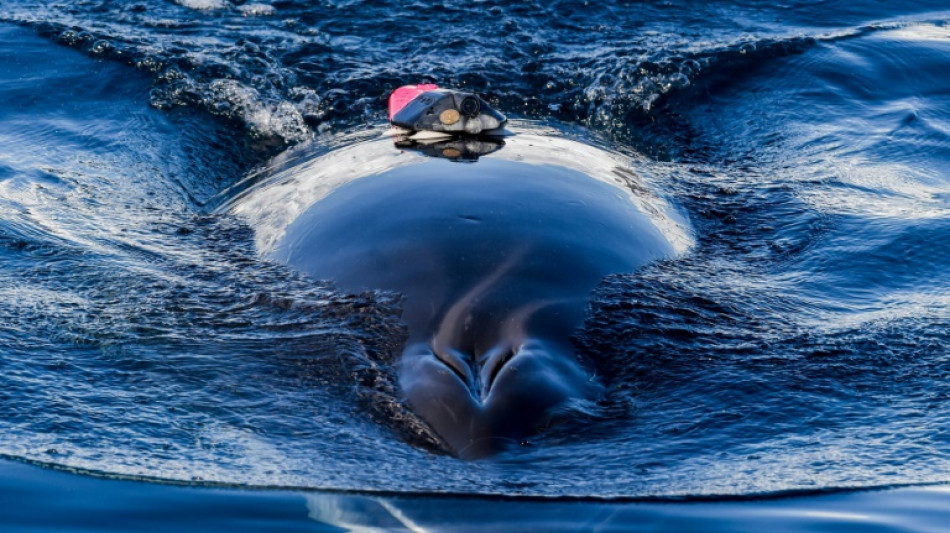
Norway study highlights whale excrement's role in ecosystem / Photo: Ari Friedlaender - Stanford University/Goldbogen Laboratory/AFP/File

 Argentine judge orders suspension of Falklands oil project

 US Fed raises rates to tackle 'too high' inflation, irking Trump

 Turkey releases 106 protesters, jails more LGBTQ activists

 Candidate for UN chief calls for AI regulation akin to nuclear weapons

 'We're losing control,' AI pioneer Yoshua Bengio tells AFP

 IR-MED and Dice Technologies Announce collaboration to Evaluate and Advance Pressure-Injury Prevention Platform in Japan

 Watts, Pitt, Cruz to light up Spain's top film festival

 Toogood Gold's Table Mountain Sits in the Shadow of a Nevada Gold Rush

 MEXC July–August Security Report: 38.66M USDT in Risk Funds Intercepted, Futures Insurance Fund Hits 792M USDT

 Emporio Armani names Dario Vitale new creative director

 EU to ban social media for under 13s, curb access until 15

 Wildfires push endangered Sumatran elephants to brink: Indonesian NGO

 Bank of Japan set to raise rates under pressure from inflation, US

 EU chief to unveil social media, gaming curbs for under-15s

 'Resident Evil' film brings video game's ethos to the big screen

 GA-ASI Mojave First UAS To Complete Battlefield Short Field Ops

 Sanders, Bannon warn of AI dangers in rare US left-right alignment

 Empty benches as schools reopen in Venezuela's quake-hit Guaira

 Tiny English village holds 'independence' vote over asylum seeker housing

 US Treasury chief says to meet Chinese counterpart at weekend

 BingX Evolves into a Multi-Asset Trading Platform, Connecting Users to Global Opportunities

 International Trading Institute Expands Professional Trader Development Beyond the Master’s in Trading

 Lake Energy Secures $80 Million for U.S. Renewable Energy Expansion

 Stocks drop, oil climbs and Treasury yields hit 19-year high

 SkySail Strategies Outperforms Wall Street's 30-Year Risk Standard With Proprietary AI Inference Model

Minke whale excrement is "worth its weight in gold" as it plays an important role in fertilizing phytoplankton and thereby reducing the cetacean's carbon footprint, according to a Norwegian study.
For the first time, researchers from the Norwegian Institute for Marine Research have studied the concentration of nutrients in whale excrement before it is dissolved in seawater.
"It can sound disgusting, but for the ecosystem it's worth its weight in gold," researchers said in a statement Thursday.
"The idea is simply that the faeces fertilize the sea in the same way that cows and sheep do on land," they continued.
The researchers analysed the excrement of minke whales harpooned by whalers -- as Norway is one of few countries allowing the commercial hunting of these cetaceans.
The some 15,000 whales that migrate each summer to the Norwegian archipelago of Svalbard in the Arctic release some 600 tonnes of excrement on the surface of the water each day, at a rate of about 40 kilograms (88 pounds) per animal.
According to the study, the daily excrement releases about 10 tonnes of phosphorus and 7 tonnes of nitrogen into the oceans, nutrients that are essential for the growth of phytoplankton -- microscopic algae that absorb carbon dioxide through photosynthesis and convert it into oxygen.
The scientists concluded that the minke whale excrement contributed to between 0.2 and 4 percent of daily phytoplankton production in the Arctic Svalbard region.
"The real contribution of whales is probably higher because these estimates do not include urine, which is very rich in nitrogen," research leader Kjell Gundersen told AFP.
Each minke whale -- an animal weighing 40-50 tonnes as an adult that feeds by filtering large quantities of water -- releases "several hundred litres of urine" per day.
"If there are fewer whales, there is a risk that there will be less fertilisation of the ocean," Gundersen said.
"More phytoplankton production also means more CO2 is absorbed," he added.
"This is positive for the climate," he noted, "but we don't know the net balance of whales in terms of greenhouse gases" because cetaceans also emit methane when they breathe.
This question, which is still largely unexplored, will be the subject of a European study that will start in June and last four years.
U.Ndiaye--CPN
