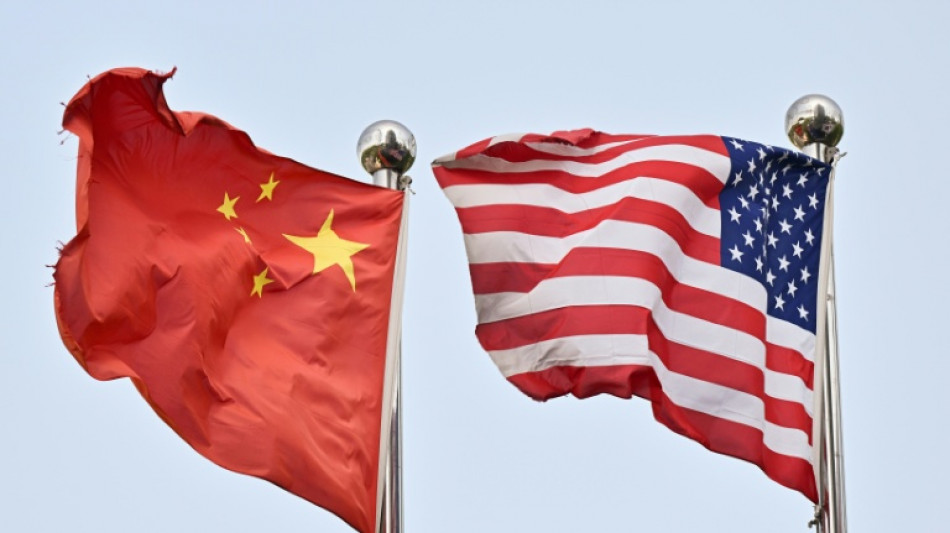
US-China 'Board of Trade' may help ties but experts flag market worries / Photo: Pedro Pardo - AFP/File

 In Brazil's Amazon, the hunt for oil fuels hopes and fears

 Baby orangutans in India expose 'frightening' scale of trafficking

 Oversight Board blasts 'inadequate' Meta safeguards for AI deepfakes

 Harry makes first public appearance since return to UK

 Princess Diana's brother makes new explosive claims against Charles

 Trump admin overhauls key protection for endangered species

 Mbappe draws political fire over Ceuta t-shirt controversy

 Third malaria death in Germany from outbreak tied to Frankfurt airport

 AtlasClear Holdings Reports Preliminary Fiscal 2026 Revenue of Approximately $20.1 Million, Up 85%; Revenue Plus Interest Income of Approximately $21.9 Million

 'Another arrow to the quiver': World Bank posts record private capital mobilization

 Ireland to boycott Eurovision 2027 over Gaza

 India's Tata Sons reappoints N. Chandrasekaran as chairman

 Germany urges EU action against China to defend carmakers

 Japan eyes changing prostitution law to punish sex buyers

 Modi pitches India as global chipmaking hub

 Ukraine plans record defence spending in 2027

 NASA scan discovers new, 'once in a century' Moon crater

 Most stocks rise as Fed hikes and indicates drive to curb inflation

 UK-Sudanese author pens book to give children 'African history of Africa'

 Argentine judge orders suspension of Falklands oil project

 US Fed raises rates to tackle 'too high' inflation, irking Trump

 Turkey releases 106 protesters, jails more LGBTQ activists

 Candidate for UN chief calls for AI regulation akin to nuclear weapons

 'We're losing control,' AI pioneer Yoshua Bengio tells AFP

 IR-MED and Dice Technologies Announce collaboration to Evaluate and Advance Pressure-Injury Prevention Platform in Japan

As Washington and Beijing mull a new mechanism to adjust trade between the world's two largest economies, some analysts warn that it could interfere with market forces, while others consider it a path to smoother coexistence.
What is the managed approach to trade that Donald Trump's administration is seeking with China, as both sides work towards the US president's potential meeting with Chinese leader Xi Jinping in the coming weeks?
- What is a 'Board of Trade'? -
After top US economic officials held talks with their Chinese counterparts in Paris last weekend, US trade envoy Jamieson Greer said both sides discussed creating a "US-China Board of Trade."
The mechanism would help to formalize and identify what kinds of goods the United States should be exporting to and importing from China, he said.
The board could look into opportunities for expanding trade in non-sensitive products, or discuss mutual tariff reduction in non-strategic sectors, said Wendy Cutler of the Asia Society Policy Institute.
For now, officials appear to have made progress towards Chinese purchase commitments for agriculture, energy and planes from the United States, added Cutler, a former US trade official.
- Is this new to US-China ties? -
The talks come as Washington looks towards "managed trade," which Chad Bown of the Peterson Institute for International Economics said focuses on outcomes rather than policies.
This could mean import commitments or voluntary export restraints, as in the case of Japan in the 1980s to manage the flow of autos into the United States, he said.
A more recent example is the "Phase One" deal that Washington signed with Beijing during Trump's first presidency, marking a truce in their trade war, Bown added.
The agreement saw China agree to import an added $200 billion in US products over two years -- although China did not meet the commitment.
- Why has this sparked worry? -
"Instead of taking regulations out, tariffs down, and making it easier for customers and companies to decide what they sell at what prices, it (would be) more mechanized," said Joerg Wuttke, a partner at advisory firm DGA-Albright Stonebridge Group.
"That's not a good sign," he told AFP. "Where are the market forces?"
Such an approach is also not good for competitiveness, and could fuel concern among other trading partners, Wuttke warned.
A US-based business leader, speaking on condition of anonymity, said that managing trade raises concerns over how Washington will decide which industries to prioritize, and which sectors will benefit.
- Does it help the relationship? -
Bown of PIIE believes a managed trade agreement between the United States and China could be more successful than previous attempts to solve economic conflicts.
The question is whether this leads to "a more sustainable, longer-term relationship" that is better than a "constant back and forth of conflict," he said.
"It's clear the old system didn't work. Could we try a new system that might work?"
But any trade agreement would have to be realistic and acceptable to both parties.
"You'd have to have a sincere commitment by both sides to make this work," he added. "Even then, it's going to be really, really hard."
T.Morelli--CPN


