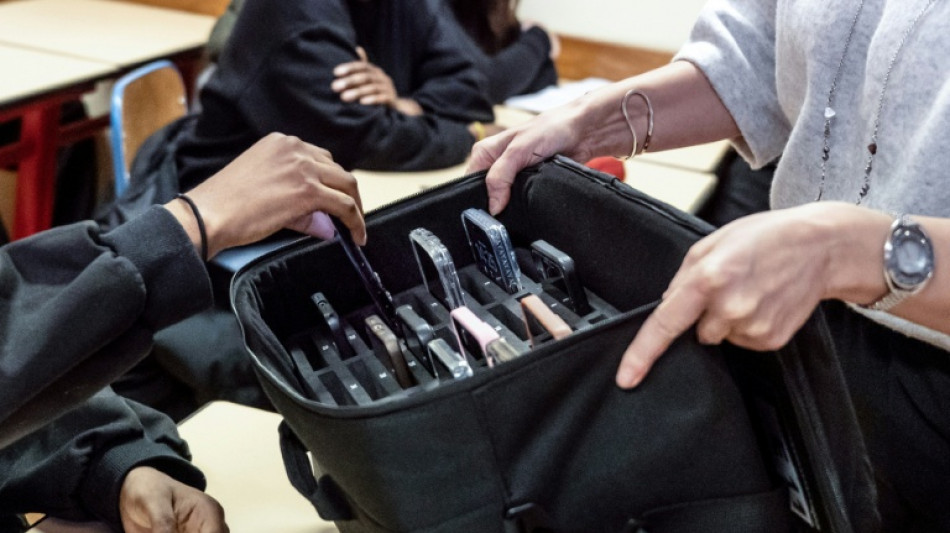
Sweden plans to ban mobile phones in schools / Photo: BERTRAND GUAY - AFP/File

 AI 'warning shots' focus Beijing on national security risks

 Philippine tribe in limbo over US-led tech hub

 Saudi-led coalition says Houthis fired ballistic missile at Riyadh

 Cuba works to restore power after another blackout

 Brigitte Bardot widower slams sale of star's belongings

 Indonesia accepts Malaysia's help to tackle wildfires

 Nvidia, OpenAI CEOs to attend Xi dinner at White House
 Cuba hit with seventh major blackout of the year

 Nigeria miners struggled to breathe in cell before 37 died: survivors

 Warren Buffett steps down as Berkshire Hathaway chairman

 Isolated Syrian-Druze city blames Damascus for shortages

 Kerry James Marshall: American 'blackness' painter celebrated in Europe

 Infantino 'must go', says German FA vice-president

 Japan's busiest rail station tests robot bins

 Backpackers fret over Australian visa crackdown

 Bank of Japan hikes rates to 31-year high to battle inflation

 AI doomsday warnings unlikely to slow IPOs but questions linger

 In Brazil's Amazon, the hunt for oil fuels hopes and fears

 Baby orangutans in India expose 'frightening' scale of trafficking

 Oversight Board blasts 'inadequate' Meta safeguards for AI deepfakes

 Harry makes first public appearance since return to UK

 Princess Diana's brother makes new explosive claims against Charles

 Trump admin overhauls key protection for endangered species

 Mbappe draws political fire over Ceuta t-shirt controversy

 Third malaria death in Germany from outbreak tied to Frankfurt airport

Sweden plans to ban mobile phones from primary and middle schools in order to ensure that children can focus on learning in the classroom, the government said on Wednesday.
The ban would mean that pupils in classes up to grade nine, or aged 15-16, would hand in their phones in the morning and get them back at the end of the school day.
"Studies show that Swedish students are distracted by digital tools in the classroom to a greater extent than students in the OECD on average," the government said in a statement.
"The government is therefore proposing a ban on mobile phones throughout the school day."
Around 80 percent of Swedish primary and middle schools already have bans on mobile phones in the classroom, introduced at the principals' discretion, according to Swedish news agency TT.
But Education Minister Simona Mohamsson told a press conference a nationwide ban was needed to ensure that all schools were mobile-free zones.
"It will decrease distractions in the classroom," she said, describing it as "a win for both teaching and mental health."
She said the ban could also "help many parents in their struggle at home" to reduce screen time.
Mohamsson said data showed that Swedish middle school students spend an average of almost seven hours a day on screens, not including screen time during school hours.
If adopted by parliament, the ban would go into force in time for the start of the autumn term in August 2026, and would also apply to after-school care facilities.
The Scandinavian country launched a national "digitalisation" strategy for nursery, primary and middle schools in 2017 that saw tablets and laptops replace many textbooks and handwriting.
But it began rolling back that policy in 2023 amid criticism over declining school performances.
St.Ch.Baker--CPN