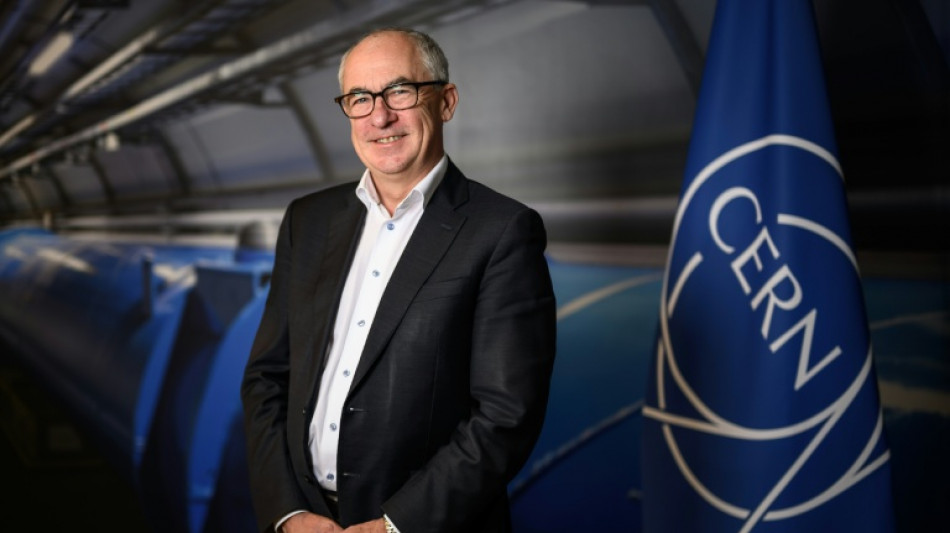
CERN chief upbeat on funding for new particle collider / Photo: Fabrice COFFRINI - AFP

 AI 'warning shots' focus Beijing on national security risks

 Philippine tribe in limbo over US-led tech hub

 Saudi-led coalition says Houthis fired ballistic missile at Riyadh

 Cuba works to restore power after another blackout

 Brigitte Bardot widower slams sale of star's belongings

 Indonesia accepts Malaysia's help to tackle wildfires

 Nvidia, OpenAI CEOs to attend Xi dinner at White House

 Cuba hit with seventh major blackout of the year

 Nigeria miners struggled to breathe in cell before 37 died: survivors

 Warren Buffett steps down as Berkshire Hathaway chairman

 Isolated Syrian-Druze city blames Damascus for shortages

 Kerry James Marshall: American 'blackness' painter celebrated in Europe

 Infantino 'must go', says German FA vice-president

 Japan's busiest rail station tests robot bins

 Backpackers fret over Australian visa crackdown

 Bank of Japan hikes rates to 31-year high to battle inflation

 AI doomsday warnings unlikely to slow IPOs but questions linger

 In Brazil's Amazon, the hunt for oil fuels hopes and fears

 Baby orangutans in India expose 'frightening' scale of trafficking

 Oversight Board blasts 'inadequate' Meta safeguards for AI deepfakes

 Harry makes first public appearance since return to UK

 Princess Diana's brother makes new explosive claims against Charles

 Trump admin overhauls key protection for endangered species

 Mbappe draws political fire over Ceuta t-shirt controversy

 Third malaria death in Germany from outbreak tied to Frankfurt airport

Mark Thomson, the new head of Europe's physics laboratory CERN, voiced confidence Tuesday about raising the billions of dollars needed to build by far the world's biggest particle accelerator.
CERN, the European Organization for Nuclear Research, seeks to unravel what the universe is made of and how it works.
The planned Future Circular Collider (FCC) would be a proton-smashing ring with a circumference of 91 kilometres and an average depth of 200 metres.
Scientists believe that ordinary matter -- such as stars, gases, dust, planets and everything on them -- accounts for just five percent of the universe.
The FCC will try to reveal what makes up the other 95 percent, the so-called dark matter and dark energy that scientists have yet to observe directly.
"That project would start operation in the second half of the 2040s," Thomson told reporters.
The British particle physicist took over as CERN's director-general on January 1.
He said the gigantic collider would cost around $19.5 billion.
"About half of that comes out of the existing ongoing budget, and we have to find the resources for the other half," he said.
"I'm very optimistic personally, but it's not going to be straightforward."
In December, in a first for the laboratory, private donors pledged $1 billion towards the construction of the FCC.
"They're not expecting anything in return. This is really for the good of science," said Thomson.
- 'Giant leap forward' -
Based on the outskirts of Geneva, CERN has 25 member states and its council is set to take a decision in 2028 on whether to go ahead with the FCC.
For now, CERN's Large Hadron Collider (LHC) is currently the world's biggest particle accelerator, whizzing particles into each other at phenomenal speeds.
The 27-kilometre proton-smashing ring, running about 100 metres below France and Switzerland, has, among other things, been used to prove the existence of the Higgs boson.
Dubbed "the God particle", its discovery in 2012 broadened science's understanding of how particles acquire mass and earned physicists Peter Higgs and Francois Englert the 2013 Nobel Prize for Physics.
The LHC is expected to have fully run its course by around 2040.
It is set to resume operations in February after a winter break, before shutting down again in June.
It will then undergo upgrades, including more powerful focusing magnets and new optics, becoming the High Luminosity LHC (HL-LHC), aimed at conducting more detailed studies thanks to an increased number of collisions.
"This is technology we just didn't have when we designed the LHC," said Thomson.
"We're going to have a brighter machine, so we get much, much more data, and every bit of data we get, we have a clearer image of what's going on.
"This is really an opportunity for discovery. And I'm not sure what we will discover.
"Sometimes you make small steps in science. This is not a small step. This is a giant, giant leap forward."
P.Schmidt--CPN