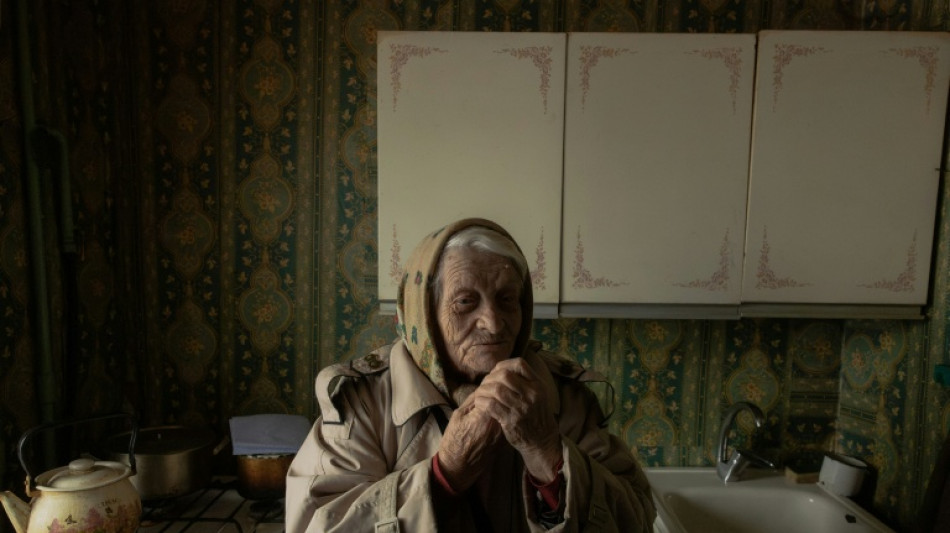
'Hard to survive': Kyiv's elderly shiver after Russian attacks on power and heat / Photo: Roman PILIPEY - AFP

 AI 'warning shots' focus Beijing on national security risks

 Philippine tribe in limbo over US-led tech hub

 Saudi-led coalition says Houthis fired ballistic missile at Riyadh

 Cuba works to restore power after another blackout
 Brigitte Bardot widower slams sale of star's belongings

 Indonesia accepts Malaysia's help to tackle wildfires
 Nvidia, OpenAI CEOs to attend Xi dinner at White House

 Cuba hit with seventh major blackout of the year

 Nigeria miners struggled to breathe in cell before 37 died: survivors

 Warren Buffett steps down as Berkshire Hathaway chairman

 Isolated Syrian-Druze city blames Damascus for shortages

 Kerry James Marshall: American 'blackness' painter celebrated in Europe

 Infantino 'must go', says German FA vice-president

 Japan's busiest rail station tests robot bins

 Backpackers fret over Australian visa crackdown

 Bank of Japan hikes rates to 31-year high to battle inflation

 AI doomsday warnings unlikely to slow IPOs but questions linger

 In Brazil's Amazon, the hunt for oil fuels hopes and fears

 Baby orangutans in India expose 'frightening' scale of trafficking

 Oversight Board blasts 'inadequate' Meta safeguards for AI deepfakes

 Harry makes first public appearance since return to UK

 Princess Diana's brother makes new explosive claims against Charles

 Trump admin overhauls key protection for endangered species

 Mbappe draws political fire over Ceuta t-shirt controversy

 Third malaria death in Germany from outbreak tied to Frankfurt airport

Shivering in her flat after Russian strikes knocked out the heating, 91-year-old Lidia Teleschuk said she couldn't remember a winter this harsh since World War II.
Russia has this month stepped up its strikes against Ukraine's power and heating infrastructure, plunging Kyiv residents into darkness and cold as temperatures dropped as low as -20C.
"In 1942, it was even worse," Teleschuk said.
"There hasn't been a winter like this since. It's been awful. It will be hard for us to survive."
The heavy targeting of the Ukrainian capital -- which Russia failed to seize at the start of its invasion -- has forced residents to find makeshift solutions to stay warm.
It has been particularly painful for elderly people like Teleschuk.
In her flat deprived of electricity, heating and hot water, the 91-year-old showed AFP how she gets through the day.
Running her hand through her brittle white hair, she mimed heating water on a gas stove to wash herself in the cold mornings.
She had also poured some of the hot water into plastic bottles, turning them into small sources of heat.
"But it's not enough, dear children. It's just enough for me to warm up a little," she said.
The temperature inside her apartment hovered between 8C and 11C.
- 'Go numb' -
Volunteers from the Starenki foundation, which delivers food and essentials to the elderly, were visiting Teleschuk to check in on her.
She beamed as one of them, programme director Alina Diachenko, gave her a battery-powered fairy light.
"Volunteers take a little time to chat. That's very important -- not just the food, but the attention," Diachenko said.
Yevgenia Yeromina, 89, couldn't hear a thing, but she too was delighted to see visitors.
She led them to her kitchen, explaining how she warmed her hands over the open flame of her gas stove.
"My hands, my fingers, they go numb," she said, slowly unclenching her fists.
She touched the pipes, which remained hopelessly cold.
Repair crews are racing to reconnect homes to power and heat, but sub-zero temperatures and repeated air strikes have slowed their efforts.
Russian strikes this month have repeatedly cut power to tens of thousands of homes and heating to 6,000 apartment blocks -- half of all those in the city.
Some of the 3.6 million people in the city have left, heading to country houses and relatives for warmth and light.
Over 900 buildings still had no heating on Tuesday, President Volodymyr Zelensky said, urging local authorities and government officials to act faster.
"There was just a little bit of heat, then bam, they bombed again, and now nothing works," Yeromina sighed.
- 'Already lived my life' -
Playfully lifting the corner of her long trench coat, Yeromina showed how she had layered up to stay warm.
A few streets away, in her flat on the 6th floor, 88-year-old Esfir Rudminska had adopted a similar strategy.
"I dress really warm, like a cabbage with two or three sweaters!" she said, head wrapped in a white silk scarf.
She was sitting in bed, the room dark except for a portable reading lamp perched on her bed.
Under the blankets, a few plastic bottles filled with hot water and power banks for her phone, on which she played crosswords.
Repeated bombings were making her nervous.
"You can get through anything, eat a piece of bread with tea and you're fine. But morally, my nerves can't take it. I try to hold on," she said, hugging a furry white hot water bottle.
"Sometimes, there's no one at home, I cry and it seems to get easier, even though I'm not a crier. I'm 88 years old, I've already lived my life."
L.Peeters--CPN