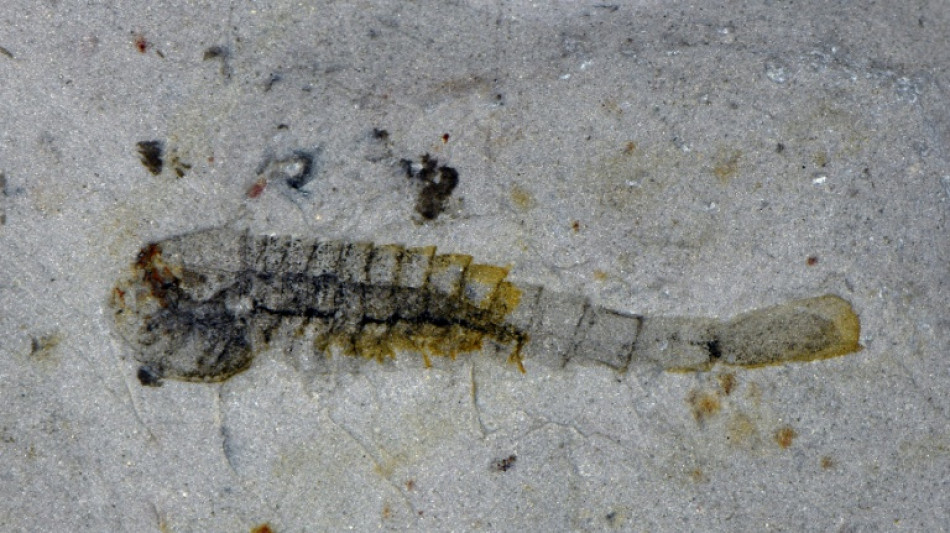
'Extraordinary' trove of ancient species found in China quarry / Photo: Han Zeng - AFP

 US House faces test on sweeping Russia sanctions bill

 British PM says to make 'difficult decisions' as inflation rises

 Global fuel price demos: a round-up

 Leverate Launches MCP for Traders to Connect AI Assistants With Trading Platforms

 MEXC Launches $1M "Discover Your Wall Street DNA" Campaign to Help Traders Find Their Market Fit

 Stocks edge higher ahead of US Fed rate call

 BASIS.pro Expands On-Chain Infrastructure with XDC Network Partnership and Zypher DAO as Auto Earn Goes Live

 Pickle-flavoured tart? AI inspires Japan's convenience stores

 EU chief hosts Canada's Carney in push to 'deepen' alliance

 Meta chief pushes back on AI slowdown calls

 US Fed to deliver rate decision with markets betting on hike

 Sanders, Bannon warn of AI dangers in rare US left-right alignment

 Empty benches as schools reopen in Venezuela's quake-hit Guaira

 Tiny English village holds 'independence' vote over asylum seeker housing

 US Treasury chief says to meet Chinese counterpart at weekend

 BingX Evolves into a Multi-Asset Trading Platform, Connecting Users to Global Opportunities

 International Trading Institute Expands Professional Trader Development Beyond the Master’s in Trading

 Lake Energy Secures $80 Million for U.S. Renewable Energy Expansion

 Stocks drop, oil climbs and Treasury yields hit 19-year high

 SkySail Strategies Outperforms Wall Street's 30-Year Risk Standard With Proprietary AI Inference Model

 Just add fish: Scientists pursue more rice, less disease in Senegal paddies

 Belgium completes outer structure of offshore energy island

 China retail sales growth weakens further in August
 In Kashmir, lake weeds mix with traditional art
 'Widow's Bay' and 'The Pitt' take key Emmy awards

Almost a hundred new animal species that survived a mass extinction event half a billion years ago have been discovered in a small quarry in China, scientists revealed Wednesday.
The treasure trove of fossils offers a rare glimpse into a cataclysmic event that brought a sudden end to the greatest explosion of life in our planet's history.
The site where the fossils were found in the southern Chinese province of Hunan was "extraordinary," Han Zeng of the Chinese Academy of Sciences told AFP.
"We have collected over 50,000 fossil specimens from a single quarry that is 12 metres high, 30 metres long and eight metres wide," added the lead author of a new study in the journal Nature.
In this small space, the Chinese team uncovered more than 150 different species -- 91 of them new to science -- between 2021 and 2024.
Han described "wonderful experiences when we realised that those animals were right there on the rock."
"Many fossils show soft parts including gills, guts, eyes and even nerves," he added.
Among the species discovered were ancient relatives of worms, sponges and jellyfish.
They also found many arthropods -- a family that includes modern-day crabs and insects -- including spiny, stalk-eyed creatures called radiodonts which were the apex predator of the time.
The discovery is particularly exciting for scientists because of the period when these strange animals lived.
- Evolution's big bang -
Life first emerged on Earth more than 3.5 billion years ago -- but was little more than a layer of slime for most of our planet's history.
Then came the Cambrian explosion, known as evolution's "big bang", roughly 540 million years ago.
Suddenly, most of the major groups of animals alive today -- including vertebrates which would eventually include humans -- evolved and started populating the world's oceans.
This burst of life is thought to have been driven by a rise in oxygen in Earth's atmosphere.
However it came to a sudden end when up to half of all animals died off 513 million years ago.
This mass extinction, known as the Sinsk event, is thought to have been caused by declining oxygen levels.
The animals in the Chinese quarry, which were dated to around 512 million years ago, represent the first major discovery of soft-bodied fossils that lived directly after the Sinsk event, Han explained.
This means the fossils -- dubbed the Huayuan biota after the county where they were found -- "open a new window into what happened," he added.
- Safety in the cellar -
Michael Lee, an evolutionary biologist at the South Australian Museum not involved in the research, said "the new fossils from China demonstrate that the Sinsk event affected shallow water forms most severely".
A deep-water fish called coelacanth similarly survived the mass extinction that wiped out all the dinosaurs that did not evolve into birds, he pointed out.
"The deep ocean is one of the most stable environments through geological time, in a similar way to how the cellar of a house is buffered from daily and seasonal changes and has less temperature fluctuations than the attic," Lee told AFP.
Han said his team was also surprised that some of the animals in the quarry had also been found at Canada's Burgess Shale site, which dates from an early period of the Cambrian explosion.
This suggests that these animals were already able to travel halfway across the world at this early stage, he added.
The Sinsk event is not considered among the best-known "big five" mass extinctions in our planet's history.
However Han said there is evidence of 18 or more mass extinctions over the last 540 million years, calling for more attention to be paid to the immensely destructive events.
Scientists have warned that Earth is currently going through another mass extinction -- this one caused by humans.
Y.Tengku--CPN