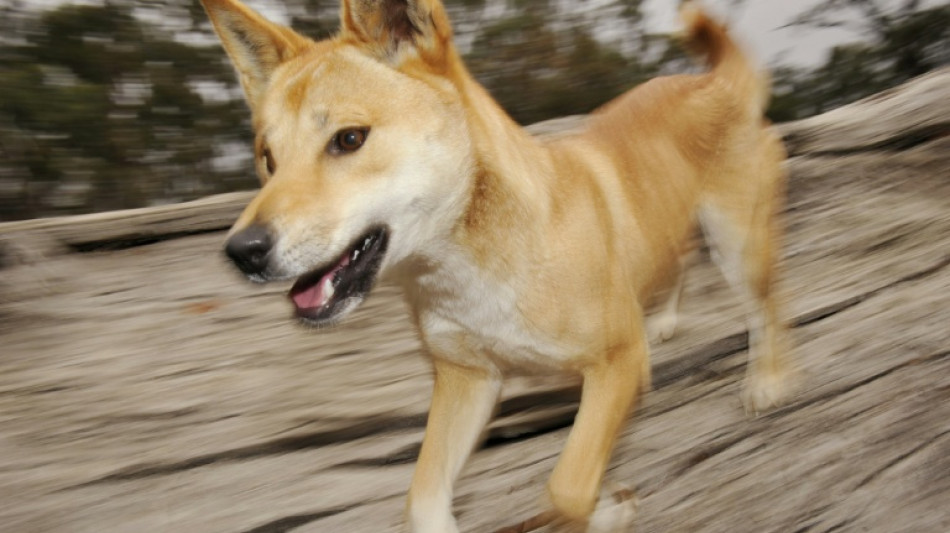
Backlash as Australia kills dingoes after backpacker death / Photo: WILLIAM WEST - AFP

 AI 'warning shots' focus Beijing on national security risks

 Philippine tribe in limbo over US-led tech hub

 Saudi-led coalition says Houthis fired ballistic missile at Riyadh

 Cuba works to restore power after another blackout
 Brigitte Bardot widower slams sale of star's belongings

 Indonesia accepts Malaysia's help to tackle wildfires

 Nvidia, OpenAI CEOs to attend Xi dinner at White House

 Cuba hit with seventh major blackout of the year

 Nigeria miners struggled to breathe in cell before 37 died: survivors

 Warren Buffett steps down as Berkshire Hathaway chairman

 Isolated Syrian-Druze city blames Damascus for shortages

 Kerry James Marshall: American 'blackness' painter celebrated in Europe

 Infantino 'must go', says German FA vice-president

 Japan's busiest rail station tests robot bins

 Backpackers fret over Australian visa crackdown

 Bank of Japan hikes rates to 31-year high to battle inflation

 AI doomsday warnings unlikely to slow IPOs but questions linger

 In Brazil's Amazon, the hunt for oil fuels hopes and fears

 Baby orangutans in India expose 'frightening' scale of trafficking

 Oversight Board blasts 'inadequate' Meta safeguards for AI deepfakes

 Harry makes first public appearance since return to UK

 Princess Diana's brother makes new explosive claims against Charles

 Trump admin overhauls key protection for endangered species

 Mbappe draws political fire over Ceuta t-shirt controversy

 Third malaria death in Germany from outbreak tied to Frankfurt airport

Australian authorities have sparked a backlash by killing a group of dingoes linked to the death of a young Canadian woman on an island in the country's east.
The Queensland government said six animals were put down after 19-year-old backpacker Piper James's body was found on January 19 at a beach on the World Heritage-listed island of K'gari.
The euthanisation programme has stirred debate about how to manage the local population of dingoes, a sandy-coloured canine believed to have first arrived in Australia 4,000 to 5,000 years ago.
An autopsy conducted on James' body found evidence "consistent with drowning" but also detected injuries corresponding to dingo bites.
"Pre-mortem dingo bite marks are not likely to have caused immediate death," said a spokesperson for the Coroners Court of Queensland.
The coroner's investigation into the cause of death was expected to take several weeks.
In response, the Queensland government said a pack of 10 dingoes involved would be euthanised after rangers had observed some "aggressive behaviour".
Six of the dingoes had already been euthanised, the state's environment minister, Andrew Powell, told reporters Sunday.
"Obviously, the operation will continue," he said.
The traditional owners of K'gari, the Butchulla people, said the state's failure to consult with them before euthanising the dingoes -- or wongari in their language -- was "unexpected and disappointing".
"Once again, it feels as though economic priorities are being placed above the voices of the people and traditional owners, which is frustrating and difficult to accept," the Butchulla Aboriginal Corporation said in a statement to Australian media this week.
- 'You are food' -
Wildlife experts said killing the animals was the wrong response and may threaten the island's dingo population, estimated at just 70-200 animals.
Given their small numbers, killing a pack of 10 animals would harm the population's genetic diversity, said Mathew Crowther, professor of quantitative conservation biology at the University of Sydney.
"There's no moral from the dingoes' point of view. They're just being wild animals, doing wild things," Crowther told AFP.
Dingoes tend to lose their fear of people as they interact with tourists, some of whom defy advice against feeding the animals.
"That's the worst thing you can do to a wild animal," Crowther said.
"They just relate humans to food, and if you don't give them food, well, you are food -- that's basically how it is."
Dingoes are wild, predatory animals and need to be treated with respect, said Bill Bateman, associate professor in the school of molecular and life sciences at Curtin University.
The canines are more likely to attack children or people who are alone, and may be triggered when people turn their backs or run, he said.
"These are important animals, and therefore we need to change the way we deal with them, otherwise we're just going to keep reacting to these attacks and driving the population of dingoes down," Bateman told AFP.
Wildlife managers, rangers, Indigenous people and tourism operators need to work together so that humans and dingoes can coexist on the island, he said.
Todd James, the father of Piper, has described on social media how his family's hearts were "shattered" by her death.
News of the dingoes' euthanisation was "heart-wrenching", he told Australian media, adding however that he recognised it may be necessary for safety because of the pack's behaviour.
A.Agostinelli--CPN