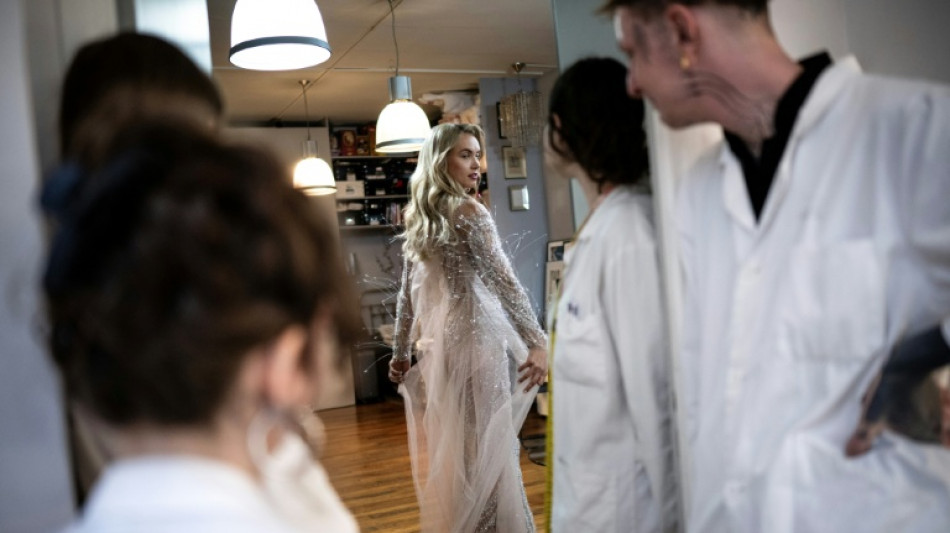
Haute Couture Week begins in Paris / Photo: JULIEN DE ROSA - AFP

 AI 'warning shots' focus Beijing on national security risks

 Philippine tribe in limbo over US-led tech hub
 Saudi-led coalition says Houthis fired ballistic missile at Riyadh
 Cuba works to restore power after another blackout
 Brigitte Bardot widower slams sale of star's belongings
 Indonesia accepts Malaysia's help to tackle wildfires

 Nvidia, OpenAI CEOs to attend Xi dinner at White House

 Cuba hit with seventh major blackout of the year

 Nigeria miners struggled to breathe in cell before 37 died: survivors

 Warren Buffett steps down as Berkshire Hathaway chairman

 Isolated Syrian-Druze city blames Damascus for shortages

 Kerry James Marshall: American 'blackness' painter celebrated in Europe

 Infantino 'must go', says German FA vice-president

 Japan's busiest rail station tests robot bins

 Backpackers fret over Australian visa crackdown

 Bank of Japan hikes rates to 31-year high to battle inflation

 AI doomsday warnings unlikely to slow IPOs but questions linger

 In Brazil's Amazon, the hunt for oil fuels hopes and fears

 Baby orangutans in India expose 'frightening' scale of trafficking

 Oversight Board blasts 'inadequate' Meta safeguards for AI deepfakes

 Harry makes first public appearance since return to UK

 Princess Diana's brother makes new explosive claims against Charles

 Trump admin overhauls key protection for endangered species

 Mbappe draws political fire over Ceuta t-shirt controversy

 Third malaria death in Germany from outbreak tied to Frankfurt airport

Four days of ultra-exclusive Haute Couture fashion shows get underway in Paris on Monday, but how is the calendar constructed and who gets to take part? AFP has the answers.
– A restricted circle -
Only 13 houses hold the official "Haute Couture" accreditation, which is a legally protected term overseen by France's Federation de la Haute Couture et de la Mode (FHCM).
These include luxury heavyweights Dior, Chanel and Givenchy, as well as Jean Paul Gaultier, Maison Margiela, Alexis Mabille and Schiaparelli.
The designation is granted for one year only and must be renewed each season.
Some major French labels are not included, such as Saint Laurent and Hermes.
The former gave up Haute Couture in 2002 when founder Yves Saint Laurent left the house, while the latter plans to launch around 2027.
These houses are joined by seven "corresponding members", which have an activity considered similar to Haute Couture but are not based in France.
They include Italian brands Armani and Valentino, Lebanese designer Elie Saab and Dutch duo Viktor & Rolf.
The FHCM also invites several guest designers to show each season.
Syria's Rami Al Ali, France's Julie de Libran and Swiss designer Kevin Germanier are among the 28 houses showing through Thursday.
There will also be a debut by Phan Huy, who is the youngest designer ever invited to Paris Haute Couture Week by the FHCM -- aged just 26 -- and is the first Vietnamese couturier in the programme.
"What is interesting is both the presence of very large houses and young designers from abroad who bring new energy and a new vision," said Pierre Groppo, fashion and lifestyle editor-in-chief of Vanity Fair France.
– Criteria -
Official Haute Couture houses must meet strict criteria to earn the label.
Designs must be original, made to measure and by hand, and created exclusively by the brand's permanent artistic director, in workshops based in France.
The house must also have two separate workshops: a "tailleur" workshop for structured, architectural garments such as jackets, coats and trousers, and a "flou" workshop for soft, fluid pieces such as dresses or blouses.
The FHCM monitoring committee also requires a workforce of at least 20 employees, as well as the presentation of two shows a year in Paris, in January and July.
In theory, houses are meant to present at least 25 looks combining daywear and eveningwear.
There is some flexibility for smaller houses, however.
"If there are only 21 or 22 looks, we're not going to play the police," Pascal Morand, head of the FHCM, told AFP, adding that the rule of two shows per year had also recently been relaxed.
– History -
Haute Couture predates ready-to-wear fashion, which is industrially produced clothing in large quantities.
Designers cater to an extremely exclusive clientele able to purchase pieces for thousands of dollars intended for red carpets, galas, weddings or other public events.
It was born in Paris in the late 19th century, with figures such as Charles Frederick Worth, Jeanne Paquin and Paul Poiret, and has been legally protected and regulated since 1945 by the French industry ministry.
Morand called it a "laboratory" of craftsmanship and creativity that is a "symbol of French identity."
In December, it was added to France's intangible cultural heritage list, the first step towards earning world heritage status which is granted by the UN's UNESCO body.
P.Schmidt--CPN